

How to Convince Your Boss We Need Telematics: A 2026 Business Case Guide
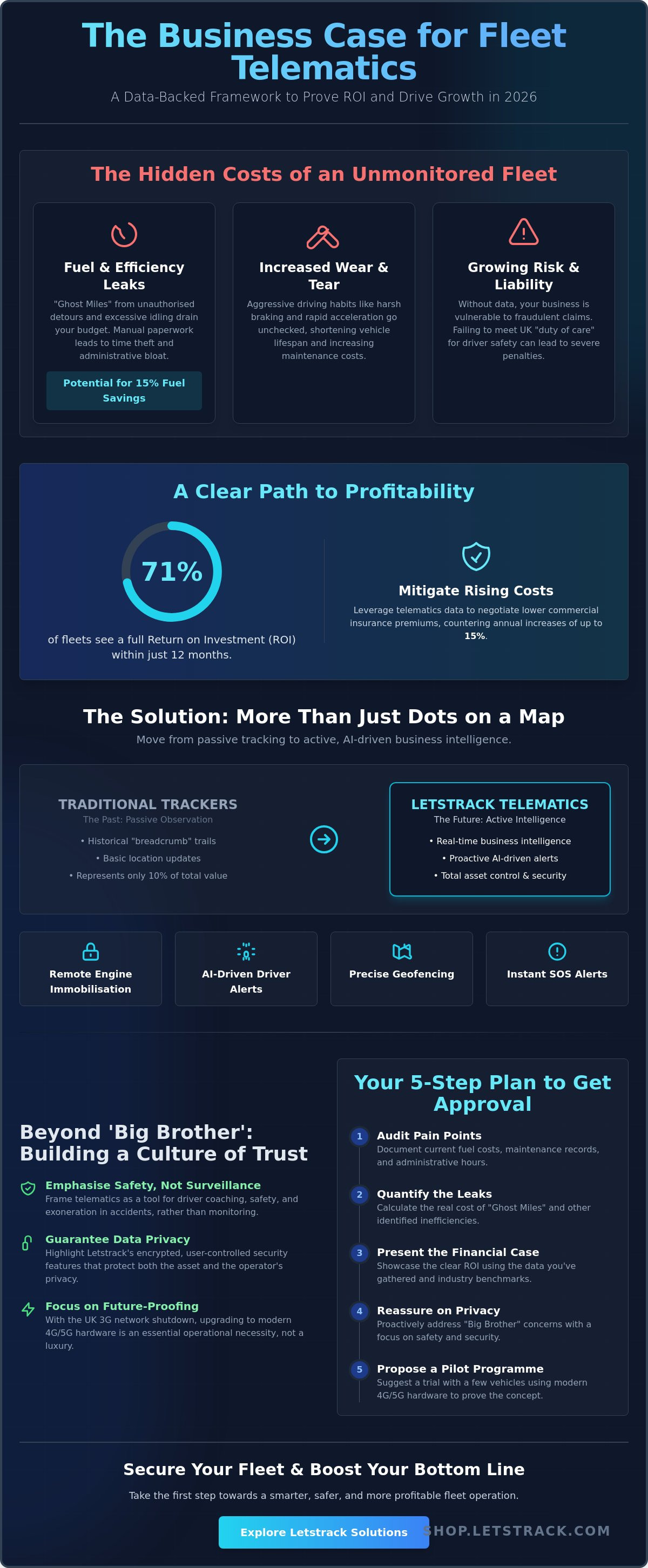
Did you know that 71% of fleets using a GPS tracker see a full return on their investment within just 12 months? In 2026, with commercial insurance premiums climbing by up to 15% and the UK 3G network shutdown making older systems obsolete, staying connected to your fleet is no longer optional. You know the value of real-time visibility, but the real challenge is figuring out how to convince my boss we need telematics without it sounding like a luxury spend.
We understand the pressure of managing rising fuel costs and manual, error-prone paperwork. It is difficult to maintain peace of mind when you lack a clear window into your asset locations or driver safety. You deserve a tool that provides total control and psychological tranquility, ensuring your team stays safe and your operations remain efficient.
This guide provides a masterclass in upward persuasion, offering a data-backed framework to prove the ROI of telematics to your leadership. You will learn how to present a clear business case, highlight critical benefits like 15% fuel savings, and follow a step-by-step pitch plan that turns "too expensive" into "essential for growth."
Key Takeaways
- Identify and quantify the "Ghost Mile" drain on your UK fuel budget caused by unauthorised detours and excessive idling.
- Master how to convince my boss we need telematics by reframing trackers as active digital guardians that provide real-time business intelligence rather than passive surveillance.
- Build a robust financial case by calculating ROI from reduced vehicle wear and leveraging data to negotiate lower commercial insurance premiums.
- Overcome driver privacy concerns by emphasising Letstrack’s encrypted, user-controlled security features that protect both the asset and the operator.
- Follow a clear five-step action plan to audit fleet pain points and launch a successful pilot using advanced 4G and 5G hardware.
The Hidden Costs of an Unmonitored Fleet in 2026
Running a fleet without visibility is like trying to fill a bucket with holes. In 2026, the "Ghost Mile" problem is more expensive than ever. Unauthorised detours and excessive idling don't just waste time; they drain UK fuel budgets already squeezed by rising duties. Every minute a van idles unnecessarily, your profit margin shrinks. Understanding these leaks is the first step in learning how to convince my boss we need telematics to protect our revenue.
Beyond fuel, there is an invisible toll on your assets. Aggressive driving habits like harsh braking and rapid acceleration significantly shorten a vehicle's lifespan. Without data, these habits go unchecked, leading to premature repairs and higher maintenance bills. To better understand how to present these challenges to leadership, watch this helpful video:
Poor visibility also creates massive opportunity costs. If your dispatchers don't know exactly where assets are, they can't optimise routes in real-time. This leads to fewer jobs completed per day and frustrated customers who expect modern transparency. When you are researching Understanding Telematics, it's clear that the "cost of doing nothing" far outweighs the investment in a modern tracker.
Identifying Efficiency Leaks in Daily Operations
Manual logbooks are a relic of the past that breed administrative bloat. They are often inaccurate, leading to "time theft" and hours of wasted office work. In 2026, UK businesses face higher operational costs, making manual errors a luxury you can't afford. Inefficient routing doesn't just waste fuel; it damages your reputation. Customers today demand precision and instant updates, things you can't provide without active location sharing.
The Growing Cost of Fleet Risk and Liability
Liability is perhaps the most dangerous hidden cost. In a "he said, she said" accident scenario, your business is vulnerable to fraudulent insurance claims and rising litigation costs. UK employers also have strict "duty of care" obligations. You must prove you are prioritising driver safety to stay compliant. Implementing a robust data strategy is key to meeting these legal standards. For a deeper look at protecting your assets, see the ultimate guide to fleet preventative maintenance. This data is exactly what you need when planning how to convince my boss we need telematics to safeguard our future.
Understanding Telematics: More Than Just GPS Tracking
Telematics is often misunderstood as simple vehicle tracking. In reality, it is a sophisticated fusion of telecommunications and informatics. This combination transforms raw data into real-time business intelligence that empowers decision-makers. While many leadership teams view it as "dots on a map," that visual representation only represents about 10% of the total value. To master how to convince my boss we need telematics, you must shift the focus toward this broader intelligence ecosystem.
The Letstrack difference lies in moving from passive observation to active, AI-driven protection. Traditional trackers merely record where a vehicle has been. Our modern systems monitor what is happening right now. In 2026, this includes advanced capabilities like remote engine immobilisation and precise geofencing. These tools don't just track assets; they actively secure them against theft and misuse. This level of control provides the psychological tranquility that comes from knowing your fleet is always under a watchful, digital eye.
AI-Driven Insights and Real-Time Alerts
Safety is a primary concern for any leadership team. Modern AI now identifies high-risk driving patterns, such as harsh cornering or sudden acceleration, before accidents occur. This proactive guardianship allows you to coach drivers and prevent incidents. Instant SOS alerts provide an immediate linkage between the driver and the office, offering peace of mind for your team in the field. The Letstrack S5 GPS Tracker is a prime example of this comprehensive monitoring. It ensures that your most valuable assets and the people operating them are always protected by an intelligent, vigilant system.
Vehicle Health and Preventative Maintenance
Unexpected downtime is a silent profit killer for UK businesses. Telematics now integrates deeply with vehicle diagnostics to monitor engine health in real-time. This IoT-driven approach allows you to schedule service intervals based on actual usage and mechanical stress rather than arbitrary calendar dates. By catching small mechanical issues before they become catastrophic failures, you ensure maximum fleet uptime and extend the lifespan of your vehicles. Using a dedicated Vehicle Health Tracker helps maintain your fleet in peak condition. This level of technical precision is a compelling argument when explaining how to convince my boss we need telematics to reduce long-term maintenance costs and improve operational efficiency.
Your business deserves the confidence that comes from total visibility and immediate awareness. Consider browsing our latest GPS tracker models to see how active protection can transform your daily fleet management.
Building the Financial Business Case for Your Boss
Persuading the C-suite requires a shift from technical features to hard financial outcomes. When you are preparing how to convince my boss we need telematics, the most powerful tool in your arsenal is the return on investment (ROI). Data from 2026 shows that 71% of fleets using a tracker see a full return on their investment within the first 12 months. This is not just a technology spend; it is a strategic move to insulate the business against rising operational costs.
One of the most immediate wins is asset recovery. The cost of a single stolen vehicle far outweighs the price of a high-spec GPS tracker. When a vehicle disappears, you lose the asset, the equipment inside, and the revenue from missed jobs. A modern system with engine immobilisation allows for immediate awareness and rapid recovery, turning a potential total loss into a minor operational blip. In this context, ROI is the sum of saved insurance excesses and recovered asset value minus the cost of your digital guardianship.
Fuel Efficiency and Carbon Footprint Reduction
Fuel remains one of the largest variable expenses for any UK fleet. By monitoring driving behaviours like harsh acceleration and excessive idling, businesses typically reduce fuel consumption by 10-15% within the first year. This data is essential for "Green Fleet" reporting, which is now a cornerstone of UK corporate social responsibility (CSR). Showing your boss a path to lower emissions while saving thousands at the pump is a compelling argument. To understand how these savings fit into a broader operational strategy, read our guide on what is fleet management for 2026.
Insurance Premium Discounts and Asset Protection
UK commercial insurance rates are seeing a 7-15% increase this year due to rising repair and litigation costs. However, insurers look favourably on fleets that use Thatcham-approved or high-spec hardware like the Shield 4G GPS Tracker. These devices prove you are actively managing risk, which can be used as leverage to negotiate lower premiums. Beyond the discount, the real-time data acts as your "digital witness," protecting the company from the "nuclear verdicts" and fraudulent claims that are becoming more common in 2026.
HMRC compliance is another area where telematics pays for itself. Automating the logs for Benefit-in-Kind (BIK) and business mileage eliminates manual, error-prone paperwork. This reduces administrative bloat and ensures the business stays on the right side of tax regulations without wasting hours of staff time. When you show your boss that telematics solves fuel waste, insurance hikes, and tax headaches, the decision to invest becomes a matter of simple logic.
Overcoming the 'Big Brother' Stigma and Privacy Concerns
The "Big Brother" label is a common roadblock, but it's based on a misunderstanding of modern guardianship. When figuring out how to convince my boss we need telematics, you must frame the technology as a shield for the workforce, not a sword for management. A tracker acts as a digital guardian that provides objective proof of a driver's professionalism; it is the ultimate witness in a dispute. It transforms a complex technical tool into a source of daily comfort for both the office and the road.
Transparency is the antidote to suspicion. By establishing clear usage policies and utilising features like "Letstrack Circles", you create an ecosystem of collaborative safety. This ensures that every team member feels connected and protected rather than merely watched. Importantly, all Letstrack data is fully encrypted and user-controlled, ensuring strict alignment with UK GDPR and privacy laws. This technical precision ensures that your business stays compliant while prioritising the psychological tranquility of your staff.
Data Security and Driver Empowerment
Telematics empowers drivers by providing them with the data to defend themselves. If a driver is falsely accused of speeding or being at fault in an accident, the tracker provides the granular evidence needed for exoneration. Through the Letstrack app, drivers can monitor their own performance scores in real-time. This shifts the dynamic from top-down surveillance to personal mastery. It gives drivers immediate awareness of their own habits, allowing them to take control of their safety and professional reputation.
Incentivising Safe Driving over Punishment
Instead of using data to find faults, use it to celebrate excellence. Propose a "Driver of the Month" programme that rewards the highest safety scores. This approach transforms the conversation around telematics into one of positive reinforcement and career development. High scores lead to lower risk; which in turn reduces staff turnover and builds a company culture of mutual trust. For real-world examples of how our technology fosters connection and safety, visit the Letstrack YouTube channel. Seeing the practical utility in action helps remove the fear of the unknown.
A secure fleet is a happy fleet. Empower your team with the tools they need for total peace of mind by exploring our latest GPS tracker range today.
The Action Plan: How to Present the Letstrack Solution
Moving from the theoretical benefits of fleet visibility to a full-scale implementation requires a structured pitch. Knowing how to convince my boss we need telematics is about showing a clear, low-risk path to success. You must present a logical roadmap that addresses the board's concerns regarding cost, complexity, and operational disruption. Frame the transition as an upgrade to the company's resilience and a direct boost to the bottom line.
Step 1: Audit your fleet. Document your current fuel spend, accident frequency, and vehicle downtime over the last six months. These figures represent your "efficiency leaks." Step 2: Propose a pilot programme. Suggest a small-scale trial using a versatile unit like the Rapid 4G Tracker. This allows you to gather real-world data from your own vehicles without a massive upfront commitment. Step 3: Project the ROI. Using the industry data that 71% of fleets see returns within a year, build a conservative 12-month projection. Show how a 10-15% reduction in fuel consumption pays for the hardware itself. Step 4: Demonstrate ease of use. Explain that modern trackers don't require days of downtime for installation, ensuring your team stays on the road.
Seamless Integration with Letstrack Hardware
Initial setup friction is a major barrier for many leadership teams. The Easy Plug Tracker solves this with a "Plug and Play" design. It requires no specialist tools or technical expertise, allowing for an instant rollout across your entire fleet. Once connected, the integrated app-and-web ecosystem provides immediate visibility. For businesses with expansive service areas, the global discovery and map features ensure you stay connected to your assets, no matter where the job takes them. This instantaneous awareness acts as a rhythmic anchor for your operations, providing the control you need to succeed. It is the most practical way to show how to convince my boss we need telematics through effortless implementation.
Scalable Solutions for UK Businesses
Your business case doesn't have to be an "all or nothing" proposal. Letstrack offers a scalable ecosystem that grows alongside your business requirements. You might start by securing high-value equipment with a few "Valuables" tags before scaling up to full vehicle tracking. This modular approach allows you to prove value at every stage of the rollout. Our mission is to bring "peace of mind" and "connection" to every aspect of your operation. By linking business assets to the same level of digital protection we provide for families, you create a culture of vigilance and safety that benefits everyone.
Ready to transform your fleet's efficiency and secure your company's future? Book a consultation with Letstrack to build your bespoke business case.
Empower Your Business with Data-Driven Peace of Mind
Securing your fleet in 2026 requires more than just a map; it demands a proactive strategy that addresses rising insurance costs and fuel waste. By moving from passive tracking to active AI-driven protection, you transform your vehicles into intelligent assets. You now have the data-backed framework and action plan needed for how to convince my boss we need telematics to ensure long-term business resilience. This shift moves your company from reactive repairs to predictive maintenance and total asset guardianship.
Letstrack is already trusted by leading UK businesses to provide psychological tranquility through Thatcham-compliant hardware and real-time AI-driven safety alerts. These tools don't just monitor; they protect your team and your bottom line with unwavering vigilance. It is time to replace operational uncertainty with the confidence of constant linkage and total control. Your drivers deserve the safety of a digital protector, and your business deserves the efficiency of modern informatics.
Take the final step toward a more secure and efficient future. Request a Personalised ROI Consultation for Your Fleet and start building your bespoke business case today. Empower your leadership with the facts and lead your team with absolute confidence.
Frequently Asked Questions
Is it legal to track employees with telematics in the UK?
Yes, it is legal to use a GPS tracker for business purposes provided you comply with UK GDPR and the Data Protection Act 2018. You must have a legitimate business reason, such as improving driver safety or asset security. Transparency is essential; employers should always inform staff about what data is being collected and why. Establishing a clear usage policy ensures your team feels protected rather than monitored.
How much can telematics actually save my business in the first year?
Businesses typically see a 10% to 15% reduction in fuel consumption within the first twelve months of implementation. These savings stem from reduced engine idling and more efficient routing. Additionally, monitoring vehicle health prevents costly emergency repairs. When researching how to convince my boss we need telematics, highlighting these direct operational savings is often the most persuasive argument for leadership teams.
Can telematics really lower my fleet insurance premiums?
Many UK insurers offer discounts for fleets that install Thatcham-compliant hardware or demonstrate a commitment to risk reduction. Telematics provides the objective data insurers need to reward safer driving habits. By proving your fleet is lower risk, you gain significant leverage during premium negotiations. This proactive guardianship protects the company from the rising cost of commercial insurance seen across the UK in 2026.
What happens if a driver refuses to have a tracker installed?
Resistance usually comes from a lack of understanding about the technology's purpose. Frame the tracker as a digital guardian that can exonerate drivers in the event of a false claim or accident. Explain that the data is encrypted and used to improve safety rather than for micromanagement. Most drivers accept the technology once they realise it provides them with immediate awareness and professional protection.
How long does it take to see a return on investment (ROI)?
Research indicates that 71% of fleets report a full return on their investment within the first 12 months. The combination of fuel savings, lower insurance costs, and improved dispatch efficiency covers the initial hardware and subscription costs quickly. This rapid turnaround is a key point when explaining how to convince my boss we need telematics to secure the company's financial future.
What is the difference between passive GPS and real-time telematics?
Passive GPS systems store location data for later download, which offers no immediate benefit during an emergency. Real-time telematics provides instantaneous awareness and live alerts via a 4G or 5G connection. This allows for active protection, such as remote engine immobilisation or instant SOS notifications. Real-time systems transform a simple tracking tool into a comprehensive security ecosystem for your entire fleet.
Does telematics monitor fuel consumption directly or just mileage?
Advanced telematics systems monitor fuel consumption directly by connecting to the vehicle's engine diagnostics. This provides precise data on fuel wasted during idling or aggressive driving. While mileage tracking is helpful for HMRC compliance, direct fuel monitoring allows you to identify specific efficiency leaks. This level of technical precision helps you make informed decisions that directly improve your bottom line.
Is telematics data admissible in UK courts for accident disputes?
Yes, telematics data is frequently used as objective evidence in UK court proceedings and insurance disputes. It acts as a digital witness, providing granular details like speed, braking force, and exact location at the time of an incident. This data is vital for defending against fraudulent claims or "nuclear verdicts." Having an encrypted, unalterable record of events provides the psychological tranquility that your business is always protected.