


Telematics for Vehicle Maintenance: The 2026 UK Guide to Predictive Fleet Health
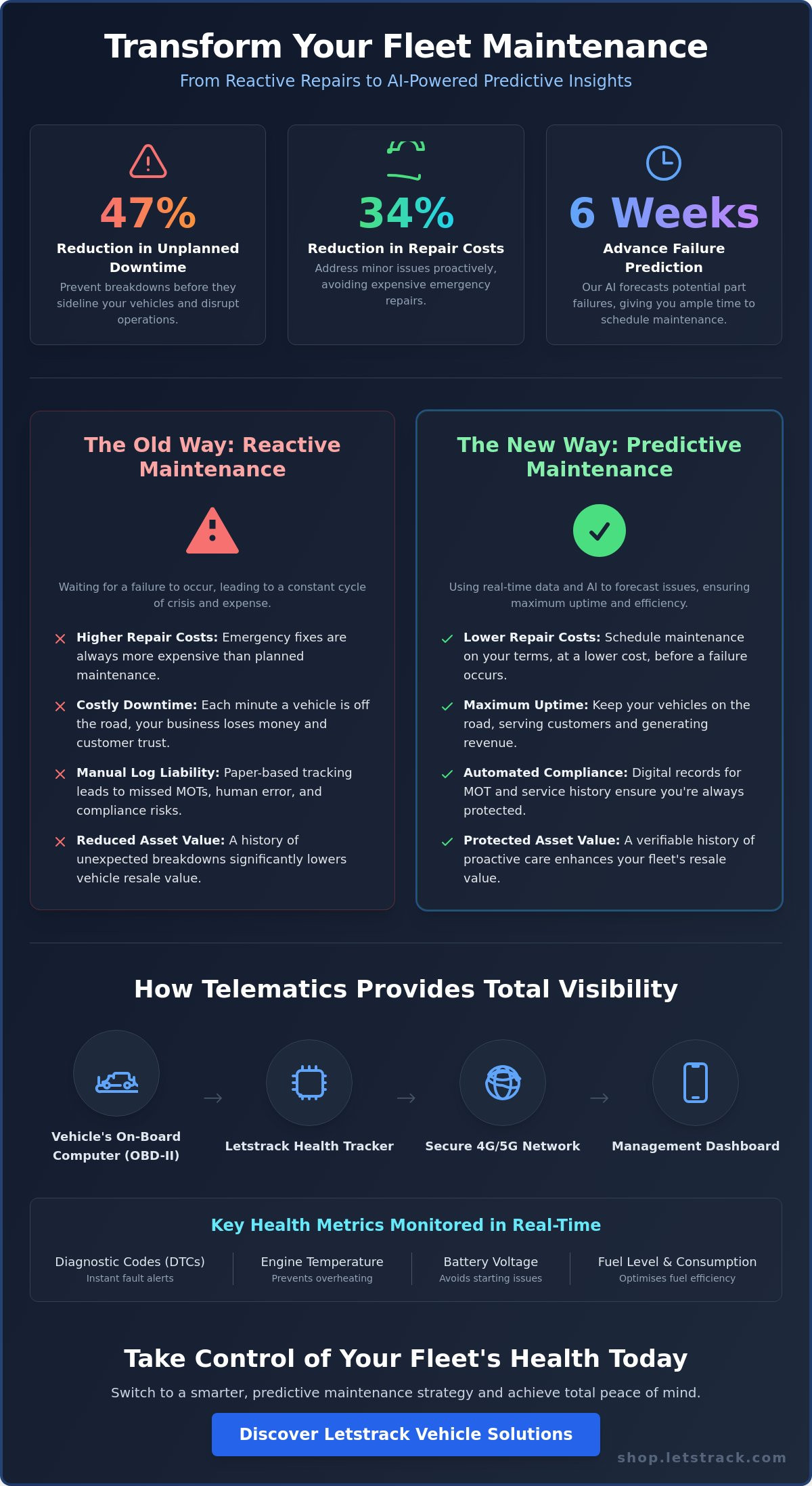
Did you know that AI-powered predictive maintenance can slash your unplanned vehicle downtime by 47% and reduce your repair costs by 34%? As a fleet manager in the UK, you're likely feeling the pressure of rising parts costs and the constant stress of a vehicle breaking down during a peak delivery window. It's frustrating to watch your profits vanish into reactive repairs and manual MOT tracking. Implementing advanced telematics for vehicle maintenance transforms your fleet into a vigilant ecosystem of protection and efficiency.
You're here because you want total control over your assets and the psychological tranquility that comes with a healthy, reliable fleet. This 2026 guide shows you how to eliminate unexpected breakdowns and slash repair bills using AI-driven strategies that predict failures up to six weeks in advance. We'll explore the latest UK regulations, including the Smart Tachograph 2 mandate and UN R155 cybersecurity standards, to ensure your business stays compliant and your vehicles stay on the road longer.
Key Takeaways
- Identify the hidden financial drains of reactive maintenance and how unplanned downtime impacts your asset lifecycles in the UK market.
- Discover how to use the OBD-II port and CAN-bus to extract real-time diagnostic trouble codes for instant health monitoring.
- Shift your strategy from basic preventative servicing to advanced telematics for vehicle maintenance to forecast part failures with precision.
- Learn to assess fleet health and deploy GPS tracker solutions that balance high-tech data depth with rapid, easy installation.
- Use Letstrack Circles to keep your maintenance teams and drivers connected within a single, watchful ecosystem for total peace of mind.
The High Cost of Reactive Maintenance in the UK
UK businesses often overlook the compounding costs of reactive repairs. It's more than just a garage bill; it's a leak in your company's engine. When you wait for a vehicle to fail before acting, you're choosing the most expensive path to fleet management. This approach leads to higher repair costs, shorter asset lifecycles, and a significant drop in resale value. Integrating telematics technology allows you to see these risks before they manifest as a breakdown on a busy road network.
Relying on "fixing" rather than "preventing" creates a culture of constant crisis management. Shifting your focus to telematics for vehicle maintenance means you stop being a mechanic's best customer and start being a vigilant protector of your assets. This transition eliminates the chaotic scramble of emergency repairs. It replaces daily anxiety with the calm, steady reliability of a planned maintenance schedule. By monitoring engine health in real-time, you ensure your fleet remains a source of profit rather than a financial drain.
To better understand how this technology works, watch this helpful video:
The Downtime Domino Effect: Beyond the Repair Bill
One van down during a morning delivery run isn't just one missed stop. It triggers a chain reaction that impacts delivery schedules and erodes customer trust. The rising cost of emergency roadside assistance and short-term replacement rentals can quickly exceed the original repair estimate. Instantaneous awareness through a vehicle health tracker prevents minor faults from becoming major failures that sideline your drivers. When you have immediate visibility into engine diagnostics, you can address a sensor issue before it turns into a total engine seize.
Why Manual Maintenance Logs are a Liability in 2026
Paper logs and manual spreadsheets are a genuine business risk. In 2026, the administrative burden of tracking MOT deadlines and statutory inspections across a fleet is immense. Human error in mileage tracking often leads to overdue oil changes or snapped timing belts. These oversights are costly and entirely avoidable. By automating your tracking, you create a robust digital audit trail. This transparency is vital for UK business insurance and compliance, ensuring your business remains protected and your vehicles stay legal at all times.
How Telematics Technology Monitors Vehicle Health
Think of telematics as a secure, digital bridge. It connects your vehicle’s complex internal computer directly to your management dashboard. While standard tracking tells you where a van is, telematics for vehicle maintenance tells you how it feels. This constant flow of data ensures you're never left in the dark about the mechanical integrity of your fleet. By leveraging high-speed 4G and 5G connectivity across the UK, hardware like the Vehicle Health Tracker maintains a constant linkage between your assets and your office. This level of visibility is essential to improve fleet productivity and protect your bottom line.
The transition from manual checks to automated oversight is a game-changer for UK fleet managers. You no longer have to wait for a driver to report a strange noise or a dashboard light. The system monitors the pulse of every vehicle simultaneously. This vigilance creates a protective shield around your business. It allows you to manage by exception, focusing your energy only on the vehicles that truly need attention. It's about having total control without the need for constant manual intervention.
OBD-II and CAN-bus: The Heart of Vehicle Diagnostics
The real magic happens through the OBD-II port and the CAN-bus system. Simple GPS trackers only report location and speed. In contrast, deep data extraction pulls real-time diagnostic trouble codes (DTCs) directly from the engine's brain. Using a device like the Easy Plug Tracker provides an instant plug-and-play solution for health monitoring. You gain immediate access to critical metrics:
- Engine coolant temperature to prevent catastrophic overheating.
- Real-time oil pressure readings to protect engine longevity.
- Precise battery voltage levels to avoid costly morning non-starts.
This technical precision allows you to spot a failing alternator or a cooling leak days before a driver notices a warning light. It's the difference between a quick sensor replacement and a full engine rebuild.
The Role of AI in Interpreting Diagnostic Data
Raw data can be overwhelming for any busy manager. Letstrack’s AI acts as a watchful guardian by filtering out background noise to identify genuine mechanical risks. It translates complex, cryptic error codes into plain-English alerts. Instead of a confusing "P0300" code, you receive a clear notification about an engine misfire. This clarity empowers you to make fast, informed decisions about repairs. Telematics-driven maintenance serves as a 24/7 digital health check that never sleeps. If you want to secure your fleet's future, consider how a tracker can transform your operational awareness today.
Predictive vs. Preventative Maintenance: 2026 Comparison
In 2026, the traditional service schedule is a relic of the past. Traditional preventative maintenance relies on static intervals, such as every 12 months or 10,000 miles. This rigid approach often leads to unnecessary expenditure or, worse, missed failures. Modern telematics for vehicle maintenance shifts the paradigm toward predictive models. Instead of guessing, you use historical data and real-time sensor input to forecast exactly when a component will reach its limit. This level of precision transforms your fleet from a series of ticking clocks into an ecosystem of predictable performance.
The financial logic is clear. Replacing parts based on actual wear rather than a calendar date maximises your ROI. You avoid the waste of discarding healthy components while simultaneously preventing the catastrophic expense of a roadside failure. Real-time alerts empower you to schedule these surgical repairs during off-peak hours. This ensures your vehicles are back on the road before the next morning's delivery window opens. You gain total control over your schedule, rather than letting the vehicle's failures control you.
The Shift to Usage-Based Maintenance Strategies
Relying on a "one size fits all" mileage rule is inefficient for a modern UK fleet. A van navigating heavy stop-start traffic in central London experiences far more engine wear than one cruising the M6. Modern systems factor in idling time, engine load, and even aggressive driving behaviour to calculate true service needs. By using the S7 GPS Tracker, you gather granular usage data that reflects the reality of your operations. This data allows you to customise maintenance windows for each specific vehicle, ensuring no asset is over-serviced or under-protected.
AI-Driven Predictions: Avoiding the Breakdown Before it Happens
AI-driven systems act as a watchful companion for your business. They identify subtle patterns, like a slight drop in battery voltage or a fluctuating alternator output, long before the vehicle fails to start. This provides a level of psychological tranquility that traditional methods simply cannot match. You move through your workday with the confidence that your fleet is under vigilant protection. These predictive health reports also allow you to optimise your parts inventory. You only stock what you know you'll need soon, freeing up capital and reducing warehouse clutter. It's a cleaner, smarter way to run a business.
Implementing a Maintenance-First Telematics Strategy
Start by auditing your fleet's current status. Identify high-risk vehicles, such as older diesel vans or high-mileage assets, that require more frequent oversight. Implementing telematics for vehicle maintenance isn't just about the hardware; it's about the people using it. Train your drivers to understand that a mechanical alert isn't a nuisance. It's a protective measure that prevents them from being stranded. Establish a clear workflow for when an SOS alert arrives. This ensures your team knows exactly who to call and which garage to visit before a minor fault escalates. This proactive approach is proven to deliver a 47% reduction in unplanned downtime.
By integrating telematics for vehicle maintenance into your daily operations, you create a culture of vigilance. You're no longer reacting to smoke; you're monitoring the heat. This shift empowers your staff and provides them with the tools needed to maintain a zero-downtime standard. It's about building a business that is both resilient and highly efficient. When your team sees the benefit of fewer breakdowns, they become active participants in your fleet's health guardianship.
Automating MOT and Service Scheduling for UK Compliance
UK compliance requires more than just a valid MOT. In 2026, you must prove your vehicles meet strict safety and environmental standards, including the ZEV Mandate targets. You can set up geofences around your trusted garage. When a vehicle enters this zone, the system automatically marks it as "in-service" on your dashboard. Syncing your data with UK DVSA databases ensures you never miss a statutory inspection or MOT deadline. This automation removes the risk of human error and keeps your business on the right side of the law. It provides a digital audit trail that is invaluable for insurance renewals and regulatory checks.
Choosing the Right Hardware: Hardwired vs. Plug-and-Play
Your choice of hardware depends on your specific operational needs. The Shield 4G GPS Tracker offers a permanent, hardwired solution that is tamper-proof and ideal for long-term monitoring. If you need a more flexible approach, the Rapid 4G Tracker allows for quick fleet deployment without complex wiring. All data is protected by high-level encryption to ensure full GDPR compliance for your driver and vehicle information. This is particularly critical following the June 2026 implementation of UN R155 cybersecurity regulations. Ready to secure your fleet? Explore our range of trackers to find the perfect fit for your maintenance strategy.
The Letstrack Advantage: Vigilant Health Guardianship
Choosing Letstrack means moving beyond simple data collection. Our technology acts as a watchful companion for your business, transforming a complex technical tool into a source of daily comfort and confidence. We believe that telematics for vehicle maintenance should do more than just report faults; it should foster connection. Through the "Letstrack Circles" concept, your maintenance teams and drivers stay linked within a single, watchful ecosystem. This constant linkage ensures that everyone is informed, empowered, and ready to act before a minor mechanical whisper becomes a costly roar.
Our mission is to bring psychological tranquility to fleet managers across the UK. By combining high-tech sophistication with emotional security, we help you protect your most valuable assets and the people who operate them. We treat our software and hardware as a single, inseparable ecosystem designed for one purpose: your peace of mind. Every feature we build is a defensive measure against the unpredictability of the road, ensuring your business remains resilient and your operations stay transparent.
Real-Time Alerts and the Intuitive Letstrack Interface
The Letstrack app is the digital heart of your maintenance strategy. It translates the precision of telematics for vehicle maintenance into instantaneous awareness. You receive push notifications the moment a vehicle reports a critical engine fault, allowing for immediate intervention. This mobile integration transforms raw diagnostic data into a source of daily confidence. Whether you are managing five vans in London or fifty across the UK, the "global discovery" feature allows you to track vehicle health across multiple locations from the palm of your hand. It's a modern, digital-first approach that mirrors the speed and accuracy of your business.
Total Fleet Security: From Engine Health to Immobilisation
True guardianship requires a multi-layered approach to safety. By linking maintenance alerts with advanced security features, you create a total protective shield. The Smart Guard Tracker allows you to pair engine health monitoring with remote engine immobilisation. If a vehicle reports a critical safety failure, or if an asset is at risk, you have the power to intervene instantly. This level of control is the ultimate value proposition for any business owner. Don't wait for the next breakdown to drain your profits. Switch to a proactive maintenance strategy with Letstrack today and experience the power of vigilant health guardianship. Secure your fleet now and stay connected to what matters most.
Transform Your Fleet with Predictive Vigilance
The transition to telematics for vehicle maintenance is more than a technical upgrade; it's a commitment to the longevity of your business. You've seen how predictive AI can foresee mechanical failures weeks in advance, allowing you to bypass the chaos of unplanned downtime. By automating your MOT and service scheduling, you ensure total compliance with UK DVSA standards while removing the administrative burden from your daily operations. This shift from reactive crisis management to proactive health guardianship is the key to maintaining a competitive edge in 2026.
Letstrack provides the ultimate protective shield for your assets. With UK-based engineering and technical support, real-time AI-driven health alerts, and encryption-standard data security, you can manage your fleet with absolute peace of mind. It's time to replace operational anxiety with the calm confidence of total visibility. Take control of your maintenance schedule and protect your bottom line today. Secure your fleet’s health with Letstrack now and build a more resilient future for your business.
Frequently Asked Questions
How does telematics reduce vehicle maintenance costs?
Telematics reduces costs by transforming reactive repairs into a planned, predictive strategy. By identifying minor faults before they escalate into major mechanical failures, you avoid the high price of emergency roadside assistance and replacement rentals. Research shows that AI-powered predictive maintenance can lead to a 34% decrease in overall maintenance costs for UK fleets. This vigilant oversight ensures you only pay for repairs when they are truly necessary.
What is the difference between preventative and predictive maintenance?
Preventative maintenance relies on rigid, calendar-based schedules like servicing every 12 months or 10,000 miles. Predictive maintenance uses real-time data and AI to forecast exactly when a part will fail based on actual usage. This modern approach to telematics for vehicle maintenance ensures you don't waste money replacing healthy parts too early. It provides a more precise, data-driven shield for your fleet's health compared to traditional methods.
Can telematics devices track engine fault codes (DTCs)?
Yes, advanced trackers connect directly to your vehicle's internal computer via the OBD-II port or CAN-bus. This connection allows the device to extract real-time diagnostic trouble codes (DTCs) and transmit them instantly to your dashboard. Instead of a vague warning light, you receive a specific error description. This instantaneous awareness allows you to diagnose engine issues accurately without needing a physical inspection at a garage, saving you valuable time.
Will a telematics tracker void my vehicle manufacturer warranty?
No, installing a telematics device typically won't void your vehicle's manufacturer warranty in the UK. Under the Block Exemption Regulation, you're free to use third-party components as long as they are installed correctly and don't cause damage. Plug-and-play devices are particularly safe as they require no wiring modifications. You should always check your specific warranty terms, but most modern trackers are designed to be non-intrusive and safe for all engine types.
How does telematics help with UK MOT and service compliance?
Telematics automates the tracking of MOT due dates and statutory inspection intervals. By syncing with UK DVSA databases, the system provides timely alerts to ensure you never miss a legal deadline. This automation creates a robust digital audit trail, which is essential for business insurance and regulatory compliance. It removes the risk of human error in manual logbooks, keeping your fleet legal and your business protected at all times.
Can I install these maintenance trackers myself?
Yes, many trackers are designed for simple, self-installation. Plug-and-play models fit directly into the vehicle's OBD-II port in seconds. These devices are ideal for rapid fleet deployment and require no technical expertise. For more permanent, tamper-proof solutions, hardwired trackers are available. These may require a professional installer to ensure the wiring is secure and the data transmission remains uninterrupted, providing you with long-term peace of mind.
How do AI alerts in the Letstrack app improve vehicle health?
AI alerts improve health by filtering background noise to identify genuine mechanical risks. The Letstrack app translates complex technical data into plain-English notifications that you can act on immediately. This vigilant guardian works 24/7, spotting subtle patterns like fluctuating battery voltage before a breakdown occurs. This constant linkage between your phone and your vehicle ensures you're always informed and in total control of your fleet's condition, wherever you are.
Is driver data secure when using telematics for maintenance?
Yes, your data is protected by high-level encryption and full GDPR compliance. Letstrack prioritises privacy by ensuring that all vehicle and driver information is user-controlled and securely transmitted. This security is particularly vital following the June 2026 regulations regarding vehicle cybersecurity. You can manage your fleet with confidence, knowing that your proprietary maintenance data and driver location history are shielded from unauthorised access at all times.