

What Does a Vehicle Tracker Look Like? A Visual Guide for 2026
Could a device no larger than a standard box of matches be the only thing standing between your car and a professional thief? With vehicle theft in England and Wales rising by 25% in 2023 according to the Office for National Statistics, you're right to be vigilant. You likely want protection but might wonder what does a vehicle tracker look like and if it's too bulky to hide. It's a common concern that an obvious device could be easily spotted and removed by a criminal.
This guide will show you the latest sleek and discreet designs that blend seamlessly into your car. You'll discover how these compact units provide instant alerts and real-time tracking without cluttering your dashboard. We'll break down the different physical forms, from plug-and-play OBD devices to hidden hardwired units, so you can choose the perfect "Digital Guardian" for your peace of mind. Knowing these physical details ensures you can hide your tracker effectively and maintain total control over your asset.
Key Takeaways
- Understand exactly what does a vehicle tracker look like, from compact "black boxes" to discreet plug-and-play modules designed to stay hidden.
- Explore the most effective hiding spots behind the dashboard or centre console to maximise your vehicle’s security and prevent detection.
- Compare hardwired units with OBD-II port trackers to determine which design best suits your car’s layout and your personal need for permanence.
- See how physical hardware works in tandem with the Letstrack app to transform a simple device into a powerful, real-time digital guardian.
- Master the art of choosing a tracker that balances a small physical footprint with high-tech features like geofencing and instant SOS alerts for total peace of mind.
The Physical Evolution of Vehicle Trackers
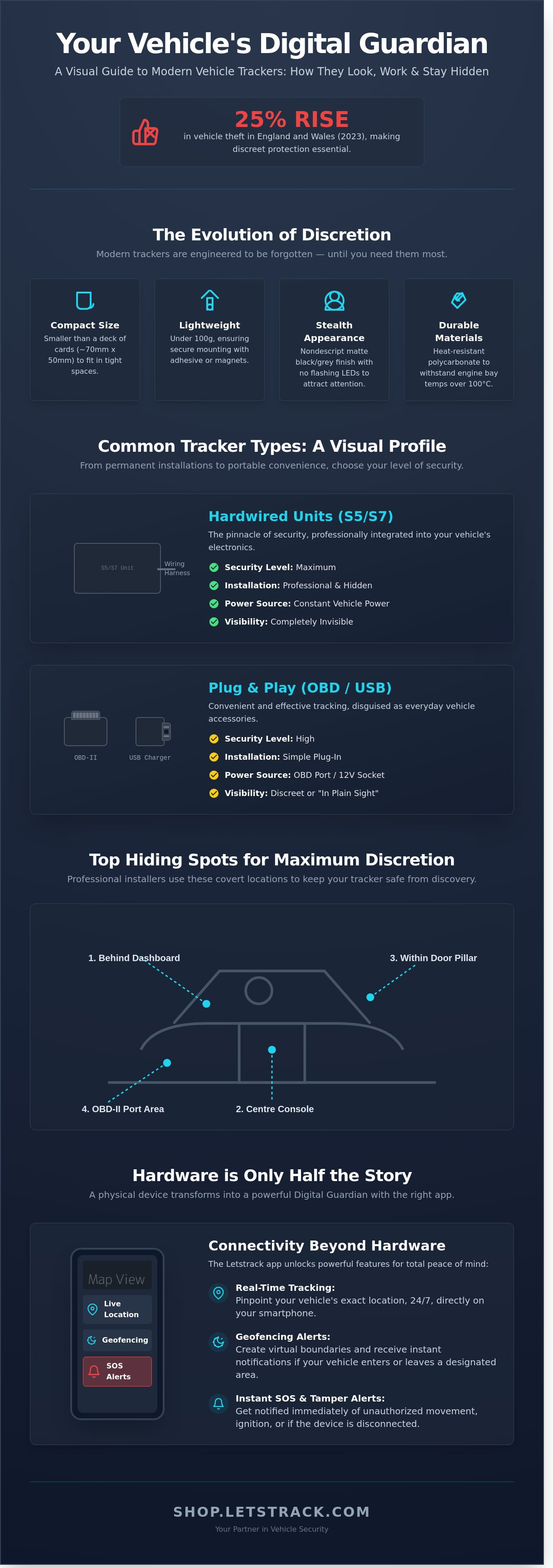
Modern vehicle trackers have undergone a radical transformation since their inception. In 2026, these devices are designed to be forgotten until they're needed most. If you're wondering what does a vehicle tracker look like today, the answer is often "almost invisible." Most units are compact, electronic devices no larger than a standard deck of playing cards, typically measuring around 70mm by 50mm. This small footprint is a deliberate security choice, ensuring the hardware remains hidden from thieves who might attempt to disable security systems during a vehicle theft. To better understand this concept, watch this helpful video: The aesthetic of a modern tracker is intentionally nondescript. You won't find bright colours or flashing LEDs that draw attention. Instead, devices like the S5 GPS tracker feature a matte black or dark grey finish to blend into the shadows of a vehicle's chassis or dashboard. Manufacturers use high-grade, heat-resistant polycarbonate or durable plastics. These materials are essential because engine bay temperatures can exceed 100°C, and the device must maintain its structural integrity to protect the sensitive electronics inside.Why Size and Shape Matter for Security
Smaller devices are significantly harder for criminals to locate during a quick sweep of the cabin. Slim, aerodynamic profiles allow for discreet installation in tight crevices behind the dashboard or within the door pillars. Weight is kept to a minimum, often under 100 grams. This ensures that adhesive strips or magnetic mounts stay secure over time, even when the vehicle is subjected to the vibrations of a typical UK motorway journey.Standard Components Inside the Casing
The internal architecture of a GPS tracking unitCommon Types of Trackers and Their Visual Profiles
Understanding what does a vehicle tracker look like depends entirely on its intended use and power source. Modern tracking technology is designed to be discreet, often mimicking standard automotive parts to prevent tampering. Most devices fall into four distinct categories, ranging from integrated security systems to portable tags that you can swap between vehicles in seconds.
Hardwired Units: The S5 and S7 Standard
Hardwired units provide the highest level of security for UK vehicle owners. These devices are typically housed in a durable, black plastic casing that measures approximately 8cm by 5cm. Unlike portable versions, they feature a dedicated wiring harness. This loom integrates directly into the vehicle's electrical system, allowing the tracker to draw constant power and monitor ignition status.
Professional installers hide these units deep behind the dashboard or within the door panels. You won't see them during a routine car inspection. The presence of a small, external GPS antenna was common in older models, but 2026 standards favour internal antennas for a cleaner profile. You can achieve professional-grade security and insurance compliance with the Letstrack S5 GPS tracker, which remains invisible to the untrained eye while providing 24/7 vigilance.
Plug-and-Play: OBD and USB Variants
Plug-and-play devices offer a balance of high-tech connectivity and user convenience. The Easy Plug Tracker is a prime example of an OBD-II device. It's roughly the size of a matchbox and features a standardised 16-pin connector. This rectangular plug fits directly into the diagnostic port found under the steering column or near the fuse box in most UK cars manufactured after 2001.
USB trackers take discretion a step further. These devices are indistinguishable from standard mobile phone chargers. They plug into the 12V cigarette lighter socket or a modern USB-A port, providing dual functionality as both a power source for your phone and a silent guardian for your car. These are ideal for drivers who want to avoid complex wiring or need to move their security between different vehicles. Because they look like everyday accessories, they provide an "in plain sight" security layer that potential thieves often overlook.
Battery-Powered Asset Tags
Wireless asset tags are the most versatile option for non-powered equipment like trailers or classic cars. These are compact, rugged squares or rectangles, often measuring less than 10cm on their longest side. They don't require any wires, relying instead on long-life internal batteries that can last for several years. Their flat profile allows them to be magnetically attached to the chassis or tucked into seat pockets. When people ask what does a vehicle tracker look like in a commercial context, they're often describing these sturdy, waterproof blocks.
Choosing the right form factor ensures your vehicle stays connected without compromising its interior aesthetics. Secure your peace of mind by browsing our Shield 4G GPS tracker for long-term asset protection and real-time awareness.
Where Do Vehicle Trackers Get Hidden?
Placement depends entirely on the physical form of the tracker you choose. If you're wondering what does a vehicle tracker look like when it's actually installed, the answer is usually "invisible." Professional installers prioritise covert locations to prevent tampering and ensure the device remains a silent guardian. Hardwired units, such as the Letstrack S5, are usually tucked deep behind the dashboard or inside the centre console. These devices tap directly into the vehicle's 12V power supply, providing 24/7 vigilance without the need for manual recharging.
Plug-in units offer a different tactical approach. These devices are restricted to specific ports, typically the OBD-II port located near the steering column. However, security isn't compromised just because the port location is standard. Many users employ extension cables to mask the unit's presence. This allows the tracker to be tucked away behind internal panels while leaving the port appearing empty or occupied by a dummy plug. The goal is always to maintain a clear "view" of the sky for GPS signals while remaining invisible to the eye.
The Dashboard and Glovebox
The area behind the glovebox is a favourite for installers because of the abundance of space and easy wiring access. It provides a secure cavity where a device can be zip-tied to the internal subframe. Because plastic dashboard components don't block GPS signals, this is an ideal "invisible" location for high-frequency tracking. Non-metallic surfaces allow satellite signals to pass through easily. This ensures your connection to the Letstrack app remains stable even when the hardware is completely out of sight.
External and Under-Chassis Placement
For those who need a non-permanent or rapidly deployable solution, ruggedised trackers with magnetic mounts are the industry standard. Understanding what does a vehicle tracker look like in a ruggedised form is key for fleet managers who need to inspect assets quickly. These devices, like the Letstrack Rapid 4G, are usually larger to accommodate bigger batteries and waterproof, IP67-rated casing. They're commonly placed on the vehicle frame or under-chassis. This is a frequent choice for larger fleet vehicles or high-value plant machinery where internal cabin access is restricted but security is paramount.
- Hardwired: Best for permanent, long-term theft recovery.
- Plug-in: Ideal for fleet management and monitoring driver behaviour.
- Magnetic: Perfect for assets without a dedicated power source.
Choosing a Tracker Based on Your Vehicles Interior
The interior layout of your car dictates exactly how your security hardware integrates with your daily drive. When you ask what does a vehicle tracker look like, the answer depends on your specific cabin architecture and power availability. Most UK vehicles manufactured after 2001 feature an OBD-II port, typically located within 60cm of the steering column. A plug-and-play tracker for this port is a small, rectangular block that remains visible to anyone looking in the footwell. If you prefer a "Digital Guardian" that stays out of sight, a hardwired system is the superior choice.
Consider these four factors before selecting your hardware:
- Port Accessibility: Check if your OBD-II port is exposed or behind a plastic trim. If it's exposed, a plug-in unit might be kicked or bumped by passengers.
- Permanence: Hardwired units offer a fixed security solution that thieves cannot simply unplug. Portable units provide flexibility if you frequently swap between vehicles.
- The Stealth Factor: For high-value assets, you need a device that is completely invisible. This usually requires a slim profile that fits behind the dashboard or inside the door pillars.
- Immobilisation Relays: If you want the ability to cut the engine remotely, the device will look slightly larger. This is because it includes a physical relay, a small cube roughly 3cm square, used to interrupt the fuel pump or starter motor circuit.
For Modern Cars with Minimalist Interiors
Modern Electric Vehicles (EVs) and high-end saloons often have "tight" interiors with very few gaps in the trim. In these environments, bulky hardware is impossible to hide. The Letstrack S7 GPS tracker is engineered for these minimalist cabins. It features an ultra-slim housing that professional installers can tuck away without interfering with complex sensitive electronics. This ensures your vehicle's aesthetic remains untouched while providing 24/7 vigilant protection.
For Older Vehicles and Classics
Classic cars present a different challenge. While they often have more physical space under the dashboard, their electrical systems are simpler and less suited to constant parasitic drains. Understanding what does a vehicle tracker look like for a classic car often means looking at battery-powered "tags" rather than wired units. The Rapid 4G Tracker is a robust, self-contained unit with a 10,000mAh battery. It doesn't require a connection to the car's loom, making it perfect for vehicles kept in long-term storage or those without modern wiring.
Secure your vehicle today and gain total peace of mind. View our professional tracking range
The Letstrack Advantage: Connectivity Beyond the Hardware
Understanding what does a vehicle tracker look like is the first step toward total security, but the hardware is only half the story. A tracker is only as effective as the software it connects to. Letstrack bridges this gap by turning a silent piece of hardware into an active participant in your safety strategy. Your physical device works in direct tandem with the Letstrack app. This partnership enables instant geofencing and SOS alerts that reach your phone in under 2 seconds, providing real-time peace of mind that hardware alone cannot deliver.
Letstrack Circles redefine how families and businesses stay connected. This feature allows you to share your vehicle’s location with specific colleagues or family members securely. It creates a private network where visibility is a shared benefit. We prioritise your data privacy above all else. Every bit of location data is encrypted using 256-bit protocols. You remain in total control of your information, deciding exactly who can see your assets and when.
- Integrated Ecosystem: Hardware and software function as a single, inseparable unit.
- User-Controlled Privacy: You manage all permissions and data sharing within the app.
- Instant Connectivity: Real-time updates ensure you’re never looking at outdated information.
Real-Time Monitoring and Alerts
The Letstrack app transforms raw location data into actionable insights on your smartphone. It’s not just about seeing a dot on a map; it’s about context. You’ll receive instant notifications if your vehicle moves outside a designated "safe zone" or geofence you’ve established. This immediate awareness is vital for preventing theft before it escalates. For a deeper look at how this ecosystem protects you, read The Ultimate Guide to GPS Trackers for Cars.
Support and Peace of Mind
While most people ask what does a vehicle tracker look like to ensure it's discreet, the real value is the global infrastructure supporting it. Letstrack ensures your vehicle is protected across borders, making it ideal for international travel or logistics. Our "Digital Guardian" approach means we’re always watching so you don’t have to. We provide a 24/7 vigilant companion that values efficiency and transparency. You can secure your vehicle today with a Letstrack GPS solution and experience the comfort of constant connectivity. We focus on the tech so you can focus on the journey.
Take Control of Your Vehicle's Security Today
Modern security is about more than just hardware; it's about constant connectivity and total awareness. You've seen how tracking technology has evolved from bulky external units into sleek, palm-sized devices that blend seamlessly into your car's interior or chassis. Knowing what does a vehicle tracker look like helps you identify the best covert installation spots, whether you're using a plug-and-play OBD device or a discreet hardwired unit hidden behind the dashboard.
At Letstrack, we bring over 10 years of IoT innovation to the UK market to keep you protected. Our systems provide real-time tracking with 99.9% uptime, ensuring you're never out of the loop regarding your car's location. We're already trusted by thousands of UK families and businesses to secure their most valuable assets with precision. You don't have to settle for guesswork or unreliable signals. Our technology acts as your digital guardian, offering instant AI alerts and engine immobilisation the moment suspicious activity is detected. It's time to transform your vehicle into a connected, secure asset that you can monitor from anywhere in the world, which can be an important factor if you ever need to access car title loans online using your vehicle as collateral.
Find the perfect discreet tracker for your vehicle at Letstrack
Stay vigilant and enjoy the confidence that comes with world-class protection.
Frequently Asked Questions
Is a car tracker easy to find for a thief?
A car tracker isn't easy to find if it's installed by a professional. Most modern devices are smaller than a standard matchbox and sit hidden behind the dashboard or deep within the vehicle's internal wiring looms. Professional thieves often use signal jammers, but they rarely find the physical hardware during a quick 30-second break-in. Our Letstrack devices stay invisible to provide constant vigilance.
Do vehicle trackers have flashing lights that give them away?
No, high-quality vehicle trackers don't have external flashing lights. While internal LEDs might blink during the initial setup to show a GPS fix, these are encased in solid black plastic housings. Once the device is active, it remains completely dark. This ensures that even if a thief looks under the steering column, there's no visual signal to alert them that the vehicle is being monitored in real-time.
Can I install a vehicle tracker myself?
You can install some trackers yourself, particularly battery-powered tags or OBD-II plug-in models. However, for maximum security and engine immobilisation, we recommend professional installation. A pro ensures the device is wired correctly into the 12V system and hidden where a thief won't look. DIY installations often leave the device in obvious spots, which compromises the peace of mind you're looking for.
How big is a typical GPS tracking device?
A typical GPS tracking device is remarkably compact, often measuring around 7cm by 3cm. To understand what does a vehicle tracker look like, imagine a small, black plastic box similar in size to a box of matches. This slim profile allows it to fit into tight crevices within the engine bay or behind interior panels without being detected by unauthorised users.
Where is the best place to hide a tracker in a van?
The best place to hide a tracker in a van is inside the roof lining or behind the plastic trim of the load area. Since vans have more hollow space than cars, installers often use the area behind the glovebox or within the rear light clusters. These locations provide a clear line of sight to satellites through plastic panels while keeping the hardware invisible to anyone inspecting the cabin.
What happens if a thief cuts the wires to the tracker?
If a thief cuts the power wires, the tracker's internal backup battery kicks in immediately. The Letstrack app will send an instant alert to your smartphone, notifying you of a power cut event. This gives you a critical window to act before the backup battery expires. Most devices provide at least 2 to 4 hours of autonomous tracking after the main vehicle battery is disconnected.
Does a vehicle tracker look different if it has an immobiliser?
A tracker with an immobiliser looks slightly different because it includes an additional relay and extra wiring. While the core GPS unit remains small, it connects to the vehicle's fuel pump or starter motor circuit. This setup allows you to remotely stop the engine via your mobile app. Despite the extra components, the entire system is tucked away, maintaining its role as a discreet digital guardian.
Can I see the tracker in the OBD-II port?
If you use a plug-and-play model, you'll see it protruding from the OBD-II port, usually located under the dashboard. Many owners use an OBD-II extension lead to tuck the device further back, making it less obvious. If you're wondering what does a vehicle tracker look like in this setup, it's a small rectangular block that fits directly into the diagnostic socket used by mechanics.