


GPS Tracker Battery Life Comparison: The 2026 Guide to Long-Lasting Security
At 15:30 on a Tuesday, you open your app to check your child's journey home, only to find a greyed-out icon because the tracker battery died. That 0% notification is more than a minor nuisance; it's a sudden gap in your family's safety net. We understand the frustration of frequent charging cycles and the anxiety that comes when a device fails at the critical moment. You need a digital guardian that's as vigilant as you are, not another gadget that spends half its life plugged into a wall socket.
This gps tracker battery life comparison for 2026 cuts through the technical fog of 3,000mAh capacities and IoT-integrated specs. You'll discover how to choose a reliable "set and forget" solution that perfectly balances real-time tracking precision with long-lasting power. We'll examine the essential trade-offs between 10-second ping rates and multi-month battery longevity to ensure you find the right fit for your vehicles, pets, or valuables. Read on to master the science of connectivity and reclaim your peace of mind with hardware that stays awake when it matters most.
Key Takeaways
- Master the essential trade-off between real-time vigilance and energy conservation to ensure your digital guardian remains operational when it matters most.
- Understand how signal strength and customisable update frequencies impact device stamina, helping you optimise performance for reliable UK-wide coverage.
- Review our comprehensive gps tracker battery life comparison to choose between the "infinite" power of hardwired units and the flexible convenience of portable assets.
- Tailor your security strategy by matching specific battery capabilities to your unique use case, from high-mileage fleet management to safeguarding family pets.
- Discover how Letstrack’s IoT-integrated ecosystem synchronises hardware and software to maximise battery efficiency while providing constant connectivity and peace of mind.
Understanding GPS Tracker Battery Life and Performance
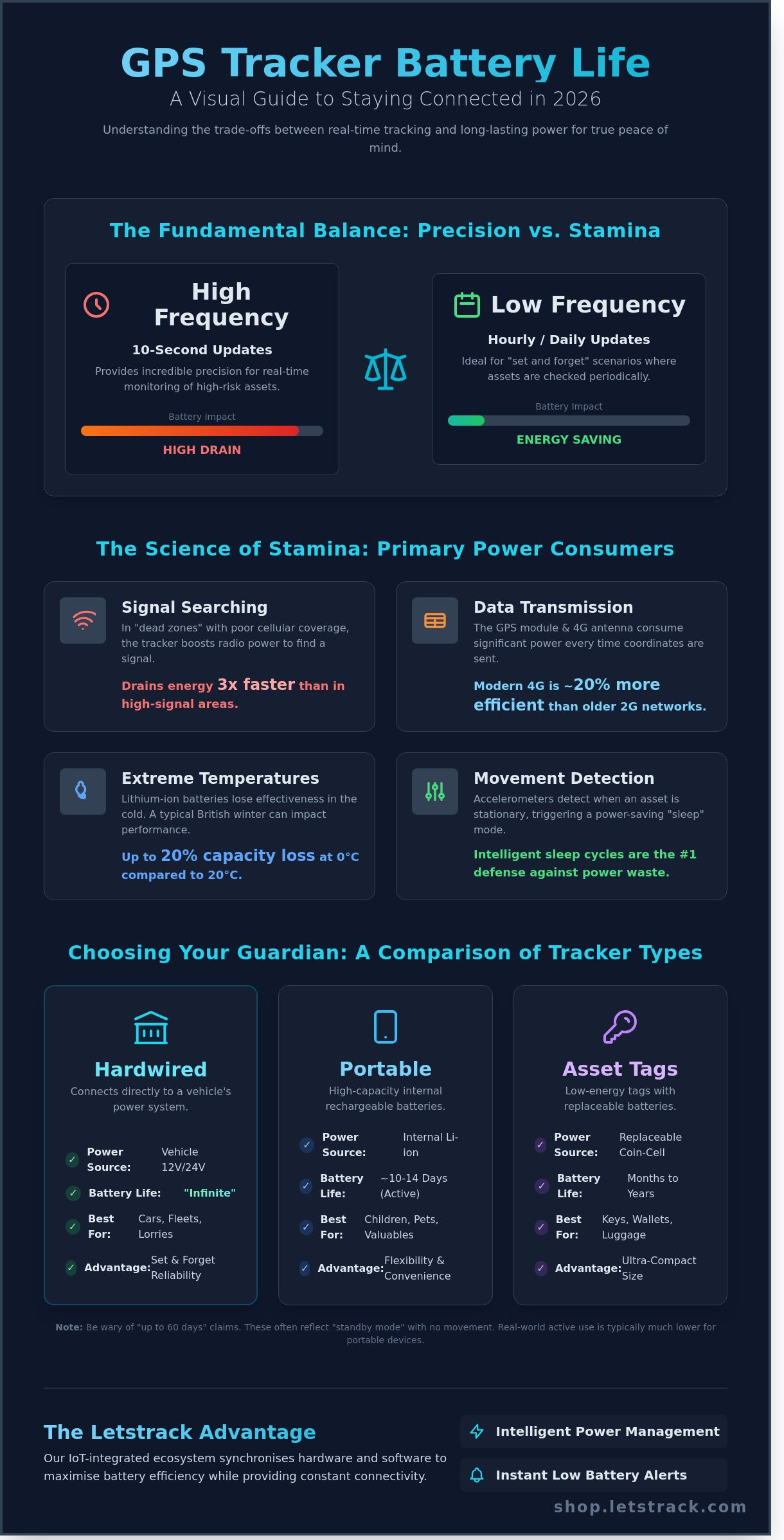
GPS tracker battery life is the specific duration a device remains fully operational before it requires a recharge or a battery replacement. It's the literal heartbeat of your security setup. When you perform a gps tracker battery life comparison, you'll notice a fundamental trade-off between real-time vigilance and energy conservation. A device that updates its location every ten seconds provides incredible precision, but it exhausts its power far quicker than one updating every hour. Finding the right balance is essential for maintaining a consistent safety net.
Most devices in the UK market fall into three distinct categories. Internal rechargeable units offer high-capacity lithium-ion power for portable use. Replaceable coin-cell batteries typically power low-energy tags used for keys or wallets. Finally, vehicle-powered trackers connect directly to a car's 12V or 24V system, effectively removing battery anxiety altogether. You should be wary of marketing claims stating "up to 60 days" of power. These figures often reflect "standby mode" where the device isn't actually moving. In real-world daily usage, active tracking might reduce that figure to 10 or 14 days depending on your settings.
The Core Components of Energy Consumption
The GPS module and the 4G antenna are the primary power consumers within any device. Every time your tracker calculates a coordinate or transmits data to the cloud, it uses a significant burst of energy. Modern GPS tracking unit hardware now utilises advanced internal processors to manage sophisticated sleep and wake cycles. These processors ensure the unit only consumes peak power when movement is detected via an onboard accelerometer. Transitioning to 4G connectivity has improved efficiency by roughly 20 percent compared to older 2G standards, as data packets are sent much faster, allowing the radio to return to a low-power state sooner.
Why 'Peace of Mind' Requires Reliable Power
The emotional cost of a dead battery is high. If a vehicle is stolen or a family member needs assistance, a tracker with no power provides zero protection. This is why Letstrack prioritises intelligent connectivity. We design our ecosystem to keep you in the loop, ensuring the "Digital Guardian" is always watching. Our software provides instant alerts when power levels dip, so you can act before the connection is lost. For a broader look at how these systems integrate into your lifestyle, read our Ultimate Guide to GPS Trackers for Cars. In any gps tracker battery life comparison, the most important metric isn't just the days on the box, it's the reliability of the alert when you need it most.
The Science of Stamina: What Actually Drains a Tracker's Battery?
Battery life isn't just about the milliampere-hour (mAh) rating. It's about how the device manages energy during peak activity. In our gps tracker battery life comparison, we find that four primary factors dictate how long your device stays online: signal searching, data transmission frequency, temperature, and movement detection. Each of these elements can either preserve your peace of mind or leave you with a dead device when you need it most.
Signal strength is a major power consumer. When a tracker enters a "dead zone" or a remote area with poor cellular coverage, it doesn't just sit idle. It increases its radio power to hunt for a handshake with the nearest tower. This process can drain energy 3 times faster than when the device is in a high-signal urban area. Environmental factors also play a critical role. Lithium-ion batteries suffer in the British winter; at temperatures of 0°C, a standard battery can lose up to 20% of its effective capacity compared to its performance at a stable 20°C.
Motion sensors act as the first line of defence against power waste. By integrating high-sensitivity accelerometers, modern trackers can detect when a vehicle or asset is stationary. This triggers a power-saving "sleep" mode that shuts down non-essential components until movement is detected again. This ensures the device is only working when there's something to report.
Update Frequency: The Silent Battery Killer
Ping rate is the frequency at which a device communicates its coordinates to the server. A device set to a 10-second real-time ping provides incredible precision for high-risk assets, but it exhausts its charge quickly. Conversely, switching to a 1-hour interval can extend the life of a single charge from a few days to several months. Many users find the Letstrack S7 GPS tracker offers the perfect balance through Dynamic Reporting. This smart feature automatically adjusts the frequency based on movement. If your car is parked at the office, the tracker stays quiet. Once you start the engine, it resumes real-time updates instantly.
Software Optimisation and AI Alerts
Hardware is only half the battle. Letstrack software uses AI to filter out false alerts, which prevents the device from waking up unnecessarily. This reduces digital "noise" and saves vital energy. Letstrack Circles also offer a decentralised monitoring approach. Instead of the device constantly polling the server for every single family member, the system manages data flow efficiently within the app ecosystem. Secure data handling and encryption also play a role in longevity. By ensuring every byte of data is necessary and secure, the device avoids the energy-intensive process of re-sending packets lost to poor protocols. This level of efficiency is a core part of any professional gps tracker battery life comparison in 2026. It ensures your connection to what matters remains unbroken without constant recharging.
Comparison: Hardwired, Plug-and-Play, and Battery-Powered Trackers
Choosing the right hardware depends on your specific security needs and how often you want to handle the device. A gps tracker battery life comparison reveals a clear divide between permanent vehicle installations and flexible asset protection. Hardwired units offer infinite power by drawing directly from the vehicle, while portable trackers provide extended stamina for non-powered assets. This distinction ensures you can choose a "Digital Guardian" that fits your lifestyle, whether you're protecting a daily driver or a remote shipping container.
Hardwired and OBD: Set and Forget Security
The S5 GPS Tracker is the gold standard for permanent vehicle protection. It taps into the 12V or 24V system, ensuring the device stays online 24/7 without intervention. For those who want immediate results, the Easy Plug Tracker fits into the OBD II port found in almost every UK car manufactured after 2004. You get constant power and real-time alerts without a complex installation process. These solutions provide the ultimate peace of mind because they eliminate the risk of a dead battery during a theft recovery situation.
Drivers often worry about trackers draining a car's starter battery. Modern Letstrack hardware solves this with intelligent power management. These devices enter a low-power state when the vehicle is stationary, drawing as little as 2mA. This is lower than the natural discharge rate of a standard vehicle battery, so your car stays protected even during long periods of inactivity. You get a vigilant companion that's always awake but never a burden on your vehicle's electrical health.
Portable and Asset Trackers: Versatile Stamina
Portable units like the Shield 4G GPS Tracker lead the market in long-life performance. These are perfect for caravans, plant machinery, or high-value shipments where a power source isn't available. If you require maximum capacity for long-term deployments, the Rapid 4G Tracker offers a robust solution that can last months on a single charge. These devices use 4G connectivity to provide rapid updates while prioritising energy conservation during downtime.
The role of magnetic mounts is vital for these trackers. They allow for discreet, secure placement on the underside of a chassis or inside a metal container. Battery lifespans vary based on how often the device sends a location update:
- Asset tracking mode: 1 month to 1 year (reporting once or twice daily).
- Real-time recovery mode: 10 to 30 days (reporting every few minutes).
- Personal wearables: 3 to 5 days (ideal for family safety and elderly care).
By matching the tracking mode to your specific asset, you can extend the device's life significantly. This flexibility ensures your valuables remain connected to the Letstrack ecosystem, providing a steady pulse of security across the UK and beyond.
Choosing Your Guardian: Battery Life Needs by Use Case
Selecting the right device depends entirely on your specific lifestyle and security goals. A gps tracker battery life comparison reveals that what works for a daily commuter won't suffice for a caravan stored over winter. You must match the hardware to your unique environment to maintain total peace of mind and constant connectivity.
Family and Personal Safety
The LT Personal is designed specifically for children and the elderly. It balances a small, wearable footprint with reliable uptime. Even when the battery drops below 15 percent, the SOS alert system remains active to ensure emergency signals reach the Letstrack app. This creates a safety net that never sleeps. For a deeper look at protecting your loved ones, read our Personal GPS Tracker Guide.
Valuables and Small Assets
For keys and bags, Bluetooth is the most efficient choice for daily use. The Touchtag Premium uses a standard coin-cell battery that lasts up to 365 days. Performing a gps tracker battery life comparison shows a massive gap between these year-long tags and rechargeable GPS units that require frequent charging. 'Find My' compatibility allows the UK's network of smartphones to locate lost items without draining the tag's power. It's the ultimate "set and forget" security solution for your most portable belongings.
Fleet Managers vs. Private Owners
Fleet managers typically prioritise hardwired units to ensure 24/7 connectivity without manual charging. This allows for constant real-time data without the risk of a dead battery halting operations. Private car owners often prefer the flexibility of magnetic or plug-and-play devices. In the UK, caravan and motorhome owners face the challenge of seasonal storage. If your vehicle sits in a secure compound for 120 days during winter, you need a tracker with a high-capacity internal battery and intelligent "deep sleep" modes to remain vigilant without a mains connection.
Pre-Purchase Checklist
Before buying, evaluate these four critical specs to ensure the device meets your specific safety needs:
- Update Frequency: Does the device allow you to switch between 10-second real-time tracking and 1-hour interval updates to save power?
- Battery Capacity: Look for mAh ratings; a 5000mAh battery will significantly outlast a 500mAh unit in long-term storage scenarios.
- Low Power Alerts: Ensure the app sends push notifications when the charge hits 20 percent so you're never caught off guard.
- Network Support: Check if the device uses 4G or LPWAN (Low Power Wide Area Network) which is 30 percent more energy-efficient than older 2G technology.
Secure your assets today by choosing the Shield 4G GPS Tracker for long-term protection and reliability.
Letstrack Solutions: Maximising Connectivity and Peace of Mind
Letstrack doesn't just manufacture hardware; we provide a complete IoT ecosystem designed to keep you connected to what matters most. By seamlessly integrating robust hardware with our intuitive mobile app, we ensure your assets remain visible and protected 24/7. This synergy is the foundation of our mission to provide genuine peace of mind. It transforms a simple tracking device into a reliable lifeline for families and businesses across the United Kingdom.
Our "Global Discovery" feature on the Letstrack map provides a unified view of your entire world. Whether you're monitoring a fleet of vans or keeping an eye on a child’s journey home, the map offers real-time data with incredible precision. This instant awareness is vital for modern security. While a gps tracker battery life comparison might show various hardware options, the Letstrack advantage lies in how our software manages that power to deliver consistent, actionable intelligence without compromise.
The Letstrack Advantage: Engineered for Endurance
Reliability depends on more than just a large battery; it requires intelligent energy management. When you conduct a gps tracker battery life comparison, you'll find that Letstrack units are engineered to balance high-performance tracking with long-term endurance. Our devices use advanced AI to optimise data transmission, ensuring you get the updates you need without draining the power cell unnecessarily.
- Premium Vehicle Security: The S7 GPS Tracker is our flagship solution for UK vehicle owners. It offers a permanent connection to your car or van, removing battery anxiety entirely.
- Engine Immobilisation: Unlike basic portable units, the S7 allows you to remotely disable the engine via the app. This feature provides a proactive layer of defence that battery-only units simply can't match.
- Smart Battery Alerts: For our portable range, the Letstrack app acts as a vigilant partner. It sends instant push notifications to your smartphone when battery levels drop below 15%, ensuring you're never caught off guard by a dead device.
Ready to Secure What Matters?
Investing in a GPS tracker is about more than just technology; it's about appointing a Digital Guardian for your most valuable assets. Our IoT platform is always awake and always watching, providing a level of vigilance that human monitoring cannot replicate. We prioritise your privacy with encrypted data, giving you total control over who sees your location information and when.
Don't wait for an incident to happen before you take control of your security. Whether you need to protect a luxury vehicle, a pet, or a family member, we have a solution tailored for the UK market. Our trackers are built for the digital-first era, combining speed, accuracy, and emotional security in one package. Explore the full range of Letstrack long-life trackers today and experience the confidence that comes from being truly connected.
Take Control of Your Security Today
Choosing the right hardware is the first step toward total security. This gps tracker battery life comparison shows that the best device isn't just about the largest battery; it's about how intelligently that power is used. Hardwired trackers offer a permanent "fit and forget" solution for vehicles, while portable tags provide flexible protection for pets and valuables. Letstrack has spent over 10 years of IoT innovation refining this balance. Our system delivers real-time AI-driven alerts that notify you of movement instantly without draining your power on idle time. You can manage every device through a single integrated app with global tracking capabilities, ensuring you're never out of touch. It's time to move beyond basic tracking and embrace a system that acts as your dedicated digital guardian. You deserve the confidence that comes with 2026-standard connectivity. Your safety shouldn't depend on a low-battery notification. Upgrade to a Letstrack Digital Guardian for long-lasting peace of mind. Stay vigilant and stay connected to what matters most.
Frequently Asked Questions
How long does a car tracker battery typically last?
A hardwired car tracker draws power directly from your vehicle, functioning indefinitely while the car battery remains active. Portable Letstrack devices offer varied durations; our compact tags last up to 12 months, while heavy-duty asset trackers provide 3 years of protection on a single charge. This gps tracker battery life comparison shows that usage patterns dictate your charging schedule. Stay vigilant by choosing a device that matches your specific security needs.
Do GPS trackers work when the car battery is disconnected?
Most high-quality trackers include an internal backup battery that activates immediately if thieves disconnect your vehicle's main power source. These emergency reserves typically provide 2 to 48 hours of real-time tracking depending on the hardware model. This ensures your Digital Guardian stays awake during a theft attempt. You'll receive an instant alert via the Letstrack app the moment power is cut, giving you a critical head start.
What is the difference between passive and real-time tracking battery life?
Real-time tracking requires constant cellular connectivity to send instant location updates, which consumes more power than passive logging. A real-time device might require charging every 10 to 20 days if set to frequent updates. Passive trackers only record data to internal memory for later download, often extending battery life by 40 percent. Letstrack prioritises real-time awareness because delayed data cannot prevent a theft in progress.
Can I improve the battery life of my portable GPS tracker?
You can extend your tracker's longevity by adjusting the update frequency within the Letstrack app. Reducing the ping rate from every 10 seconds to every 5 minutes can increase battery duration by up to 300 percent. Use Power Saving Mode to put the device to sleep when no movement is detected. These simple adjustments ensure your valuables remain protected for longer periods without manual intervention.
Does cold weather in the UK affect my tracker's battery performance?
Cold UK winters can reduce lithium-ion battery efficiency by 20 to 30 percent when temperatures drop below 5 degrees Celsius. Chemical reactions inside the battery slow down in freezing conditions, leading to faster voltage drops. Position your tracker in a sheltered area of the vehicle to provide some insulation against the elements. Our IoT-integrated hardware is tested to withstand standard British weather, maintaining connectivity even during a cold snap.
How will I know when my tracker's battery is running low?
Your Letstrack app sends an automated push notification when the battery level falls below 20 percent. You can also view the exact percentage of every device in your Letstrack Circle at any time. This transparent monitoring eliminates guesswork and ensures your safety net never fails. Check your dashboard regularly to maintain 100 percent visibility over your family and assets.
Are there GPS trackers that never need charging?
Hardwired trackers never require manual charging because they integrate directly into your vehicle’s 12V or 24V electrical system. Solar-powered units also exist for trailers and caravans, utilising 4 to 6 hours of daylight to maintain a full charge indefinitely. These fit and forget solutions provide permanent peace of mind. They ensure your assets are always visible on the Letstrack map without you ever touching a charging cable.
How does the update frequency (ping rate) affect battery drain?
The ping rate is the primary factor in battery consumption; a device updating every 5 seconds uses 10 times more power than one updating every hour. Every transmission requires the modem to wake up and search for a cellular signal. Balance your security needs by selecting a 30-second interval for high-risk assets and a 12-hour interval for stationary valuables. This tactical approach maximises your gps tracker battery life comparison results.