


Managing a Grey Fleet Policy in 2026: The Complete UK Guide
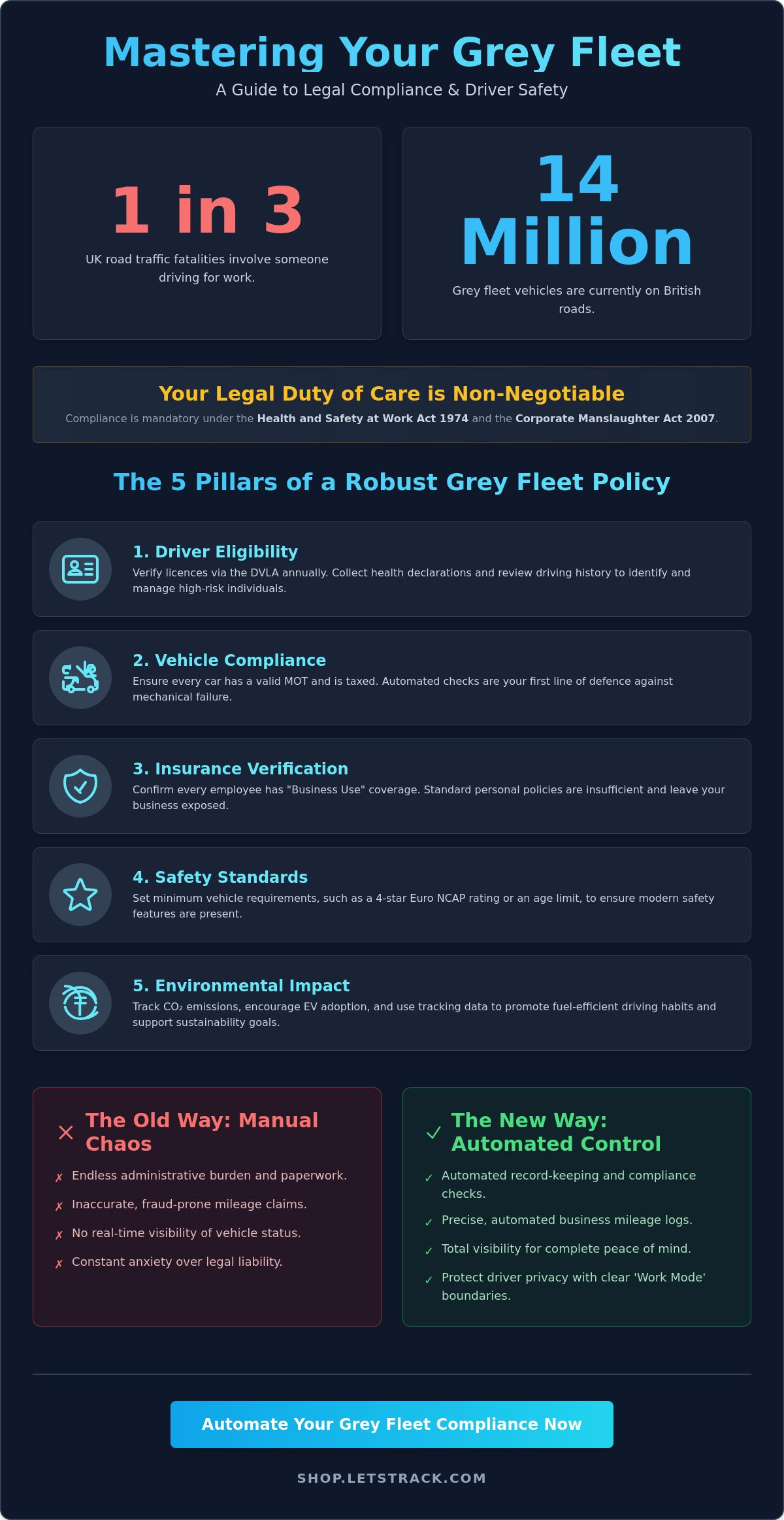
One in three road traffic fatalities in the UK involves someone driving for work. It is a sobering statistic that highlights the hidden risks within the 14 million grey fleet vehicles currently on British roads. You are likely tired of the administrative burden of manual MOT checks and the constant anxiety over legal liability if a staff member has an accident. Managing a grey fleet policy shouldn't be a source of stress or endless paperwork.
You'll learn how to build a robust, legally compliant framework that protects your business and ensures every vehicle is roadworthy using modern tracking technology. We will show you how to automate record-keeping and gain total peace of mind regarding driver safety. This guide covers the 2026 HMRC mileage rates, the new National Work-Related Road Safety Charter, and the digital tools that turn complex compliance into a simple, connected experience for your entire team.
Key Takeaways
- Understand why managing a grey fleet policy is a non-negotiable legal requirement under the Health and Safety at Work Act 1974.
- Identify the five essential pillars of compliance, from verifying driver licences to tracking mandatory MOT and maintenance schedules.
- Discover how to replace manual spreadsheets with real-time GPS technology to automate business mileage and eliminate administrative errors.
- Learn how to protect driver privacy by defining clear 'Work Mode' boundaries that only track location during business hours.
- Get a step-by-step implementation plan to audit your current fleet and deploy non-invasive hardware for immediate peace of mind.
What is a Grey Fleet Policy and Why is it Legally Non-Negotiable?
A grey fleet consists of any vehicle owned and driven by an employee for business purposes. While the driver owns the car, your business owns the legal risk. Managing a grey fleet policy is a critical requirement because your responsibility for staff safety doesn't stop at the office door. It extends to every mile driven on your behalf. This responsibility is a core component of modern fleet management, where compliance and safety are the primary objectives for any UK organisation.
To better understand how these risks impact your organisation, watch this helpful video from Brake Charity:
In January 2026, the UK government launched the National Work-Related Road Safety Charter. This initiative sets a national standard for any business requiring staff to drive for work. Relying on a verbal agreement or a "gentleman's handshake" regarding vehicle safety is no longer sufficient. You need a written, signed document that outlines expectations and responsibilities. Without this, your business remains exposed to the Corporate Manslaughter and Corporate Homicide Act 2007. A digital policy provides the peace of mind that you've taken every reasonable step to protect your team.
Understanding Your Duty of Care
Your legal obligation is to ensure every vehicle used for business travel is safe, insured, and fit for purpose. It's vital to distinguish between commuting and business travel. Commuting to a fixed place of work is generally exempt, but any trip between sites or to a client meeting falls under your remit. Under the Road Traffic Act 1988, duty of care is the legal requirement for employers to proactively manage and mitigate the risks faced by employees while they're driving for work.
The Financial Risks of Poor Management
Neglecting your grey fleet leads to spiralling insurance premiums and potential legal fees if an incident occurs. Implementing accurate mileage tracking is the most effective way to prevent reimbursement fraud. This ensures you only pay for actual miles driven. Beyond direct costs, the administrative time spent manually chasing MOT certificates and insurance documents drains your productivity. Automated systems replace this manual chaos with real-time visibility, ensuring you stay in control without the paperwork headache.
The 5 Essential Pillars of a Robust Grey Fleet Management Strategy
Managing a grey fleet policy effectively requires more than a simple checklist. It demands a structured strategy built on five key pillars that secure your business and empower your drivers. Since grey fleet vehicles account for approximately 40% of all cars on UK roads, the scale of risk is significant. You must move from reactive management to a proactive "Digital Guardian" approach that prioritises instant awareness.
- Driver Eligibility: Verify licences through the DVLA at least once a year. Collect health declarations and review driving history to identify high-risk individuals before they hit the road.
- Vehicle Compliance: Ensure every car has a valid MOT and up-to-date tax. With the average personal car in the UK being almost 10 years old, these checks are your first line of defence against mechanical failure.
- Insurance Verification: Confirm that every employee has "Business Use" coverage. Personal policies typically only cover social, domestic, and pleasure trips, leaving your business exposed during work journeys.
- Safety Standards: Set minimum requirements for any vehicle used for work. This might include a minimum 4-star Euro NCAP rating or an age limit of seven years to ensure modern safety tech like autonomous emergency braking is present.
- Environmental Impact: Sustainability is a priority in 2026. Grey fleet vehicles often have higher CO2 emissions than company cars. Encourage EV adoption and use tracking data to promote fuel-efficient driving habits.
By managing a grey fleet policy with these pillars in mind, you transform a liability into a controlled, safe environment. You can automate these checks with a vehicle health tracker to stay ahead of maintenance and compliance issues without the manual stress.
Verifying Roadworthiness and Tyres
Tyre safety is the most ignored factor in grey fleet risk management, yet it's the only point of contact between the vehicle and the road. Worn tyres increase stopping distances and the risk of aquaplaning. Implement a quarterly vehicle health check requirement for all staff to ensure tread depth and pressures meet legal standards. For deeper context on staying ahead of these risks, read our guide to preventative maintenance.
Insurance: The 'Business Use' Trap
Standard 'Social, Domestic, and Pleasure' insurance is insufficient for work-related trips. If an employee has an accident while driving to a client meeting without business cover, the insurer will likely void the claim. You don't want to be left chasing manual files or paper certificates. Use digital auditing tools to verify that 'Occasional Business Use' clauses are active in 2026 policies, ensuring every journey is protected by a valid safety net.
Overcoming the Compliance Burden: Moving Beyond Manual Checks
Manual record-keeping is a gamble your business can't afford to take. Spreadsheets are static, while your fleet is in constant motion. Managing a grey fleet policy through paper trails often leads to significant compliance gaps. You need a system that's as vigilant as you are. Relying on employees to remember MOT dates or insurance renewals creates a point of failure that could lead to legal repercussions.
Real-time visibility transforms your management from reactive to proactive. By using GPS technology, you gain an instant overview of business journeys as they happen. This "Digital Guardian" approach ensures you're always watching over your team's safety during work hours. It's about shifting from a "check-box" exercise to a live safety ecosystem. Managing a grey fleet policy shouldn't be a full-time manual job; it should be an automated process that runs silently in the background.
Integrating vehicle health data allows you to predict maintenance needs before a breakdown occurs. By monitoring engine diagnostics via IoT-integrated tools, you receive instant alerts about fault codes. This connectivity means you can advise an employee to visit a garage before a minor issue becomes a roadside emergency. It protects your productivity and, more importantly, your people.
Leveraging Plug-and-Play Technology
The Easy Plug Tracker is the ideal solution for grey fleet flexibility. It requires no complex wiring. This protects the integrity of the employee's personal vehicle while providing you with high-tech data. You simply plug it into the OBD-II port for immediate connectivity. This device acts as a silent sentry, automating the 'MOT due' alert system. It removes the need to chase staff for certificates, as the system notifies you well before any document lapses.
Accurate Mileage and Expense Reporting
Precision is the enemy of reimbursement fraud. Stop relying on estimated mileage logs that often result in inaccurate claims. With precision GPS data, you get 100% accuracy on every business journey. The Letstrack app simplifies the month-end expense claim process by separating business and private miles with a single tap. This level of connectivity also supports your sustainability goals. Better route planning reduces unnecessary miles, lowering the carbon footprint of your personal vehicle fleet by a measurable margin.
Balancing Duty of Care with Driver Privacy: The Ethics of Tracking
Employee pushback is the single biggest hurdle to modernising your operations. Many staff members view GPS technology with a "Big Brother" lens, fearing constant surveillance of their personal lives. You can overcome this resistance by making clear communication the cornerstone of managing a grey fleet policy. When you explain that the technology is there to protect them, not to catch them out, adoption rates increase by over 80% based on recent industry feedback. Transparency is the only way to build a culture of mutual trust.
Defining a clear "Work Mode" boundary is essential for maintaining this trust. Managing a grey fleet policy with a focus on specific business hours ensures that tracking only occurs during work-related journeys. Modern systems allow employees to toggle between private and business modes with a single tap. This approach satisfies your legal duty of care without infringing on an individual's right to privacy. It acts as a digital handshake that respects the boundary between professional obligations and personal time.
Data security is non-negotiable for UK businesses in 2026. All location data must be encrypted and fully GDPR compliant to ensure it remains secure and user-controlled. In the Letstrack ecosystem, employees have visibility into the data they share, which transforms the tracker from a monitoring tool into a digital witness. If a staff member is involved in an accident, the GPS data provides undeniable proof of their speed and location. This provides a safety net that protects them from false claims or unfair liability.
Letstrack Circles for Business Teams
Using the "Letstrack Circles" concept helps you build a culture of connectivity and safety. It reframes real-time location sharing as a collaborative tool for team coordination rather than top-down surveillance. For lone workers visiting remote sites in their own cars, this connectivity is a lifeline. Integrated SOS alerts allow staff to signal for help instantly if they feel threatened or experience a breakdown. This provides a robust safety net that manual check-ins simply cannot match.
Drafting the Privacy Clause
Your written policy must include a specific privacy clause that details exactly what data the S5 GPS Tracker collects. Be transparent about the fact that the system records location, speed, and idling only during designated work hours. Showing employees the mobile app interface helps demystify the technology. It gives them peace of mind knowing they have a permanent, digital record of their work travel for accurate reimbursement and safety verification.
Ready to protect your team with ethical tracking? Invest in a smarter grey fleet solution today.
Implementing Your Grey Fleet Policy with Letstrack Technology
Transitioning from a paper-based system to a digital-first strategy is the final step in securing your organisation. Managing a grey fleet policy effectively requires a structured rollout that empowers your team rather than burdening them. By following a clear implementation roadmap, you transform your duty of care into a seamless, automated reality that provides total peace of mind.
- Step 1: Audit Your Fleet: Start with a digital health check of your current drivers. Identify which vehicles are over 10 years old, as these represent the highest risk for CO2 emissions and mechanical failure.
- Step 2: Deploy Non-Invasive Hardware: Distribute the Shield 4G to your staff. It provides high-speed connectivity without requiring permanent vehicle modifications, making it ideal for personal cars.
- Step 3: Staff Training: Conduct a brief session on the Letstrack mobile app. Show drivers how to set up geofencing for client sites and how to use instant alerts to stay informed about their vehicle's safety.
- Step 4: Review AI Reports: Use the monthly AI-driven dashboard to identify high-risk driving behaviours. Focus on reducing harsh braking and rapid acceleration to lower your risk profile and fuel costs.
This phased approach ensures that managing a grey fleet policy becomes a natural part of your daily operations. You aren't just ticking a compliance box; you're building a vigilant safety culture that protects every member of your team on every journey.
Choosing the Right Hardware
Different drivers have different needs. For your high-mileage users who are constantly on the road, the S7 Tracker offers the most robust real-time tracking and battery backup. For occasional drivers or those using bicycles for local business deliveries, a simple Bluetooth tag provides sufficient location sharing for expense verification. Always prioritise 4G connectivity to ensure consistent updates across the UK's diverse terrain. For high-value assets or high-risk roles, consider engine immobilisation features as a premium safety standard to prevent unauthorised use.
The Future of Fleet Management
The 2026 road safety landscape is defined by connectivity. IoT technology is turning personal cars into 'smart assets' that communicate directly with your business systems. This integration allows for predictive maintenance and instant SOS response, moving far beyond the capabilities of traditional telematics. If you're ready to scale your operations, read our full fleet management guide for a deeper look at enterprise solutions. Secure your business and empower your drivers with the precision of Letstrack today.
Take Control of Your Road Safety Strategy
Managing a grey fleet policy effectively is no longer about chasing paper. It's about leveraging 4G connectivity and real-time data to protect your most valuable assets: your people. You've seen how digital tools eliminate the 40% risk factor associated with unmonitored personal vehicles on UK roads. By shifting to an automated system, you move from administrative anxiety to a position of total control. You ensure every journey is compliant. Every mile is accurate. Every driver is safe.
The transition to a "Digital Guardian" approach is simple and non-invasive. Our IoT-integrated mobile app provides instant awareness, while real-time AI alerts keep you informed of high-risk behaviours before they lead to accidents. With UK-based support and cutting-edge hardware, you have the technology needed to meet the 2026 National Work-Related Road Safety Charter standards with confidence. It's a proactive choice that transforms your duty of care into a seamless daily reality.
Don't leave your business safety to chance. Secure your grey fleet and gain total peace of mind with Letstrack's GPS solutions. It's time to build a connected, compliant, and secure future for your entire team.
Frequently Asked Questions
Is it legal to track employees in their personal vehicles in the UK?
Yes, it is legal to track personal vehicles if the tracking is limited to business journeys and conducted during work hours. You must obtain explicit consent from your staff and provide a clear privacy policy that explains how data is used. Using a system with a "private mode" toggle ensures that tracking stops the moment the workday ends, maintaining a respectful balance between duty of care and individual privacy.
What happens if an employee has an accident in a grey fleet car without business insurance?
If an employee drives for work with only a "Social, Domestic, and Pleasure" policy, their insurer will likely void any claim following an accident. This leaves your business directly exposed to legal action and potential prosecution under the Corporate Manslaughter and Corporate Homicide Act 2007. Without the correct "Business Use" cover, you are failing in your legal duty to ensure the vehicle is fit for its intended purpose.
How do I calculate grey fleet mileage accurately for HMRC?
Managing a grey fleet policy effectively requires absolute precision when reporting to HMRC to avoid overpayment or tax penalties. For the 2026/2027 tax year, the approved mileage rates remain 45p per mile for the first 10,000 miles and 25p thereafter for cars and vans. Replacing manual, estimated logs with IoT-integrated GPS data ensures every claim is backed by a digital record of the exact route and distance travelled.
What is the difference between a company car fleet and a grey fleet?
A company fleet consists of vehicles owned or leased directly by the organisation, while a grey fleet refers to vehicles owned and maintained by employees but used for business trips. While you have direct control over the maintenance of company cars, the 14 million grey fleet vehicles in the UK are often older and require more vigilant oversight. Both categories fall under the same health and safety legislation regarding your duty of care.
Can I mandate specific safety features for an employee's personal car?
Yes, you can and should set minimum safety standards for any personal vehicle used on company time. With the UK government mandating 18 new safety technologies in 2026, many businesses now require grey fleet cars to be under seven years old or have a minimum 4-star Euro NCAP rating. Setting these boundaries ensures that your staff are protected by modern features like autonomous emergency braking and lane-keeping assistance.
How much does it cost to implement a grey fleet tracking system?
The cost varies based on the level of connectivity and hardware complexity you choose, but the return on investment is immediate. By preventing mileage fraud and reducing the administrative time spent on manual compliance checks, most businesses see a significant reduction in operational overheads. The primary value lies in the "peace of mind" gained by avoiding the catastrophic legal costs associated with unmanaged road risk and fatalities.
What are the essential documents I need to check for grey fleet compliance?
You must verify four primary documents: a valid UK driving licence, a current MOT certificate, proof of vehicle tax, and an insurance certificate that explicitly includes business use. Since the average personal car in the UK is now nearly 10 years old, these checks are vital for ensuring roadworthiness. Automated digital systems can now monitor these expiry dates in real-time, sending instant alerts before a vehicle becomes non-compliant.
How does geofencing help in managing a grey fleet policy?
Geofencing is a powerful tool for managing a grey fleet policy because it automates the logging of site visits and client meetings. By creating virtual boundaries around specific locations, the system records exactly when a driver enters and leaves a work zone. This provides a transparent, digital audit trail for billing and expenses, while also acting as a safety net for lone workers by notifying the office of their safe arrival.