

How to Justify Fleet Management Costs: A Strategic 2026 ROI Guide
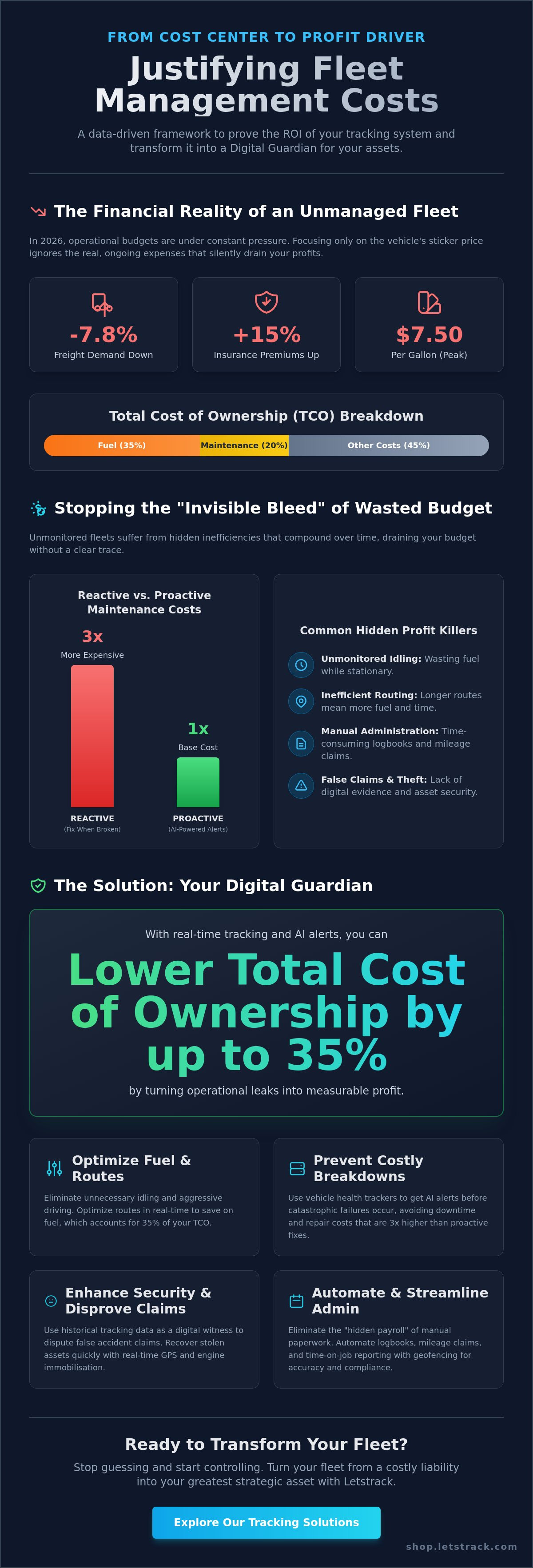
Why are fleets with perfect safety records still seeing insurance premiums jump by as much as 15% in 2026? With freight demand down 7.8% and diesel prices hitting $7.50 per gallon in some regions this May, your operational budget is under constant pressure. It's difficult to argue for new technology when your board only sees a growing list of expenses. You need a clear, data-driven strategy for how to justify fleet management costs to prove that your tracking system is a Digital Guardian, not just a line-item drain.
We understand your inherent need for total control over your assets and the safety of your drivers. This guide will show you how to transform fleet management from a perceived cost into a high-return strategic asset using bulletproof ROI frameworks. You'll learn how to lower your total cost of ownership by up to 35% through real-time tracking and AI alerts. We'll break down the exact metrics you need to turn invisible operational leaks into measurable profit margins and lasting peace of mind.
Key Takeaways
- Identify the "invisible bleed" of unmonitored idling and poor routing to recover wasted fuel budgets instantly.
- Discover how vehicle health trackers prevent catastrophic engine failures and significantly lower your total cost of ownership.
- Learn a bulletproof framework on how to justify fleet management costs by auditing hidden expenses like rising insurance premiums and vehicle downtime.
- Use historical tracking data as a digital witness to dispute false accident claims and safeguard your business's reputation.
- Build a "Digital Guardian" ecosystem using Letstrack Circles for secure, real-time team connectivity and asset protection.
The Financial Reality of Unmanaged Fleets in 2026
Operating a fleet in May 2026 feels like trying to fill a bucket with a hole in the bottom. With freight demand down by 7.8% and commercial insurance premiums rising by up to 15% even for safe drivers, every penny counts. Most business owners focus on the "sticker price" of their vehicles, but this is a dangerous distraction. To understand how to justify fleet management costs, you must look at the Total Cost of Ownership (TCO). This includes fuel, which accounts for 35% of your expenses, and maintenance, which takes up another 20%.
To better understand this concept, watch this helpful video:
Unmanaged fleets suffer from an "invisible bleed." This occurs when unmonitored idling and inefficient routing quietly drain your UK budget. If a driver idles for just one hour a day, the annual cost across a 10-vehicle fleet is staggering. By adopting a comprehensive approach to managing your assets, you move from reactive chaos to proactive control. Reactive maintenance, where you only fix things when they break, is historically 3x more expensive than using a vehicle health tracker to spot issues before they lead to catastrophic engine failure.
The Hidden Payroll of Administrative Inefficiency
Manual logbooks and mileage claims are a silent profit killer. Your staff likely spends dozens of hours every month chasing paper trails and verifying routes. This is the "hidden payroll" of fleet administration. Automated reporting doesn't just save time; it provides the data-backed evidence needed for HMRC compliance. If you're still wondering what is fleet management?, it's essentially the transition from guesswork to digital precision. It's about having the right data at the right time to make informed decisions.
Why "Peace of Mind" has a Monetary Value
Security is a financial strategy. The cost of a stolen van far exceeds its market value when you factor in lost revenue, insurance claims, and the rate increases seen in early 2026. Installing a GPS tracker for car or van provides instant alerts and engine immobilisation. This vigilant protection ensures your reputation remains intact. A late delivery due to a breakdown or theft isn't just a mistake; it's a lost customer. Real-time awareness ensures you stay connected to what matters most, providing a level of confidence that spreadsheets simply can't quantify.
Quantifying ROI: Mapping Telematics to the Balance Sheet
Proving the value of a tracking system requires moving beyond simple location dots on a map. You must connect real-time data to specific line items on your profit and loss statement. When looking at how to justify fleet management costs, focus on the immediate reduction in operational waste. By adopting leading practices for fleet management, such as life-cycle cost analysis and route density optimisation, you can transform your fleet from a cost centre into a profit driver. This strategic shift is essential in a year where UK insurance premiums are climbing by as much as 15%.
Labour costs are often a fleet's second-largest expense. Geofencing allows you to automate the verification of site visits and "time-on-job" metrics. Instead of relying on manual time sheets, which are prone to human error or inflation, you get an encrypted, digital record of exactly when a vehicle arrived and departed. This level of transparency doesn't just save money; it builds trust with your clients by providing undeniable proof of service. If you want to see how this works in practice, you can explore our advanced vehicle trackers to start protecting your margins today.
Fuel Efficiency and the 2026 Carbon Mandate
With diesel prices fluctuating wildly in May 2026, precision is your best defence. High-speed devices like the Rapid 4G Tracker provide the granular data needed to eliminate unnecessary idling and aggressive driving habits. Driver behaviour monitoring directly impacts your miles per gallon (MPG) by curbing harsh acceleration and speeding. Implementing these telematics insights typically reduces annual fuel spend by 10% to 15% through total route optimisation.
Extending Asset Lifespan with IoT
Capital preservation is a core pillar of a "Digital Guardian" strategy. Using vehicle health trackers to monitor engine diagnostics via OBD-II ports allows you to catch minor faults before they become total engine failures. This shift toward preventative maintenance ensures your vans stay on the road longer, delaying the massive capital expenditure of fleet replacement. It's about vigilantly watching over your hardware to ensure every asset reaches its full potential life cycle without unexpected downtime.
- Direct Savings: Immediate fuel reduction via idling alerts and route density.
- Maintenance: Real-time engine health checks to prevent catastrophic repair bills.
- Insurance: Active GPS monitoring can help mitigate the impact of 2026 rate hikes.
- Labour: Automated geofencing to verify payroll and billable hours with 100% accuracy.
Soft Costs vs. Hard Savings: The Invisible Justification
Hard savings like fuel reduction are easy to spot on a spreadsheet, but the true value of a tracker often lies in the costs you never have to pay. When considering how to justify fleet management costs, you must account for "soft" savings that protect your bottom line from unpredictable shocks. Think about the "Down Vehicle" calculation. If one of your delivery vans is off the road for four hours due to an unmonitored mechanical failure, you aren't just losing the repair fee; you're losing the billable revenue that vehicle should have generated. In 2026, where profit margins are squeezed by a 7.8% decline in freight demand, these "invisible" hours can be the difference between a profitable month and a loss.
Compliance and legal protection provide another layer of financial security. With litigation severity on the rise, having a digital witness is vital. Historical GPS data allows you to dispute false accident claims with absolute precision. If a third party claims your driver was speeding or at a specific location at 2:00 PM on May 10, 2026, your Letstrack dashboard provides the encrypted, timestamped proof to settle the matter instantly. This doesn't just save on potential legal fees; it prevents your insurance premiums from skyrocketing even further beyond the 15% increases already seen this year.
Your team is your most valuable asset, and data-backed performance reviews help keep them. Fair, transparent tracking removes the "he said, she said" friction from management. Drivers feel empowered when they can prove their efficiency and safety records. Additionally, providing your customers with real-time tracking links for their deliveries builds an immediate sense of trust. It transforms a standard service into a connected, premium experience, ensuring client retention remains high despite market volatility.
Risk Mitigation and SOS Response
Protecting your staff is a moral and financial imperative. For lone workers or drivers in remote areas, SOS alerts offer a direct line to help. If an incident occurs, an immediate notification allows for rapid emergency response, potentially reducing the severity of an injury or asset loss. This vigilant protection ensures that your "Digital Guardian" is always awake, watching over your people when they are most vulnerable. It's about providing a source of daily comfort and confidence for your team on the road.
Protecting the "Brand Guardian"
Your vehicles are moving billboards. When a driver uses a company van for unauthorised "moonlighting" or drives aggressively, it damages your public reputation. Geofencing allows you to set digital boundaries, sending instant alerts if a vehicle leaves its assigned area or operates outside of working hours. By maintaining strict control over asset usage, you ensure your brand projects an image of reliability and professionalism at all times. You stay connected to your assets, ensuring they are used exactly as intended.
Building Your Business Case: A Step-by-Step Framework
Presenting a financial case to your board or CFO requires a shift from operational talk to fiscal impact. You aren't just buying hardware; you're investing in a system that stabilises cash flow and protects EBITDA. If you're struggling with how to justify fleet management costs, follow this structured framework to build an undeniable business case that balances high-tech sophistication with financial common sense.
- Step 1: Audit Unmanaged Costs. Gather your data from the last 12 months. Focus on fuel spend, which typically accounts for 35% of total costs, and the 7% to 15% insurance premium hikes seen in early 2026.
- Step 2: Define Objectives. Clearly state if your primary goal is "Security" (preventing theft and moonlighting) or "Efficiency" (reducing fuel waste and idling). Having a clear "Digital Guardian" objective keeps the project focused.
- Step 3: Select Your Hardware. Tailor your technology to your fleet size. For standard vehicle monitoring, S5 GPS trackers offer reliable precision. For heavy-duty assets or those requiring maximum uptime in the 4G/5G transition, 4G Shield units provide the robust connectivity needed for high-speed data transmission.
- Step 4: Run a Pilot Programme. Install trackers on 10% of your fleet for 90 days. This creates a baseline ROI model that proves the technology works in your specific operational environment before a full rollout.
- Step 5: Present the Financial Impact. Show the CFO how reducing idling by 20% or preventing a single vehicle theft directly improves cash flow predictability.
Mapping KPIs to Financial Goals
To win approval, you must translate technical metrics into money. High "Idling Time" isn't just a driver behaviour issue; it's a direct leak in your fuel budget that you can stop instantly with real-time alerts. Similarly, "Engine Alerts" from a vehicle health monitor aren't just maintenance notifications. They represent Maintenance CapEx Preservation. Catching a fault early prevents the high cost of total engine replacement, keeping your capital exactly where it belongs. Secure your fleet now by exploring our range of professional GPS trackers.
The Scalability Argument
Manual oversight is a relic of the past that doesn't scale. As your business grows, adding more administrative staff to chase logbooks is an inefficient use of capital. Cloud-based connectivity is the modern solution for staying connected to your team. The Letstrack App creates a Digital Guardian ecosystem where a single manager can vigilantly oversee 50+ vehicles from a single screen. This efficiency ensures your management costs remain flat even as your fleet expands, providing the long-term peace of mind you need to scale with confidence.
The Letstrack Advantage: Connectivity as a Strategic Asset
Choosing a tracking partner isn't just about the hardware; it's about the ecosystem that supports your daily operations. Letstrack provides more than coordinates. It delivers a sophisticated ecosystem where precision-engineered hardware merges seamlessly with real-time app control. This allows you to move beyond simple monitoring to active asset management. When you're determining how to justify fleet management costs, look at the value of connectivity. Our platform acts as a vigilant companion, ensuring you stay connected to your team and your assets regardless of where they are in the world.
Letstrack Circles for business reinvent how teams coordinate in the field. Instead of constant phone calls to check status updates, you use secure, localised location sharing within your professional circle. This transparency builds trust and speed. For high-value assets that require the highest level of protection, the S7 GPS Tracker offers advanced security features, including engine immobilisation and instant AI alerts. These tools don't just track; they empower your business to react instantly to any threat or opportunity.
International fleets benefit from our global discovery features. The Letstrack map provides borderless connectivity, allowing you to oversee vehicles across the UK and Europe from a single interface. This global ambition is balanced by a personal touch, ensuring that even a massive technological infrastructure feels like a personal security detail for your business. You gain a source of daily comfort, knowing your "Digital Guardian" is always awake and watching over your investments.
Security and Data Encryption
CFOs and security officers can rest easy knowing that our infrastructure prioritises privacy. All data within the Letstrack ecosystem is fully encrypted and user-controlled. We understand that your fleet data is a sensitive strategic asset. By combining UK-based support with a robust global IoT infrastructure, we ensure your information stays secure. This commitment to data integrity is a core part of how to justify fleet management costs to stakeholders who value risk mitigation as much as profit.
From Tracking to Total Awareness
Letstrack transforms a complex GPS tool into a source of confidence. We don't just sell trackers; we sell peace of mind. By integrating our hardware and mobile app into a single, inseparable ecosystem, we provide the instant awareness you need to lead your business in 2026. Every feature is designed to move you toward a feeling of being informed and in total control. Don't leave your fleet's safety to chance. Contact a fleet specialist today to request a demo and see our Digital Guardian technology in action.
Secure Your Fleet’s Future with Digital Intelligence
The operational landscape of 2026 demands more than just survival; it requires a proactive defence against rising costs. By auditing your unmanaged expenses and mapping telematics to your balance sheet, you transform every vehicle into a high-return asset. You've seen how real-time tracking helps cut operating costs by up to 35% and how preventative maintenance protects your capital. Understanding how to justify fleet management costs isn't just about spreadsheets. It's about empowering your business with the visibility and control needed to thrive despite market volatility.
Letstrack brings a global presence from London to India, providing you with cutting-edge, real-time 4G tracking technology. Your data remains fully encrypted and user-controlled, ensuring total privacy while you monitor your assets. It’s time to move from reactive management to total awareness. Optimise your business today with Letstrack Fleet Solutions and gain the peace of mind that comes with a Digital Guardian watching over your team. Start your journey toward a more secure, efficient, and profitable future right now.
Frequently Asked Questions
How long does it take to see a return on investment (ROI) for fleet management?
Most businesses see a full return on their investment within 6 to 9 months of implementation. Immediate savings usually come from reducing engine idling and optimising routes, which can cut total operating costs by 20% to 35% almost instantly. By curbing aggressive driving habits, you stop fuel waste and reduce wear on tyres and brakes from the very first day of use.
Can fleet management software actually reduce my insurance premiums in the UK?
Yes, active GPS monitoring helps mitigate the 7% to 15% rate increases seen across the UK insurance market in early 2026. Insurers value the "Digital Guardian" approach because it provides encrypted, timestamped evidence of safe driving. This data allows you to prove a lower risk profile and dispute false accident claims with absolute precision, protecting your claims history.
Is it difficult to justify the initial hardware cost of GPS trackers?
Justifying the initial cost is simple when you compare it to the expense of a single stolen vehicle or a major engine failure. A GPS tracker provides engine immobilisation and real-time alerts that prevent asset loss. When considering how to justify fleet management costs, remember that the hardware pays for itself by preventing just one "Down Vehicle" incident or one unmonitored mechanical breakdown.
What are the biggest "hidden costs" of an unmanaged fleet?
The largest hidden costs are unmonitored idling, unauthorised vehicle use, and administrative time spent on manual logs. Idling for just one hour a day drains a significant portion of your fuel budget over a single year. Without real-time awareness, you also lose billable hours when vans are used for "moonlighting" or personal errands outside of your geofenced work zones.
How does real-time tracking improve driver retention and morale?
Real-time tracking improves morale by providing fair, data-backed performance reviews that eliminate management bias. Drivers feel more secure knowing they have an SOS alert system for emergencies and digital proof of their safe driving habits. This transparency creates a culture of trust where top performers are recognised based on objective metrics rather than subjective guesswork or hearsay.
What is the average fuel saving after implementing a fleet management system?
You can expect an average fuel saving of 10% to 15% through route optimisation and idling reduction alone. In May 2026, with diesel prices reaching as high as $5.97 per gallon in some regions, these percentages represent significant cash flow preservation. Monitoring driver behaviour further boosts your MPG by reducing harsh acceleration and excessive speeding habits across the entire fleet.
How do I explain the transition from CapEx to OpEx to my CFO?
Explain that fleet management shifts unpredictable, heavy repair bills (CapEx) into predictable monthly subscriptions (OpEx). Instead of facing massive capital outlays for premature vehicle replacements, you use data to extend asset lifespans. This transition provides the CFO with better cash flow predictability and protects EBITDA by preventing catastrophic, unbudgeted mechanical failures that could disrupt your operations.
Can fleet management help with UK HMRC mileage compliance?
Yes, automated GPS logs provide the precise records required for UK HMRC mileage and fuel claims. This eliminates the "hidden payroll" of staff manually calculating business versus private mileage. By using encrypted, user-controlled data, you ensure your business remains fully compliant while saving your administrative team dozens of hours of manual work every month.