


How to Create a Driver Safety Programme: A Complete 2026 Guide for UK Fleets
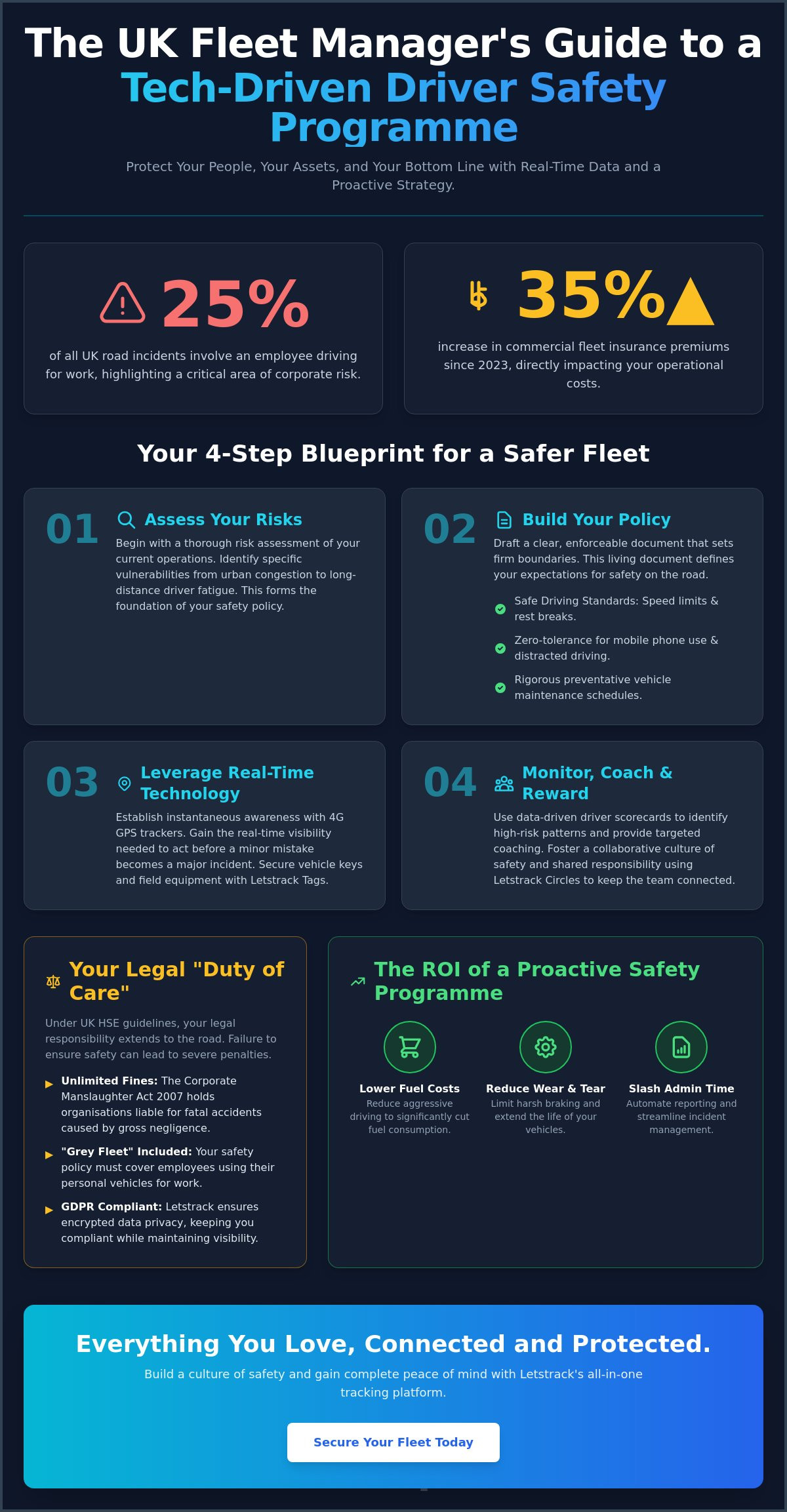
Did you know that 25% of all road traffic incidents in the UK involve someone driving for work? With commercial fleet insurance premiums rising by 35% since 2023, the financial and human cost of a single collision has never been higher. You want to protect your team, but it's hard to feel in control when you lose visibility the moment a driver leaves the depot. We understand that the anxiety over legal liability and rising operational costs can be overwhelming for any fleet manager.
You're looking for more than just a checklist; you need a way to stay connected to your assets and your people. This guide explains exactly how to create a driver safety program that transforms real-time data into psychological tranquility. You'll learn how to build a robust, tech-driven strategy that reduces collision rates, ensures compliance with 2026 UK regulations like mandatory event data recorders, and lowers your overheads. We'll preview the essential hardware and mobile tools needed to foster a culture that rewards excellence and keeps your team protected.
Key Takeaways
- Understand your legal "Duty of Care" under HSE guidelines to significantly reduce corporate liability and protect your team from road risks.
- Master the step-by-step process of how to create a driver safety program that combines thorough risk assessments with clear, enforceable policy documents.
- Establish instantaneous awareness with 4G GPS trackers, providing the real-time visibility needed to act before a minor mistake becomes a major incident.
- Use driver scorecards and Letstrack Circles to identify high-risk patterns and foster a collaborative culture of safety and shared responsibility.
- Protect every asset by integrating Letstrack Tags into your safety strategy to secure vehicle keys and essential field equipment.
Why Your Business Needs a Formal Driver Safety Programme
A driver safety programme is a structured set of policies and digital tools engineered to reduce road risk and protect your most valuable assets: your people. It isn't just about ticking a box; it's about building a digital guardianship that watches over every mile. When you research how to create a driver safety program, you're essentially designing a shield for your business that operates even when you aren't watching. This framework ensures that your team remains "Connected and Protected," transforming a complex operational challenge into a source of daily confidence.
To better understand this concept, watch this helpful video:
Beyond the technology, this framework is rooted in the Worker road safety principles that demand a proactive approach to risk. For UK employers, the Health and Safety Executive (HSE) makes it clear: your "Duty of Care" extends to the road. If your team is driving for work, they are in a workplace. This means you are legally responsible for their safety, the safety of others, and the roadworthiness of the vehicles they use. Ignoring these responsibilities leaves your business vulnerable to both physical accidents and crippling legal consequences.
The Legal Landscape for UK Fleets in 2026
Compliance isn't optional. Under the Corporate Manslaughter and Corporate Homicide Act 2007, organisations can face unlimited fines if a gross breach of duty leads to a fatality. This liability isn't limited to company-owned vans. Your "grey fleet", which refers to employees using their own cars for business, must be fully integrated into your safety programme. We ensure this transition is seamless by using encrypted data privacy protocols. This keeps you GDPR compliant while maintaining total visibility over work-related journeys.
Beyond Compliance: The ROI of Safety
Investing in safety delivers a direct financial return that goes straight to your bottom line. Safe driving habits reduce aggressive braking and acceleration, which significantly lowers fuel consumption and limits the "wear and tear" on your vehicles. Using a vehicle health tracker allows you to monitor these patterns and intervene before a small mechanical issue becomes a costly breakdown.
Real-time visibility prevents unauthorised vehicle use, ensuring your assets are exactly where they should be at all times. By centralising your data on an all-in-one platform, you slash the administrative burden of manual reporting and accident claims. Ultimately, knowing how to create a driver safety program allows you to foster a culture of vigilance. It provides the psychological tranquility that comes from knowing your team is safe, your assets are secure, and your business is protected.
Step-by-Step: Creating Your Driver Safety Policy
Your policy is the foundation of digital guardianship. It's the written promise that your team will return home safely every evening. When learning how to create a driver safety program, the first step is always a thorough risk assessment of your current operations. You need to identify where the vulnerabilities lie, from urban congestion risks to long-distance fatigue. Align your standards with the UK Health and Safety Executive guidance to ensure you're meeting your legal obligations. This isn't just paperwork; it's a living document that defines your expectations for the road.
Drafting the document is about setting clear boundaries. Establish "Safe Driving Standards" that cover speed limits, mandatory rest breaks, and a strict zero-tolerance approach to mobile phone usage. You must also integrate a rigorous vehicle maintenance schedule using preventative maintenance protocols. A safe driver in an unsafe vehicle is still a risk. By mastering how to create a driver safety program, you ensure that telematics data is reviewed and updated annually to address emerging patterns or new road safety legislation.
Essential Policy Components
Your policy must be explicit about substance use and distracted driving. There's no room for ambiguity here. Clearly outline your incident reporting procedures so drivers know exactly what to do after a collision. This includes securing the scene and providing immediate digital notification. Establish a regular frequency for licence checks and medical fitness-to-drive standards. These checks ensure everyone behind the wheel is capable, qualified, and healthy enough to handle the demands of the UK's busy road networks.
Communicating the Programme to Your Team
Transparency builds trust and fosters a culture of vigilance. Frame the programme as a safety benefit designed to protect their livelihood rather than a tool for surveillance. Use digital training modules and require a formal sign-off to ensure everyone understands the new standards. The Letstrack app empowers your team by giving them direct access to their own safety scores. It turns safety into a shared goal and provides the peace of mind that comes from knowing they're being measured fairly. If you're ready to start building this culture, explore our range of 4G GPS trackers to give your drivers the protection they deserve.
Leveraging GPS Hardware for Real-Time Visibility
While policies provide the rules, GPS hardware provides the enforcement. If you're researching how to create a driver safety program, you'll quickly realise that software alone isn't enough. You need a vigilant protector installed in every vehicle. High-performance hardware acts as a watchful companion, bridging the gap between your office and the road. By using 4G connectivity, you gain instantaneous awareness. There's no lag, no guesswork, and no blind spots. Every movement is recorded with precision, giving you the psychological tranquility that comes from true visibility.
One of the most powerful tools in your safety arsenal is engine immobilisation. Most competitors focus solely on where a vehicle is. We focus on who is allowed to move it. Engine immobilisation prevents unauthorised trips and stops theft in its tracks. For heavy-duty assets that require the highest level of security, the Shield 4G GPS Tracker offers a robust solution that keeps you in total control. This proactive approach to asset protection aligns perfectly with the broader objectives found in the UK Government's Road Safety Strategy, which prioritises the reduction of work-related road incidents through advanced technology.
Real-Time Alerts and Geo-fencing
Geo-fencing allows you to set virtual spatial boundaries around depots, client sites, or restricted zones. The moment a vehicle crosses these lines, you receive an immediate notification. This isn't just about location; it's about context. Paired with AI alerts, your hardware can detect high-risk behaviours like harsh braking, rapid acceleration, and excessive idling. The S5 GPS Tracker is ideal for this, providing discreet yet reliable monitoring that feeds directly into your safety scorecards. It ensures you're always informed, allowing you to coach drivers before a bad habit leads to a collision.
The SOS Button: Emergency Response
A physical SOS button is a critical lifeline. It provides a direct, instantaneous link between the driver and the fleet manager during a crisis. If an accident occurs, the driver doesn't need to fumble for a phone; one press sends an alert with precise location data. This significantly reduces emergency response times, which is vital for driver well-being and liability management. For team members who often work away from their vehicles, the LT Personal tracker ensures they remain protected on foot. When considering how to create a driver safety program, remember that safety doesn't stop at the driver's door. It's about maintaining a constant link to everything you love and value.
Monitoring Behaviour and Implementing Coaching
Turning Data into Actionable Coaching
Historical playback allows you to sit down with a driver and review an incident second-by-second. It removes the "he-said, she-said" and replaces it with objective truth. Implementing data-driven coaching is a primary reason why UK collision rates fell by 21.6% between 2024 and 2025. The Letstrack app provides instant feedback directly to the driver's smartphone, allowing for immediate course correction. This immediate awareness is far more effective than a traditional monthly review that happens weeks after an event has occurred.
Gamification and Positive Reinforcement
Rewarding safe behaviour is often more powerful than punishing mistakes. It builds trust and employee loyalty while reinforcing your safety standards. Set up leaderboards within your Circles to encourage friendly competition among your team. You might name a "Safest Driver of the Month" based on telematics data and provide a transparent rewards programme. Link these high safety scores to performance bonuses or insurance incentives. This approach transforms a mandatory safety programme into an empowering career benefit that keeps your team motivated and consistently safe.
Ready to empower your team with better visibility? Equip your fleet with the S7 GPS tracker to start building your safety culture today.
Securing the "Whole Journey": Tags and Asset Safety
A truly robust safety strategy extends far beyond the driver's seat. Most fleet managers focus exclusively on telematics, yet they overlook the physical vulnerabilities that disrupt a driver's day and increase their stress levels. Stolen vehicle keys and lost specialist equipment are the primary risks that often go unaddressed. When these incidents occur, they lead to rushed schedules and distracted driving. To understand how to create a driver safety program that offers complete digital guardianship, you must secure the "everything else" that keeps your fleet moving.
Integrating Letstrack Tags into your safety ecosystem ensures that your vigilant protection covers every tool and asset. These tags are compatible with both Apple and Google "Find My" networks, providing maximum recovery chances across the UK. By bringing asset tracking into the same platform as your vehicle tracking, you eliminate blind spots in your operation. This holistic approach provides the psychological tranquility that comes from knowing your entire journey is connected and protected in one place.
Key Security and Anti-Theft
Losing a vehicle key is a significant security breach that leaves your assets vulnerable to theft-by-key-loss. We recommend the Bluetooth Tag Pro for every driver keyring. It acts as a watchful companion, ensuring that keys are never left behind at a client site or depot. You can set "left behind" alerts that trigger an immediate notification on the driver's phone if they move a certain distance away from their keys. This simple technical solution removes a major operational friction point and keeps your team focused on safe driving rather than searching for lost property.
Inventory and Tool Protection
Your drivers often carry high-value diagnostic tools, cargo, or safety equipment that is essential for their work. Applying Label Sticker Tags to these items provides total visibility over your inventory. When drivers don't have to worry about the security of their equipment, they can dedicate their full attention to the road. This reduction in operational stress is a critical component of how to create a driver safety program that actually works. Discover how to protect Everything You Love by building a safety culture that values every asset your team relies on daily.
Empower Your Fleet with a Culture of Vigilance
Building a safer fleet is about more than avoiding fines. It's about ensuring every member of your team feels protected from the moment they pick up their keys until they return home. You now have the roadmap for how to create a driver safety program that bridges the gap between digital telematics and physical asset security. By combining clear policies with high-performance 4G hardware and real-time coaching, you transform your operations into a model of efficiency and safety.
Our all-in-one platform connects your vehicles, people, and assets in a single, inseparable ecosystem. This digital guardianship is supported by global engineering and dedicated UK-based support. You'll maintain total control with encrypted data privacy that ensures full GDPR compliance across your entire fleet. It's time to replace operational anxiety with the psychological tranquility that comes from total, instantaneous visibility.
Secure Your Fleet with Letstrack GPS Solutions
Take the first step toward a more secure future today. Your team deserves the peace of mind that comes from being connected and protected in one place.
Frequently Asked Questions
Is a driver safety programme a legal requirement for UK businesses?
Yes, UK employers have a legal duty to manage work-related road risk under the Health and Safety at Work Act 1974. This legislation requires you to ensure the safety of your employees and anyone else affected by your business activities. Implementing a formal programme is the most effective way to meet these obligations and protect your business from the unlimited fines associated with the Corporate Manslaughter Act.
How does GPS tracking improve driver safety without invading privacy?
GPS tracking provides the instantaneous awareness needed to identify high-risk behaviours like harsh braking or speeding before they lead to accidents. We prioritise data security through encrypted privacy protocols, ensuring that location sharing is focused on professional safety. This creates a digital guardianship that protects the driver's well-being on the road while respecting their personal boundaries through clear usage policies.
What should be included in a standard UK driver safety policy?
A comprehensive policy must outline clear standards for speed limits, mobile phone usage, and substance use. It should also detail vehicle maintenance schedules, incident reporting procedures, and regular driving licence checks. When you learn how to create a driver safety program, you'll see that these documents act as a vital contract of safety between the business and the driver, ensuring everyone understands their responsibilities.
Can a driver safety programme help reduce my fleet insurance premiums?
Yes, most UK insurers offer lower premiums to fleets that can demonstrate a proactive and data-driven approach to risk management. By using telematics to reduce collision rates, you provide objective proof of a lower risk profile to your provider. This is a critical strategy for controlling costs, especially since UK commercial insurance premiums saw a 35% increase between 2023 and 2026.
How do Letstrack Circles help with team safety and monitoring?
Letstrack Circles allow for real-time location sharing within a specific group of trusted team members. This fosters a sense of shared responsibility and collective vigilance, ensuring that colleagues can look out for one another during the working day. It provides an extra layer of security for lone workers, as the circle offers immediate visibility and a constant link to the rest of the team.
What is the best way to introduce a safety programme to reluctant drivers?
Transparency is the key to gaining buy-in from your team. Frame the programme as a safety benefit that protects drivers from false insurance claims and provides a vital lifeline in emergencies. Use gamification and rewards for high safety scores to turn the initiative into a positive experience. When drivers see the technology as a watchful companion rather than a surveillance tool, adoption becomes much smoother.
How do Letstrack Tags complement a vehicle tracking system?
Letstrack Tags secure the essential assets that trackers can't reach, such as vehicle keys and expensive diagnostic equipment. By attaching tags to driver keyrings, you prevent theft-by-key-loss and ensure that vital tools are never left behind at a client site. This completes the "whole journey" security model, protecting the physical items that are often overlooked in a standard vehicle tracking setup.
What happens if a driver presses the SOS button on a Letstrack device?
Pressing the SOS button sends an immediate, high-priority alert to the fleet manager's mobile app or dashboard. This alert includes the driver's precise GPS coordinates, allowing for a rapid and accurate emergency response. It establishes a direct link between the field and the office, ensuring that help is always just one press away when a driver feels threatened or has an accident.