
How Accurate Are GPS Trackers? The 2026 Guide to Location Precision
You open your app to check on your vehicle, only to see it positioned directly in the middle of a solid brick building. It's a frustrating moment that leaves you wondering: how accurate are gps trackers when you actually need them? We understand that seeing a 'drifted' location creates unnecessary anxiety instead of the security you were promised. You want to feel a sense of total control over your family's safety or your fleet's security, not confusion over signal dropouts or urban interference.
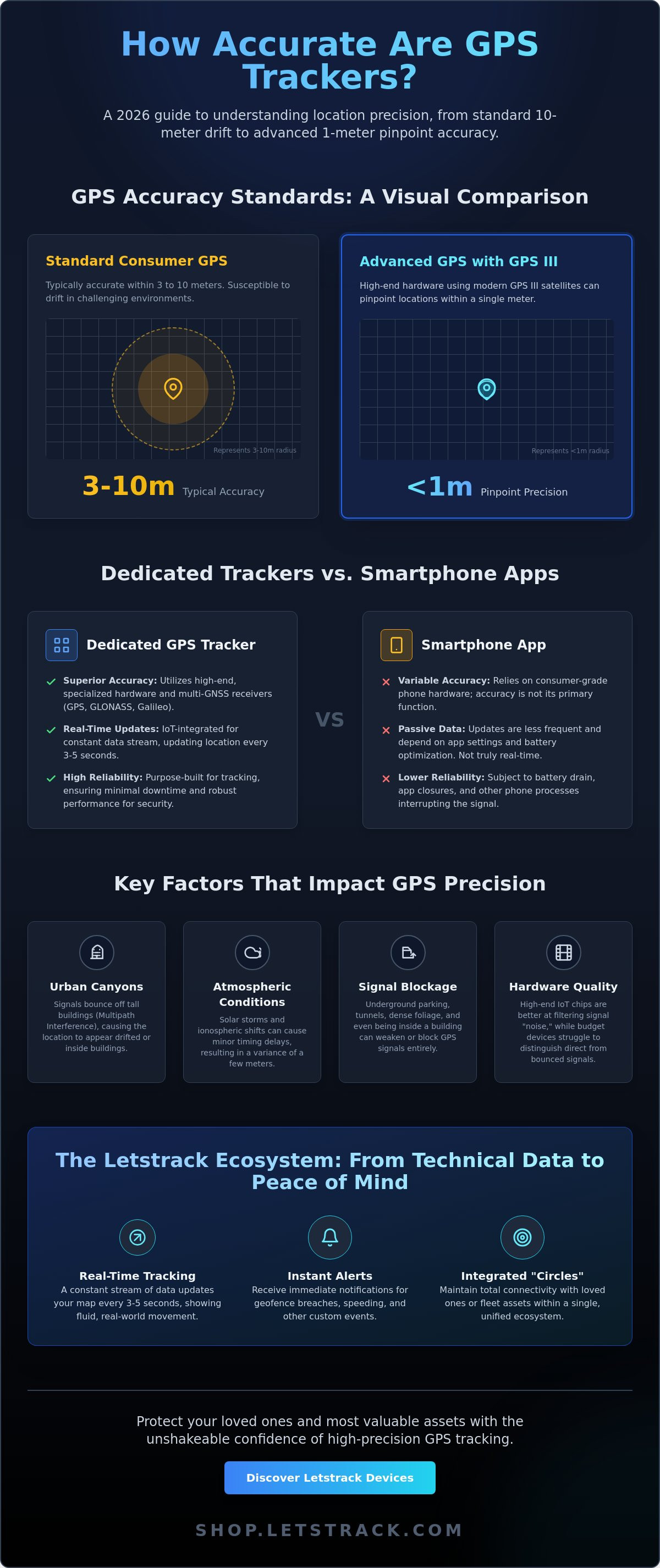
Discover the technical reality behind location precision and learn how to ensure your devices provide the reliable peace of mind you need. In this 2026 guide, we'll explain why the 3 to 10 metre accuracy standard exists and how high-end hardware can now pinpoint locations within a single metre. You'll learn to choose IoT-integrated tools that minimise drift and utilise the latest GPS III satellites for unshakeable reliability.
We'll also explore how real-time updates every 3 to 5 seconds transform a simple gadget into a vigilant digital guardian. By the end of this article, you'll know exactly how to maintain total connectivity with your loved ones and protect your most valuable assets with confidence.
Key Takeaways
- Understand the 3-10 metre accuracy standard and how advanced GPS III satellites now enable precision within a single metre.
- Discover how accurate are gps trackers compared to smartphone apps and why dedicated hardware is vital for real-time security.
- Learn to identify environmental "multipath interference" from tall buildings and how to position your tracker for the best possible signal.
- Master five simple methods to improve performance, including regular firmware updates and maintaining a clear view of the sky.
- Explore the Letstrack ecosystem to see how integrated "Circles" and real-time alerts transform technical data into daily peace of mind.
Understanding GPS Accuracy: What Should You Expect in 2026?
GPS accuracy is essentially the measure of how close a reported location is to your actual physical coordinates. For most people, this is the difference between finding a lost pet in the garden or searching the wrong street. Standard consumer GPS trackers are typically accurate to within 3 to 10 metres when used outdoors with a clear view of the sky. If you've ever wondered how accurate are gps trackers in high-stakes situations, it's this margin that determines your peace of mind. Technically, your device achieves this by ensuring the synchronisation of at least four satellite signals to pinpoint a precise 3D position on the Global Positioning System network.
To better understand the hardware behind these numbers, watch this helpful video:
There's a vital distinction between "location" and "tracking" that many users overlook. A location is a static point in time, like a pin on a map. Tracking is the continuous movement of that point over time. For a Digital Guardian to be effective, it must provide both accurate static pins and a fluid, reliable path of travel that reflects real-world movement without lag.
The Role of GNSS: Beyond Just GPS
Relying on a single satellite network is a risk you don't have to take. While most people use the term "GPS" as a catch-all, modern devices utilise Global Navigation Satellite Systems (GNSS). This includes the American GPS, the Russian GLONASS, and the European Galileo networks. When evaluating how accurate are gps trackers, the number of satellite constellations the device can access is the most critical factor. For UK users, multi-network support is a game-changer. It means your tracker can "see" more satellites at any given time. Through a process called trilateration, the device calculates the distance from multiple satellites simultaneously. This multi-constellation approach significantly reduces the chance of signal loss in tricky environments.
Real-Time Tracking vs. Passive Data
True security requires immediate awareness. Active IoT-integrated trackers, such as the Letstrack LT Personal, provide a level of connectivity that simple data loggers can't match. Passive loggers only record data for later retrieval, which is useless in an emergency. Real-time tracking ensures that your Letstrack Circles stay updated every few seconds. This constant stream of data creates a bridge between technical precision and human safety. It's the difference between knowing where your child was an hour ago and seeing exactly where they are right now. This instant awareness is the core of our mission to bring connection to every family.
Factors That Impact Your Tracker’s Precision: From Skyscrapers to Solar Storms
Even the most sophisticated technology faces challenges from the physical world. When users ask how accurate are gps trackers, the answer often depends on the surrounding architecture. In dense city centres like London or Manchester, "urban canyons" created by glass and steel skyscrapers cause signals to bounce rather than travel in a straight line. This phenomenon, known as multipath interference, can make a stationary vehicle appear to be drifting or even placed inside a solid building on your map.
Atmospheric conditions also play a subtle role in location precision. While standard cloud cover rarely stops a signal entirely, ionospheric shifts and solar activity can cause minor timing delays. These delays result in a few metres of variance. However, the most significant impact on precision isn't the weather; it's the quality of the hardware receiver used inside the device. High-end IoT-integrated chips are designed to filter out this "noise," whereas budget, consumer-grade tags often struggle to distinguish between a direct signal and a bounce.
Signal Blockage and Multipath Interference
Signals from satellites are relatively weak by the time they reach Earth. When these signals encounter glass, concrete, or thick tree cover, they can't always penetrate through clearly. This leads to three main issues for the user:
- Location Drift: Signals bouncing off buildings before reaching the receiver, creating a false position.
- Signal Dropouts: Temporary loss of connectivity when entering tunnels or underground parking garages.
- Slow Fixes: The time it takes to get an initial location, which Assisted GPS (A-GPS) helps solve by using local mobile towers to "guide" the tracker.
Receiver Quality and Refresh Rates
The difference between a budget tag and a dedicated Letstrack S7 comes down to the internal IoT chip. High-quality receivers are engineered to maintain a lock on multiple satellite constellations simultaneously, providing a more stable connection. Refresh rates are equally vital. A device that pings every 3 to 5 seconds provides a fluid, accurate path on your app. In contrast, low-power tags might only update when a third-party phone passes by, leaving you with frustrating gaps in your tracking history.
Our hardware is specifically designed to thrive in these challenging UK environments. If you want to ensure your assets are always visible, you can explore our range of high-precision 4G trackers designed for maximum reliability. By prioritising hardware with superior refresh rates and multi-network support, you gain the vigilant protection your family deserves.
Dedicated GPS Trackers vs. Smartphones: Which Provides Better Accuracy?
Many people rely on their mobile phones for navigation, but for the safety of a child or the recovery of a stolen vehicle, the question of how accurate are gps trackers compared to smartphones becomes critical. Smartphones are multi-purpose tools. To keep your phone running all day, the operating system uses "Hybrid Positioning." This method prioritises WiFi signals and mobile towers over actual satellites to conserve battery life. While this works for finding a nearby coffee shop, it often fails during high-speed tracking or in remote areas.
Dedicated devices like the Letstrack S5 operate differently. These trackers are built to maintain constant satellite locks regardless of other background tasks. They don't have to worry about running social media apps or managing a high-resolution screen. Their sole purpose is to act as a vigilant digital guardian, providing a precise and uninterrupted stream of data to your Letstrack app.
Battery Optimisation vs. Precision
The biggest hurdle for smartphone accuracy is power management. Most mobile phones turn off or "throttle" the GPS receiver the moment the screen goes dark. This results in jagged, inaccurate breadcrumb trails that might miss several turns on a map. Dedicated vehicle trackers, such as the Easy Plug Tracker, draw power directly from the vehicle's engine. This allows them to maintain a high-frequency refresh rate without any risk of shutdown. You get a smooth, real-time path of travel that reflects every street and corner perfectly.
Specialised Hardware Features
Professional GPS units contain high-gain antennas that are significantly larger and more sensitive than the tiny chips found inside a phone. This hardware is specifically tuned to pick up weak satellite signals even through car upholstery or bag linings. Beyond just hardware, the software integration matters. Our IoT-integrated ecosystem ensures that your data is encrypted and completely under your control. When you use a wearable like the LT Personal, you aren't just getting a location; you're getting a secure connection to a infrastructure designed for safety. This specialised focus is why dedicated trackers consistently answer the question of how accurate are gps trackers with higher confidence than any standard mobile app.
Maximising Performance: 5 Ways to Improve Your Tracker’s Accuracy
Achieving the highest level of precision requires more than just high-end hardware. While you now know how accurate are gps trackers in theory, their real-world performance depends heavily on how you set them up. To ensure your digital guardian remains vigilant, you must eliminate environmental obstacles and optimise your software settings. Following these five steps will help you transform a standard signal into a pinpoint reliable stream of data.
- Prioritise Line-of-Sight: Ensure the device has the clearest possible path to the sky.
- Update Firmware Regularly: Keep your satellite almanacs current to help the receiver find satellites faster.
- Select High-Frequency Pings: Use a subscription that supports updates every 3 to 5 seconds for fluid tracking.
- Enable Geofencing: Define safe zones to filter out minor "drift" and receive alerts only when it matters.
- Monitor Power Levels: Ensure your device has consistent power to maintain a strong cellular and GPS lock.
Strategic Placement for Vehicles and Assets
Placement is the most common reason for location drift. In modern UK vehicles, thick metal bodywork acts as a shield that weakens satellite signals. When installing a Shield 4G Tracker, avoid placing it directly under the engine block or inside a metal-lined glovebox. These "signal shadows" force the device to rely on weaker, bounced signals. Instead, position the tracker under a plastic dashboard or near a parcel shelf. For personal valuables, attaching a Touchtag Lite to the outer pocket of a bag rather than deep inside the lining ensures the antenna maintains a clear view of the horizon.
Software Settings and Practical Utility
Your app configuration is just as vital as the physical installation. Within the Letstrack app, you can toggle between "Real-Time" and "Battery Save" modes. For maximum precision, always choose real-time tracking, as this ensures the hardware pings the network at the highest possible frequency. A-GPS data is downloaded via the cellular network to reduce the time-to-first-fix, which helps the device find its initial position in seconds.
Beyond location data, our ecosystem offers practical tools that simplify your daily routine. For example, if you've misplaced your smartphone while packing for a trip, a simple double-press on your Letstrack Tag can ring your phone even if it is set to silent. This seamless interaction between hardware and software is what provides true peace of mind. If you are ready to upgrade your security, you can browse our full range of high-precision trackers to find the perfect fit for your needs. When you master these settings, the question of how accurate are gps trackers becomes a matter of choice rather than chance.
Why Letstrack’s Real-Time Ecosystem Delivers Unmatched Peace of Mind
When you ask how accurate are gps trackers, the answer involves more than just satellite signals. True precision depends on the speed at which that data reaches your phone. Many competitors ignore the role of cloud latency, which can make even a high-end device feel sluggish or inaccurate. Letstrack eliminates this gap by using a high-speed, IoT-integrated cloud platform. This ensures that the real-time data you see on your screen is a current reflection of the device's position, providing the instant awareness you need to act.
We believe tracking should be about connection, not just coordinates. Through "Letstrack Circles," we've created a private network that brings families and businesses together. You can monitor vehicle movements, check engine status, or receive AI-driven alerts for unauthorised movement across borders using our global discovery map. This level of integration transforms a simple tracker into a vigilant Digital Guardian that never sleeps and always watches over what you value most.
IoT Integration and Data Security
Privacy is a non-negotiable part of our ecosystem. Our platform uses end-to-end encryption to ensure your location history remains secure and user-controlled. Because we develop both the hardware and the software as a single, inseparable ecosystem, we provide a seamless experience that third-party apps can't match. You get instant SOS alerts and geofence notifications with zero delay. This immediate connectivity is what creates a true sense of safety for your loved ones, transforming complex technology into daily comfort.
Solutions for Every Vertical
Every mission requires a specific tool. We offer everything from pet tags to specialised Vehicle Health Trackers that monitor engine diagnostics and speed. These tools do more than just show a pin on a map; they provide a comprehensive view of your asset's safety. Whether you're ring-fencing a construction site or tracking a child’s walk home from school, our real-time location sharing provides a steady pulse of efficiency and reliability.
When deciding how accurate are gps trackers for your specific needs, remember that the app's response speed is just as vital as the hardware's chip. Don't settle for delayed data or confusing interfaces. Choose a system that values your time and your security. You can Protect what matters most with Letstrack’s innovative tracking solutions.
Take Command of Your Global Connectivity
Precision is no longer a luxury of the future; it's a standard you can access today. You've seen that while environmental factors like urban canyons play a role, the right hardware and strategic placement ensure you're never left in the dark. By choosing dedicated IoT devices over multi-purpose smartphones, you eliminate the power-saving trade-offs that often lead to frustrating signal gaps. This choice transforms a simple coordinate into a reliable lifeline.
Understanding how accurate are gps trackers empowers you to choose tools that prioritise constant satellite locks and fluid refresh rates. With real-time AI alerts and military-grade data encryption, Letstrack provides a secure bridge between complex technology and your family's safety. Our network offers global connectivity across more than 190 countries. This ensures your digital guardian is always awake, whether you're tracking a vehicle in London or a loved one travelling abroad.
Secure your peace of mind with a Letstrack GPS Tracker today. Don't leave your security to chance when you can have the steady, rhythmic pulse of real-time awareness at your fingertips. Stay connected to what matters most and move forward with the confidence that you're always in control.
Frequently Asked Questions
Is GPS 100% accurate?
No, GPS is not 100% accurate, but modern technology brings it remarkably close to perfection. Standard consumer devices typically provide a location within 3 to 10 metres of the actual coordinates. High-performance trackers can achieve a precision of within 1 metre. This small margin of error is usually sufficient for locating a vehicle or ensuring a child has arrived safely at school.
Does weather like rain or fog affect my GPS tracker?
Rain, fog, and snow rarely have a significant impact on your device’s ability to receive satellite signals. While extreme atmospheric conditions can cause minor signal attenuation, the radio waves used by the GPS network are designed to penetrate cloud cover. You'll find that physical obstructions like tunnels or heavy metal car parts are far more likely to cause interference than a typical UK rainstorm.
How accurate is a car tracker if it is hidden under the seat?
A tracker hidden under a car seat remains highly effective as long as it isn't completely encased in heavy metal. Signals can pass through foam, fabric, and plastic with ease. However, if the seat frame is solid steel, it may create a signal shadow. For the best results, ensure the device is positioned where it can "see" out through a window or plastic dashboard.
Why does my GPS tracker sometimes show me in a different street?
This phenomenon is usually caused by multipath interference, where the satellite signal bounces off a nearby building before reaching your device. When users ask how accurate are gps trackers in city centres, this "drift" is often the culprit. High-quality IoT-integrated hardware uses advanced algorithms to filter these reflected signals, ensuring the pin on your Letstrack map stays as close to your true location as possible.
Can a GPS tracker work indoors or in a car park?
GPS signals often struggle to penetrate thick concrete and steel, making indoor tracking less precise. In an underground car park, your device may lose its satellite lock entirely. To counter this, Letstrack devices utilise Assisted GPS (A-GPS), which uses nearby mobile towers to maintain a general location. This ensures you still have a point of reference even when the sky is completely obscured.
What is the difference between GPS and Bluetooth tracking tags?
The primary difference lies in range and independence. A gps tracker connects directly to satellites and mobile networks, providing global coverage and real-time updates every few seconds. Bluetooth tags, such as Find My compatible tags, rely on being within 10 to 30 metres of a smartphone to report their position. This makes GPS the superior choice for active vehicle security and family protection.
How often does a GPS tracker update its location?
The update frequency, or refresh rate, depends on your device settings and subscription plan. In 2026, the standard for real-time tracking is an update every 3 to 5 seconds. This fast-paced rhythm is essential for theft recovery, as it provides a fluid path of travel rather than a series of disconnected dots. Slower updates, such as every 2 minutes, are better suited for non-urgent asset monitoring.
Do I need a SIM card for my GPS tracker to be accurate?
A SIM card is essential for transmitting the location data from the tracker to your smartphone app. While the GPS receiver inside the device can calculate its position without a SIM, it has no way of telling you where it is without a cellular connection. Our IoT-integrated SIMs provide the unshakeable connectivity needed to deliver instant alerts and real-time location sharing across the UK and beyond.