

GPS Tracker for Autistic Child UK: The 2026 Parent’s Guide to Safety & Peace of Mind
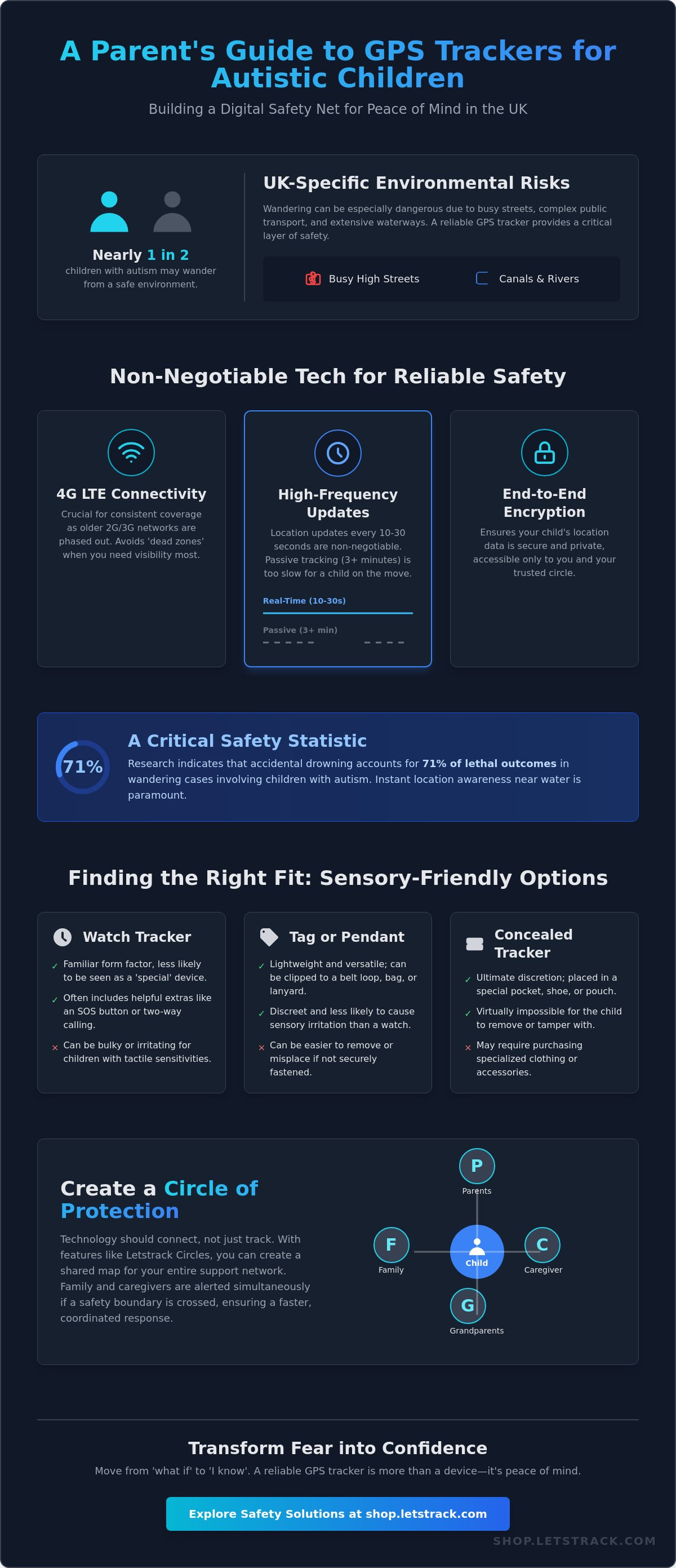
Nearly half of all children with autism will wander or bolt from a safe environment at some point. For a parent, that split second of disappearance feels like a lifetime. You're likely dealing with the constant fear of nearby traffic or water, while also worrying if a device will be too bulky or irritating for your child's sensory needs. It's a heavy burden to carry alone, but technology now offers a way to bridge that gap between independence and security.
Finding the right gps tracker for autistic child uk isn't just about buying a gadget. It's about building a digital safety net that empowers your family. This guide will show you how to select and implement a solution that offers instantaneous location awareness and psychological tranquility. We'll examine sensory-friendly wearables that your child will actually keep on, how to manage battery life in the UK's varied terrain, and the best ways to alert your entire support network the moment a boundary is crossed. You'll discover how to transform a complex technical tool into a source of daily comfort and confidence.
Key Takeaways
- Understand why 4G LTE connectivity and high-frequency location updates are non-negotiable for consistent safety across the UK.
- Compare the pros and cons of different form factors to find a gps tracker for autistic child uk that respects their unique sensory boundaries.
- Follow a practical desensitisation programme designed to help sensory-sensitive children accept and wear their new device daily.
- Utilise Letstrack Circles to create a shared map, ensuring your entire family stays connected and alerted simultaneously.
- Move beyond traditional supervision by implementing a technological 'second pair of eyes' that provides immediate awareness and peace of mind.
Understanding Wandering and the Role of GPS Tracking in the UK
Wandering, or elopement, is a frequent and stressful reality for many families. When Understanding Autism Spectrum Disorder, it becomes clear that bolting from a safe environment isn't a sign of defiance. Instead, it's often a direct response to sensory overstimulation or a focused curiosity about the world. Statistics show that nearly half of autistic children attempt to wander from a safe setting. This creates a constant, exhausting state of hyper-vigilance for parents. Traditional supervision is essential, but even the most attentive guardian can't be everywhere at once. A technological 'second pair of eyes' provides the backup you need to ensure your child remains within reach.
There's a vital distinction to make between surveillance and safety linkage. We aren't talking about invading a child's privacy. We are talking about maintaining a constant, invisible bond that protects them from harm. Our mission is to provide psychological tranquillity to UK families by replacing fear with data. By using a gps tracker for autistic child uk, you're not just watching your child; you're building a digital safety net that allows them to experience the world with more freedom and less risk.
To better understand the technology available to support your family, watch this helpful video review:
The Reality of Elopement for UK Families
The UK presents specific environmental risks that can be particularly dangerous for a child who wanders. Busy high streets, complex public transport networks, and our extensive system of canals and rivers pose immediate threats. Research indicates that accidental drowning accounts for 71% of lethal outcomes in wandering cases. When a child experiences a sensory 'bolt' reflex, they may move toward water or into traffic without a sense of danger. A reliable tracker, such as the SendSafe 4G Tracker, acts as a critical safeguard in these high-stakes moments. It gives children the space to grow while giving parents the confidence to let them.
Why Real-Time Awareness Changes Everything
Passive tracking is no longer enough. Older devices that only update every few minutes leave too much room for error. Real-time GPS spatial awareness provides instantaneous visibility, which is the rhythmic anchor of modern safety. Knowing exactly where your child is every 10 to 30 seconds transforms your mental state. You move from a place of 'what if' to a place of 'I know.' This immediate awareness is the primary value proposition for parental mental health. It ensures that if a boundary is crossed, you are alerted instantly, allowing for a rapid response that can prevent a crisis before it starts.
Essential Features for an Autism-Friendly GPS Tracker
Selecting a gps tracker for autistic child uk requires looking beyond basic location dots on a map. You need a device built for the specific demands of the UK's evolving digital infrastructure. As network providers sunset 2G and 3G bands, prioritising 4G LTE connectivity is essential. A 4G device ensures your link remains active across the varied terrain of the UK, from dense urban centres to rural parks. Without this modern standard, you risk 'dead zones' at the exact moment you need visibility most. Reliability is the foundation of psychological tranquillity.
Precision is the next pillar of safety. High-frequency updates, occurring every 10 to 30 seconds, are non-negotiable. A child in a 'bolt' state can move incredibly fast. Waiting three minutes for a location refresh is an eternity in a crisis. You deserve a system that tracks movement with fluid accuracy. This level of detail is a core component of the National Autism Association's wandering prevention resources, which highlight the importance of locative technology in a broader safety plan. Fast data transmission translates to faster recovery times.
Security must be as robust as the tracking itself. Always verify that your chosen device uses end-to-end data encryption. Your child's location is sensitive information that must remain under your exclusive control. Modern trackers, like the SendSafe 4G Tracker, treat privacy as a fundamental right. They ensure your data is never accessible to unauthorised parties. Vigilance applies to both the physical world and the digital one.
Geofencing and Safe Zones
Geofencing allows you to draw virtual perimeters around specific locations like home, school, or a favourite playground. If your child crosses these invisible lines, you receive an instantaneous notification on your smartphone. Advanced systems now include AI alerts. These smart algorithms learn your child’s typical movement patterns and can flag unusual activity before a boundary is even reached. This proactive approach moves you from reactive panic to informed guardianship.
Two-Way Audio and SOS Functionality
Communication is often a barrier for children on the spectrum. Look for "auto-answer" features that allow you to open a voice channel without the child needing to press a button. This lets you hear their environment and provide calming vocal reassurance immediately. Simultaneously, a single-press SOS button empowers the child. It gives them a direct, simple way to signal for help if they feel overwhelmed or lost. If you're ready to secure your child's safety with these advanced features, explore our range of high-precision trackers.
Choosing the Right Form Factor: Watches vs. Tags vs. Wearables
Selecting the physical design of your tracking hardware is just as critical as the software powering it. For many parents, the choice boils down to visibility versus comfort. A gps tracker for autistic child uk must be resilient enough to withstand daily life while remaining unobtrusive. You need 'hardened' hardware that survives drops, bumps, and the occasional splash during outdoor play. In 2026, battery technology has advanced significantly, but the form factor still dictates your charging routine. Watches typically require a daily top-up; discreet tags can often last several days depending on your update frequency.
Durability is a non-negotiable standard for active children. Look for devices with reinforced casings and high IP (Ingress Protection) ratings. These ratings ensure the internal electronics stay safe from dust and water. For older children or teenagers, a discreet profile is often preferred to avoid the stigma of 'being tracked.' A hidden device allows them to maintain their dignity while you maintain your peace of mind. Every child is different, so your choice should reflect their specific habits and sensory profile.
GPS Smartwatches for Kids
Smartwatches are a popular choice because they are difficult to misplace. They stay securely on the wrist and offer a familiar digital interface. The primary benefit is the inclusion of two-way calling, allowing you to speak with your child instantly. However, these devices can be bulky. For a child with sensory processing challenges, the constant pressure of a strap against the skin can lead to irritation or 'stripping' of the device. These are ideal for children who already enjoy wearing accessories and can benefit from the added communication features.
Discreet Tags and Wearables
If your child finds wrist-based items uncomfortable, discreet tags are the superior alternative. These devices can be sewn into jacket linings, clipped to belts, or placed inside shoe insoles. They offer a much lower profile and are less likely to be removed by the child. The Letstrack LT Personal is an excellent example of a versatile, compact tracker that fits into almost any pocket or bag. Tags often boast longer battery lives because they don't have power-hungry touchscreens. This makes them perfect for children with high sensory sensitivity who need a reliable gps tracker for autistic child uk that stays out of sight and out of mind.
Introducing a Tracker to a Sensory-Sensitive Child
Sensory processing issues are often the primary barrier when implementing a gps tracker for autistic child uk. Many children find the texture of silicone or the weight of hardware on their skin distressing. You aren't alone in this challenge. Overcoming it requires patience and a strategic approach that respects your child's boundaries. The goal is to move from a perceived intrusion to a comfortable, daily habit. By focusing on the tactile experience, you can help your child accept the safety link without the stress of sensory overload.
Start by modifying the device itself. Use comfort covers or soft fabric sleeves to change the tactile experience. A familiar, soft texture can make a high-tech tool feel like a natural part of their clothing. You can even use a piece of their favourite old T-shirt to wrap the device. Involving your child in the charging routine also builds familiarity. When they see the device 'sleeping' on its dock and 'waking up' for the day, it becomes a predictable, non-threatening object in their environment. This transparency builds trust and reduces anxiety around the new accessory.
The Gradual Introduction Method
Don't rush the process. Follow this three-step programme to build acceptance over several days or weeks:
- Step 1: Place the tracker in a common area where the child can see it. Don't require them to touch it. Let their natural curiosity lead the way.
- Step 2: Encourage short periods of wearing the device in a safe, low-stress environment. Start with just five minutes during a favourite activity like watching a preferred show.
- Step 3: Use positive reinforcement. Link the device to outdoor fun or trips to the park. This helps the child associate the tracker with freedom and excitement rather than restriction.
Discreet Placement Strategies
If wearing a device directly on the skin remains difficult, look for ways to hide the technology. Use specialised pouches sewn into waistbands or the interior of sensory-friendly vests. This removes the direct skin contact that often triggers a 'strip' response. You can also attach trackers to shoelaces or tuck them into a secret pocket in a favourite backpack. These methods maintain the connection without the child needing to physically interact with the hardware.
For those who need the most unobtrusive solution, the TouchTag Premium offers a slim profile that works perfectly for non-intrusive tracking. It fits into small spaces where larger devices might fail. By prioritising comfort, you ensure the safety link remains active all day long. If you're ready to find a solution that respects your child's sensory needs, explore our full range of discreet trackers.
Letstrack Solutions: Creating a Circle of Protection
Safety is never a solo mission. While the primary goal of a gps tracker for autistic child uk is to provide a location, the true value lies in the network of care you build around it. Letstrack Circles transform a single device into a shared map for your entire family. This concept ensures that no single parent carries the burden of vigilance alone. By linking multiple smartphones to one tracker, you empower grandparents, siblings, or trusted carers to see what you see. When a boundary is crossed, the alert isn't just a notification on one phone; it's a simultaneous call to action for your entire support network.
Our global discovery feature ensures that this protection doesn't stop at the UK border. Whether you're on a family holiday in Europe or visiting relatives further afield, your connection remains active. We understand that your child's data is sensitive. That's why every piece of location information is encrypted and remains under your exclusive control. You decide who enters your Circle and who sees the map. This balance of high-tech sophistication and emotional security is what creates a true sense of psychological tranquillity for families.
The Power of the Letstrack App
Real-time location sharing is the heartbeat of our software interface. You don't have to wait for a refresh or wonder if the signal is current. Updates are instantaneous, providing a fluid view of your child's movements. If you need to understand specific wandering patterns, our historical route playback feature allows you to review past journeys. This data can be vital for identifying triggers or common destinations your child bolts toward. For those seeking the highest level of dedicated personal safety, the SendSafe 4G Tracker integrates seamlessly with our app, offering a robust link between the digital and physical worlds.
Why UK Parents Trust Letstrack
We act as a vigilant digital protector, a watchful companion that's always active. UK parents choose us because we combine global ambition with a personal touch. Our technological sophistication is backed by UK-based support, ensuring you have expert help whenever you need it. We don't just sell hardware; we provide a source of daily comfort and confidence. Implementing a gps tracker for autistic child uk shouldn't be a complex technical chore. It should be a simple, empowering step toward a safer future. You deserve the peace of mind that comes from knowing you're always connected. Explore our range of personal safety trackers for peace of mind and start building your circle of protection today.
Build Your Digital Safety Net Today
You now have the roadmap to move from constant hyper-vigilance to a state of psychological tranquillity. By prioritising 4G LTE connectivity and choosing a sensory-friendly form factor, you ensure your safety link remains active across the UK landscape. Implementing a gps tracker for autistic child uk isn't just about hardware; it's about building a digital safety net that empowers your child to explore their world safely. You've learned how to desensitise your child to new devices and how to leverage shared maps to distribute the responsibility of care across your entire family circle.
Our award-winning Letstrack App ecosystem provides the real-time awareness you need to stay one step ahead. With end-to-end data encryption, your child's location remains under your exclusive, secure control. Don't wait for a moment of panic to wish you had a second pair of eyes. Take control of your family's security and gain the confidence that comes with constant linkage. Secure your child’s safety with a Letstrack Personal Tracker today. You're building a future where connection and safety go hand in hand.
Frequently Asked Questions
Is a GPS tracker legal for a child with autism in the UK?
Yes, it is legal for parents or legal guardians to use GPS trackers for their children in the UK. The UK General Data Protection Regulation (UK GDPR) and ICO guidance clarify that parental consent isn't required from the child when acting in their best interests for safeguarding. You're fulfilling your duty of care by ensuring their safety in a modern, digital environment.
Will a GPS tracker work in areas with poor mobile signal?
A high-quality device will still function, but performance depends on the network. Most modern trackers use 4G LTE to ensure the best possible coverage across the UK. While GPS satellites provide the location, a mobile signal is needed to transmit that data to your phone. If a signal is temporarily lost, the device will typically reconnect and update your app the moment it finds a network.
How long does the battery typically last on a personal GPS tracker?
Battery life varies based on the device design and how often it updates the location. A wrist-based gps tracker for autistic child uk usually lasts between 24 and 48 hours because of the screen. Smaller, discreet tags without screens often last between 3 to 7 days. You can extend this by adjusting the update frequency within your app settings to suit your daily routine.
Can I track my child’s school bus journey with these devices?
Yes, you can monitor the entire school bus journey using real-time location sharing. You'll see exactly when the bus leaves, its current speed, and when it arrives at the school gates. Historical route playback also allows you to review the journey later to ensure the transport provider is following the agreed route. This provides an extra layer of accountability and peace of mind.
Are there GPS trackers that do not require a monthly subscription?
Reliable real-time tracking almost always requires a monthly subscription to cover the cost of the mobile data used by the SIM card. While some Bluetooth tags have no fees, they don't offer the range or independence needed for a wandering child. A subscription ensures your device has a constant, dedicated link to the network, providing the instantaneous alerts that are vital for safety.
What happens if my child takes off the tracker?
If your child removes the device, advanced trackers can send an immediate 'removal alert' to your smartphone. To prevent this, many parents choose to sew the tracker into clothing or use tamper-proof wristbands. Using a discreet gps tracker for autistic child uk hidden inside a waistband or shoe insole often solves this issue for children with high sensory sensitivities who dislike wearing accessories.
Is the data from my child’s GPS tracker secure from hackers?
Your child's data is protected by end-to-end encryption and strict user access controls. This means only the people you explicitly invite into your Letstrack Circle can view the location. We treat data privacy as a fundamental safety feature. Your information is stored securely and is never sold to third parties, ensuring your digital safety net remains private and under your total command.
Can I set up alerts for multiple family members?
Yes, you can alert as many family members as you need through the Letstrack Circles feature. This app-to-app linkage ensures that everyone from parents to grandparents receives the same instantaneous notifications. If a child crosses a geofence, the entire support network is informed simultaneously. This shared awareness ensures a faster, more coordinated response during critical moments when every second counts.