

GPS Tracker for Dementia Patients UK: A 2026 Buying Guide for Peace of Mind
Discover how to choose the right GPS tracking solution to ensure the safety of loved ones with dementia while maintaining their independence.
What is a GPS Tracker for Dementia Patients and Why is it Essential?
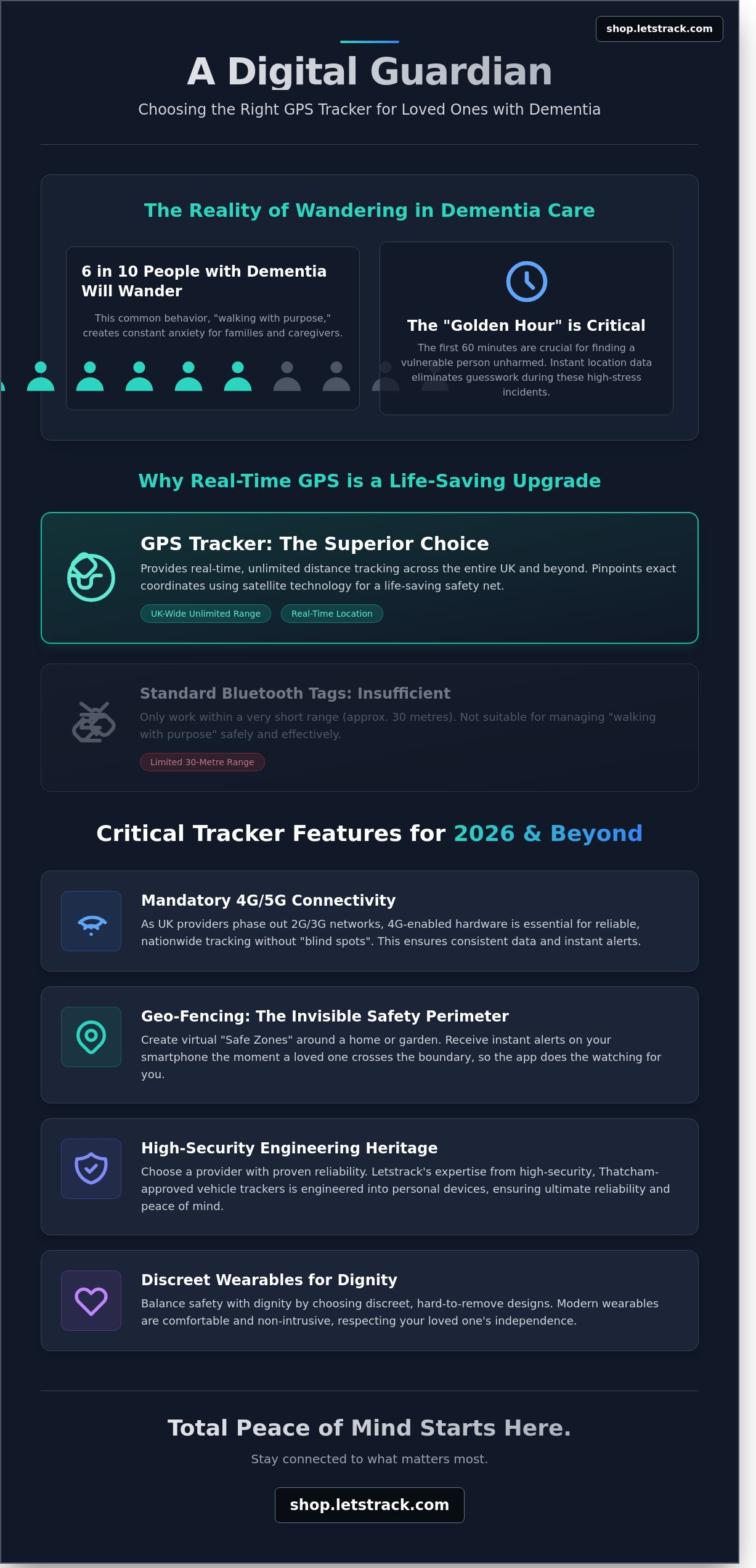
A GPS tracker for dementia patients is a small, portable device that uses global positioning technology to provide real-time location information. Far more advanced than simple Bluetooth finder tags, it is a life-saving tool designed to offer a safety net for individuals prone to "walking with purpose," a common behaviour often referred to as wandering. For caregivers, it's a vital instrument for reducing constant anxiety and burnout, while for the wearer, it can mean retaining a greater sense of freedom and independence.
When families in the UK seek the highest standard of security, their search often leads them to terms like Thatcham approved tracker. While this specific certification applies to vehicle anti-theft systems for insurance purposes, the principle behind it is exactly what’s needed for dementia care: unwavering reliability, professional-grade security, and instant, accurate location data. Think of a personal GPS tracker as a 'Thatcham-grade' safety net for your most precious loved one. As the UK's care landscape evolves towards 2026, this level of digital guardianship is becoming essential.
The Reality of Wandering in Dementia Care
Statistics from the Alzheimer's Society show that around 60% of people with dementia will wander at least once, with many doing so repeatedly. When a vulnerable person goes missing, the first few hours are critical. This "Golden Hour" concept, used by search and rescue teams, highlights the urgent need for immediate location information. A person with dementia may not be "lost" in the traditional sense but rather disoriented, unable to navigate their way back to a familiar environment. A tracker provides the instant data needed to resolve these situations safely and quickly.
How GPS Technology Provides a Safety Net
At its core, GPS technology uses trilateration—receiving signals from multiple satellites—to pinpoint a device's exact location on Earth. For families, this complex system is simplified into an easy-to-use mobile app that acts as a "Digital Guardian." This app transforms worry into reassurance, allowing caregivers to check on their loved one's location with a simple tap. It’s this constant, reliable connectivity that provides true peace of mind.
Critical Features to Look for in an Alzheimer’s GPS Tracker
Choosing the right device means focusing on the features that deliver genuine security. In 2026, the technical specifications are more important than ever to ensure a reliable connection when it matters most.
- 4G and 5G Connectivity: Older 2G and 3G networks are being phased out across the UK. A modern tracker with 4G/5G capability is non-negotiable for consistent, fast, and reliable location updates.
- SOS Emergency Buttons: A simple, one-press SOS button allows the wearer to instantly alert caregivers if they feel scared, lost, or need help, sending their location directly to the family's smartphones.
- Two-Way Audio: The ability to call the device and speak with your loved one can be invaluable. A familiar voice can de-escalate a confusing or frightening situation, providing comfort and reassurance until help arrives.
- Battery Longevity: A tracker is only useful if it’s switched on. Look for devices with long battery life and intelligent low-power modes to ensure it lasts for days on a single charge, preventing gaps in your safety net.
- Geo-fencing: This feature allows you to set up virtual "safe zones" on a map, such as the home, garden, or a local park. If your loved one crosses this invisible boundary, you receive an instant alert on your phone.
Connectivity and Network Reliability in 2026
As UK mobile networks complete the sunset of their 2G and 3G signals, any tracker relying on this older technology will become unreliable or stop working altogether. Modern 4G hardware is now the minimum standard for safety-critical devices. Letstrack ensures its devices offer robust connectivity, providing a precise location you can trust. The SendSafe 4G Tracker, for example, is built with high-spec 4G technology specifically for this purpose.
Geo-fencing: The Invisible Safety Perimeter
Setting up "Safe Zones" in the Letstrack app is simple and intuitive. You can draw a virtual perimeter around key locations and customise the alerts. For instance, you could set an alert for if your parent leaves the house after 10 p.m. but not during the day. When a boundary is crossed, the app immediately notifies everyone in your designated care circle, enabling a swift and calm response.
Comparing Tracker Types: Wearables vs. Discreet Tags
The best type of tracker depends on the individual's needs, habits, and the stage of their dementia. The primary choice is between a device that is worn on the person and one that can be discreetly placed in a pocket, bag, or coat.
- Wearable Trackers (e.g., Pendants, Watches):
- Pros: Always on the person, making the SOS button easily accessible. Less likely to be forgotten or left behind.
- Cons: Some individuals may resist wearing a new item or may try to remove it.
- Discreet Tags (e.g., Key Fobs, Pocket-Sized Units):
- Pros: Can be placed out of sight in a pocket, bag, or sewn into a coat lining. Often have a longer battery life due to their larger size.
- Cons: Can be misplaced or left behind if the person goes out without the specific item it's attached to.
For early-stage dementia, a wearable may be more easily accepted, while for later stages, a discreet tag that doesn't require the wearer's cooperation may be more effective.
Wearable Personal Trackers
For more active individuals, a wearable device like the LT Personal is an excellent choice. It’s designed for comfort and ensures the SOS button is always within reach. Modern wearables are made from skin-friendly materials and are designed to be unobtrusive, looking more like a simple pendant than a complex piece of technology.
Discreet and Asset-Style Trackers
A discreet unit like the Smart Guard Tracker offers flexibility. Its longer battery life makes it ideal for placing in a frequently used handbag or coat pocket. You can also use smaller finder tags for secondary items like keys or a wallet, creating a comprehensive network of trackable items for total peace of mind.
Implementation Guide: Privacy, Consent, and Setup
Introducing a GPS tracker requires sensitivity and careful planning. The goal is to frame it as a tool for support and safety, not surveillance, while respecting the individual's dignity and rights.
Navigating the ethical landscape is crucial. In the UK, decisions made for someone who can no longer make them for themselves are governed by the Mental Capacity Act 2005, which requires that any action taken is in the person's "best interests." It's often helpful to have a conversation with the person's GP or social worker when making this decision. To reduce friction, you can introduce the device as a "special safety watch" or a "help pendant" that makes it easier for family to stay in touch.
Organising Your Care Circle
Modern caregiving is a team effort. The Letstrack app allows you to create "Circles," adding multiple family members, friends, or carers to the monitoring group. You can set different alert levels, so a primary caregiver might receive every notification, while a neighbour might only be alerted in an emergency. The app also stores historical location data, which can help you understand a loved one’s typical walking patterns and identify any changes in behaviour. For more information, you can explore this guide on tracking people safely and legally in the UK.
Why Letstrack is the Trusted Choice for UK Families
As a London-based company, Letstrack has a deep understanding of the UK market and the specific needs of families here. We seamlessly integrate our advanced hardware with an intuitive, IoT-driven mobile app, transforming a simple GPS tool into a source of emotional security. Our mission is to provide peace of mind through technology, empowering families to protect their loved ones with confidence.
The Letstrack Advantage: Peace of Mind as a Service
We offer reliable, real-time location sharing across the entire UK, backed by robust 4G technology. Our devices, like the SendSafe 4G Tracker, are designed with dedicated safety features to support the transition to modern, digital-first caregiving.
Getting Started with Your Digital Guardian
Choosing the right device is the first step towards a safer future. Browse our full range of personal safety devices to find the perfect fit for your family's needs. Take control of your peace of mind today.
Explore our Personal GPS Trackers for complete peace of mind
Frequently Asked Questions (FAQs)
Is it legal to use a GPS tracker for someone with dementia in the UK? Yes, it is legal provided it is done in the "best interests" of the person who lacks the mental capacity to consent, as outlined in the Mental Capacity Act 2005. It's recommended to consult with family and healthcare professionals.
Is a dementia tracker the same as a Thatcham approved tracker? No. A Thatcham approved tracker is a certification for vehicle security systems that meet specific standards for theft prevention, often required by insurance companies. A personal GPS tracker for dementia care is not Thatcham certified but should be chosen based on the same principles of high reliability, security, and accuracy.
How long does the battery typically last on a personal GPS tracker? Battery life varies by device and usage, but most modern trackers last from 2 to 10 days on a single charge. Devices with low-power modes can extend this significantly.
Do these trackers work indoors or only when the person is outside? GPS signals are strongest outdoors. However, many modern trackers also use Wi-Fi and LBS (Location-Based Services) to provide an approximate location when indoors, though it may be less precise than an outdoor GPS fix.
How do I stop my loved one from taking the tracker off? For wearable devices, look for options with secure clasps. Alternatively, a discreet tracker that can be placed in a pocket, sewn into clothing, or attached to a keyring may be a better solution if removal is a concern.
Can multiple family members track the same person at once? Yes. With the Letstrack app, you can create a "Circle" of trusted family members and caregivers, and everyone in the circle can view the person's location in real-time from their own smartphone.
What is the difference between a Bluetooth tag and a real-time GPS tracker? A Bluetooth tag (like an AirTag) has a very short range (around 30-100 feet) and relies on a network of other people's phones to find its location. A real-time GPS tracker has its own SIM card and uses satellites to report its exact location anywhere in the world with mobile coverage, making it far more reliable for personal safety.
Are there monthly subscription fees for Letstrack devices? Yes, a subscription is required to cover the cost of the built-in SIM card's data usage, which enables the device to send its real-time location to the Letstrack app on your phone.