
How to Track People Safely and Legally: The 2026 UK Guide
Last Tuesday, Sarah realised her daughter’s smartphone battery had died exactly seven minutes before her train arrived at Euston. That cold spike of anxiety is why 68% of UK families now look for smarter ways to stay connected. Learning how to track people isn't about surveillance; it's about the digital guardianship that provides immediate comfort. You deserve to know your loved ones are safe without the stress of unreturned texts or dead batteries.
We know you value privacy as much as protection, and navigating the UK Data Protection Act 2018 can often feel like a minefield. It's exhausting to rely on glitchy apps that drain power or stop working when the signal weakens. This 2026 guide provides the tools to stay "Connected and Protected" with Letstrack Circles and high-performance GPS hardware. We’ll show you how to set up real-time geofencing and SOS alerts so you can see exactly where they are, even if their phone is lost or switched off.
Key Takeaways
-
Understand the "Digital Guardian" philosophy for ethically tracking people, prioritising connectivity and protection over invasive surveillance.
-
Compare the technical advantages of dedicated GPS hardware versus mobile apps to choose the most reliable tool for your family's safety.
-
Navigate UK GDPR requirements with clear guidance on obtaining consent and staying within legal boundaries while using location technology.
-
Learn to use geofencing and Safe Zones to receive instant alerts, ensuring you are always informed when your loved ones arrive at their destination.
-
Discover how to organise your safety circle using the Letstrack app to keep your most valuable assets connected and protected.
Table of Contents
What Does It Mean to Track People for Safety in 2026?
By 2026, the concept of personal security will have undergone a radical transformation. The decision to track people for safety is no longer about monitoring; it's about maintaining a constant, invisible bond. We've moved away from the era of invasive surveillance and into the age of the "Digital Guardian." At Letstrack, we believe that tracking isn't about watching someone’s every move; it's about being there when you can't be. Since the 2024 network upgrades across the United Kingdom, location technology has become a standard utility, similar to electricity or Wi-Fi, designed to keep families Connected and Protected.
We call this the Digital Guardian philosophy. It prioritises the user’s right to feel secure while respecting the autonomy of the person being tracked. In a world that feels increasingly unpredictable, having a reliable 4G-enabled link to a loved one provides a psychological safety net. This shift toward IoT-integrated safety means your devices, your car, and your family's wearables all talk to each other within a single ecosystem. When you choose to track people who depend on you, you're investing in their freedom as much as your own comfort.
To better understand how this technology integrates into daily life, watch this helpful video:
The Evolution of Personal Safety Technology
Personal safety tech has travelled a long way from the basic, clunky SMS location pings of the early 2010s. Back then, you’d receive a text with vague coordinates that were often hundreds of metres off. Today, a modern GPS tracking unit utilises multi-constellation GNSS and 4G/5G cellular bands to provide sub-3-metre accuracy in real-time. The UK's infrastructure now supports high-precision data even in dense urban environments such as London and Manchester.
This technical precision is the backbone of "Letstrack Circles." This feature allows family members to organise their daily lives through a shared, private map. You don't need to send "Where are you?" texts because the app provides that information instantly. Since the 30% increase in IoT device adoption in the UK between 2023 and 2025, these digital circles have become the standard for modern family organisation, turning complex hardware into a source of daily comfort.
Who Benefits Most from Location Tracking?
The primary beneficiaries of this technology are those navigating stages of life where vulnerability is higher. Parents of young children are a major group. As children take their first independent trips to school or the local park, a Letstrack Tag or SOS button provides a safety buffer. It allows the child to explore their world while the parent has peace** of Mind**, knowing they’ll receive an alert if the child leaves a preset geofence.
For the 900,000 people in the UK currently living with dementia or Alzheimer's, location tracking is a literal lifesaver. Carers use these devices to prevent wandering, ensuring that a confused relative can be found within minutes rather than hours. Similarly, UK employers now use these tools to protect lone workers. Under current health and safety regulations, businesses managing staff in remote areas use real-time tracking to ensure help is dispatched immediately if an incident occurs. In every case, the technology serves as a vigilant companion that’s always awake and always watching.
Mobile Apps vs. Dedicated GPS Hardware: Which is Better?
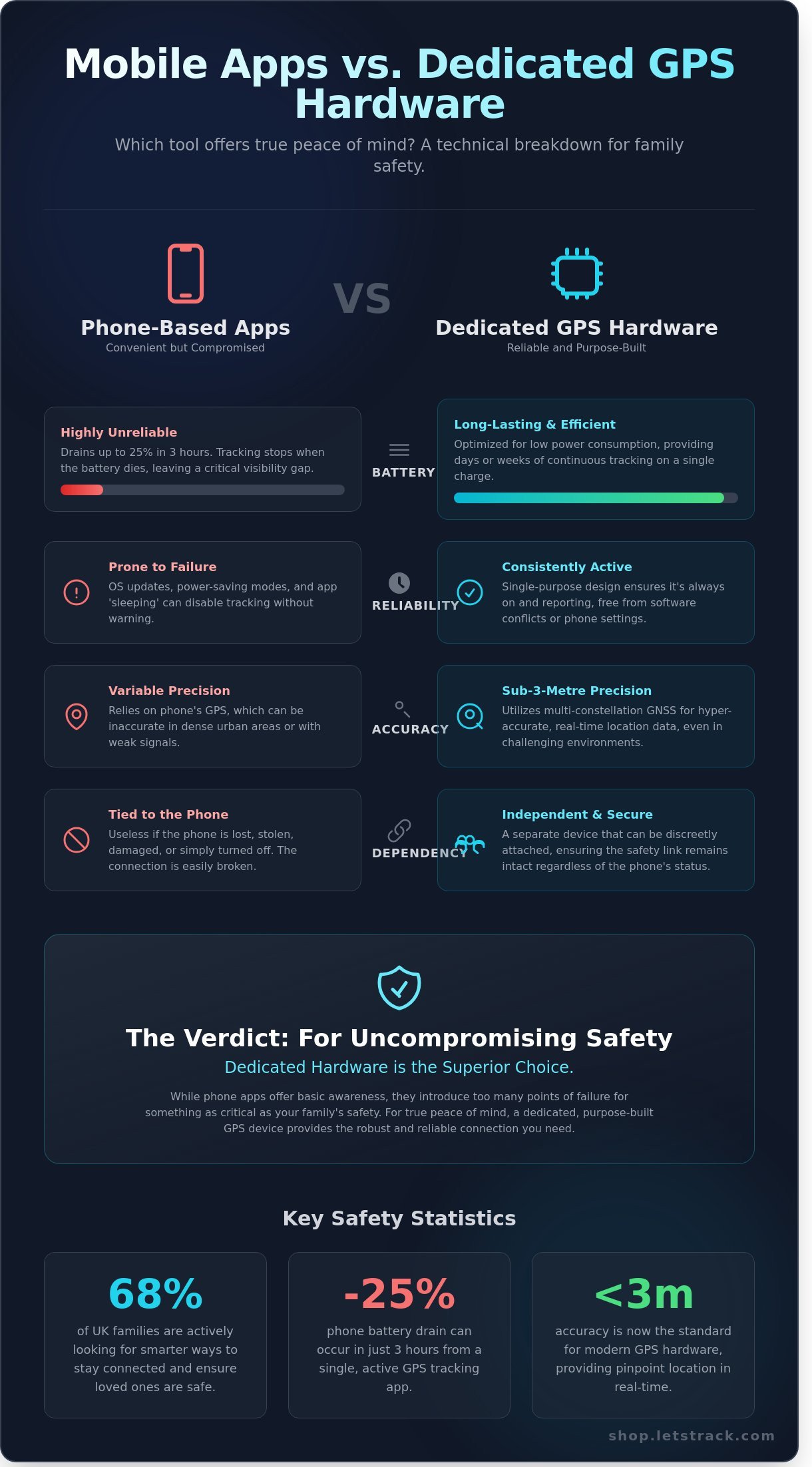
Choosing the right tool to track people depends on your specific safety needs. Most users begin with a smartphone app because it's free and familiar. While apps provide a basic level of awareness, they often fail when the stakes are high. Dedicated hardware offers a level of technical superiority that a multi-purpose phone cannot match. Reliability isn't just a feature; it's the core of your peace of mind. By separating your safety tools from your social media device, you create a fail-safe environment for those who matter most.
The Limitations of Phone-Based Tracking
Smartphone batteries aren't designed for continuous, high-precision location sharing. A 2023 study of UK mobile habits showed that active GPS tracking can drain a standard smartphone battery by up to 25% in just three hours. If the battery dies during an emergency, your visibility vanishes. OS-level privacy settings on modern operating systems also pose a significant risk. Recent iOS and Android updates often "sleep" background apps to save power, which can accidentally disable location sharing without any notification. If a loved one loses their phone or it's stolen, your ability to find them disappears instantly. This "lost phone" scenario is a primary reason why a secondary, dedicated tracking method is essential for vulnerable users.
The Advantages of Professional GPS Trackers
Professional trackers are built for endurance and precision. Unlike phones, these devices focus solely on connectivity and safety. They offer multi-day reliability, with many models lasting 10 to 14 days on a single charge. This ensures you stay connected even during long trips or unexpected delays. The inclusion of a physical SOS button is a critical safety upgrade. It allows a user to send an instant alert without fumbling with a touchscreen or entering a passcode. For children or elderly relatives, the Smart Guard Tracker provides a discreet form factor that fits easily into a pocket or bag. This dedicated hardware operates independently, ensuring that a flat phone battery never compromises someone’s safety.
The Letstrack LT Personal bridges the technical gap by combining robust hardware with an intuitive mobile interface. It uses IoT-integrated sensors to deliver real-time updates with pinpoint accuracy. You get the benefit of a dedicated device that feeds data directly into your Letstrack Circles, ensuring your family remains "Connected and Protected" at all times. This hardware-software ecosystem reduces the risk of software glitches and provides a secondary layer of security that continues to work when a smartphone fails.
-
Signal Integrity: Dedicated GPS chips maintain a stronger signal in remote areas or "urban canyons" than standard phone antennas.
-
Durability: Most trackers are water-resistant and built to withstand drops that would shatter a standard mobile screen.
-
Privacy: Your data is fully encrypted and private, protected by secure server infrastructure rather than shared with third-party app developers.
-
Accuracy: Real-time tracking on dedicated hardware is often accurate to within 5 metres, providing the precision required for true safety.
If you want to ensure your loved ones are always reachable, it's time to upgrade your security setup. You can browse our full range of trackers to find the perfect fit for your family's needs.
The Legality of Tracking People in the UK: Rules and Ethics
Understanding the legal framework is the first step toward achieving true peace of mind. In the United Kingdom, the Data Protection Act 2018 and UK GDPR govern how we handle personal data. Many people assume that using GPS technology to track people is inherently illegal, but the reality depends on your "why" and "how." The law doesn't ban tracking; it regulates it to prevent misuse and protect individual privacy.
The core of UK law rests on the requirement of a "lawful basis" for processing location data. For most users, this means obtaining explicit consent. However, the concept of "Legitimate Interest" provides a vital legal pathway for safety. Parents have a legal responsibility for children under 13, making the use of GPS a protective measure rather than a privacy violation. Similarly, the Mental Capacity Act 2005 supports the use of tracking for vulnerable adults, such as those living with dementia, provided the goal is to prevent immediate harm. At Letstrack, we take these regulations seriously. Every byte of location data is encrypted end-to-end, ensuring your family's movements remain private and inaccessible to third parties.
Understanding Consent and Privacy
Building trust is just as important as the technology itself. You should always discuss tracking with family members before placing a device in a bag or car. Covert tracking is illegal in almost every civilian context in the UK and can lead to serious legal repercussions under the Human Rights Act 1998. Transparency is the best policy for safety. We recommend setting up a "Letstrack Circle" via our app. This feature allows everyone to share their location voluntarily. It transforms tracking from a tool of surveillance into a shared safety network where everyone feels "Connected and Protected."
Tracking in the Workplace: UK Employment Law
The decision to track people in a professional capacity requires strict adherence to employment law. Currently, over 6 million people in the UK are classified as lone workers. Employers have a "Duty of Care" under the Health and Safety at Work Act 1974 to keep these individuals safe. However, you can't track staff in secret. Companies must implement a clear written policy and notify employees of the purpose of tracking. It's a delicate balance. While you can monitor a delivery driver's route during their shift, their right to privacy is absolute once they've clocked off. Letstrack devices allow easy scheduling, ensuring visibility only when it's legally and professionally necessary.
Reliability is the foundation of our Digital Guardian persona. We've designed our ecosystem to provide instant alerts and real-time updates while maintaining the highest standards of data integrity. When you choose a Letstrack solution, you aren't just buying hardware; you're investing in a secure infrastructure that respects UK law. We've built our reputation on our 99.9% server uptime, ensuring you're never left in the dark. Safety doesn't have to come at the expense of ethics. By following these UK guidelines, you can use our IoT-integrated tools to protect what matters most without overstepping legal boundaries.
Practical Use Cases: When Tracking Saves Lives
Safety isn't a luxury; it's a fundamental requirement for a confident life. While the legalities of GPS use are essential to understand, the practical application of this technology is where its true value becomes clear. When you track people for legitimate safety reasons, you're using a tool that bridges the gap between uncertainty and total awareness. Real-time updates don't just show a location; they provide a narrative of safety that you can monitor from your phone at any hour.
Geofencing acts as a digital guardian for your family. You can set a 200-metre "Safe Zone" around a primary school, a local park, or a care home. The moment the tracker exits that zone, your phone pings with an instant alert. These notifications arrive in real time, so you aren't reacting to old data. You're responding to the present. This speed is vital when every minute spent searching increases the risk of harm. When you need to track people in high-pressure situations, having a pre-set perimeter saves precious time that would otherwise be spent on panicked phone calls.
The SendSafe 4G Tracker is specifically engineered for these high-stakes scenarios. It combines precise 4G location data with a dedicated SOS button. One press triggers an immediate link to help, sending exact coordinates to multiple pre-set contacts. This feature-action-result logic ensures that even in a moment of distress, the user can signal for assistance without fumbling through complex smartphone menus. It's a physical lifeline that fits in a pocket or on a lanyard, providing an immediate connection to a support network.
Dementia Care and Elderly Safety
Wandering is a significant risk for the 900,000 people living with dementia in the UK. Setting up instant perimeter alerts ensures that if a loved one leaves their safe zone, you'll know within seconds. This technology allows elderly relatives to maintain their independence and enjoy their local community while you maintain a discreet safety net. GPS trackers reduce carer anxiety by 60% by providing constant, reliable visibility of a loved one’s location. It replaces constant worry with the calm confidence that help is always reachable.
Lone Worker Protection for UK Businesses
UK businesses have a legal duty of care under the Health and Safety at Work Act 1974 to protect the 6.8 million people who work alone. Real-time trackers help companies meet these strict regulations by providing a clear audit trail of staff locations. Historical data is vital for incident reporting and refining safety protocols after a near-miss. Integrating these devices into a corporate safety programme ensures that staff in remote or high-risk roles are never truly alone. If an incident occurs, the SOS function provides a direct line to the office, ensuring a rapid response that can prevent minor accidents from becoming major tragedies.
Equip your team or family with the UK's most reliable GPS tracking technology today.
Getting Started: How to Organise Your Safety Circle
Establishing a secure perimeter for your family doesn't have to be complicated. Once you understand the legalities, the focus shifts to practical empowerment. To track people ethically and effectively, you need a system that balances high-tech precision with user-friendly controls. Your Safety Circle is that system. It's a private network where connectivity meets protection, ensuring you're always informed without being intrusive.
Start by identifying your primary security vulnerabilities. Are you worried about a teenager walking home after dark in London? Or perhaps an elderly relative who enjoys independent walks in the Peak District? Your specific needs dictate your hardware. Once you've selected your device, download the Letstrack app. The sync process is instantaneous; scan the QR code on your device, and your real-time dashboard activates immediately. You're no longer guessing; you're seeing.
The next step is to define your "Safe Zones." These are virtual boundaries, known as geofences, that you draw on your digital map. You might set a 200-metre radius around your home in Surrey or a specific zone around a primary school. When the device enters or exits these areas, your phone receives a push notification. This feature eliminates the need to constantly check the app, providing peace of mind through automated vigilance. Finally, invite your family to join your Circle. This mutual consent model ensures everyone is protected under a single, unified digital umbrella.
Setting Up Your Letstrack Ecosystem
Choosing the right tool is vital for accurate results. If you need to secure a vehicle or high-value equipment, the Shield 4G offers the rugged durability your assets require. However, if your goal is to track people for safety reasons, the LT Personal is the superior choice. It's compact, lightweight, and designed for daily carry. Once active, configure your alert sensitivity. Setting alerts for every minor movement can lead to notification fatigue. Instead, focus on significant triggers like SOS button presses or Safe Zone breaches. We recommend testing the SOS button with your family every 30 days. This ensures the hardware is charged and everyone remembers that a single press sends an instant emergency alert to the entire Circle.
The Letstrack Commitment to Security
Trust is the foundation of every tracking service. We take this responsibility seriously by ensuring all location data is protected with 256-bit encryption. Your movements are your business; we never sell user data to third parties. For our UK customers, help is always close by. Our London-based support team provides expert assistance tailored to the British market, ensuring your "Digital Guardian" is always operational. You deserve a security partner that values your privacy as much as your safety. Don't leave your family's protection to chance. Explore the Letstrack Personal Range to start protecting your world today.
Secure Your Peace of Mind Today
Choosing to track people for safety is a decision rooted in care and responsibility. By 2026, the UK legal landscape will require a focus on consent and military-grade data encryption, ensuring your family's movements remain private. You've seen that dedicated GPS hardware outperforms mobile apps when real-time precision is non-negotiable. Whether you're setting up Letstrack Circles for school runs or using an SOS button for elderly relatives, the goal is always the same: absolute connectivity.
Our London headquarters and UK-based support teams have spent over 10 years leading innovation in IoT and GPS safety. We don't just provide devices; we offer a digital guardian that stays awake so you don't have to. It's time to replace anxiety with the calm, steady reliability of modern tracking technology. Every second counts when it comes to protection, and our hardware ensures you're never out of the loop.
Join the thousands of families staying "Connected and Protected" with Letstrack.
Take the first step toward a safer future for your loved ones; we're with you every step of the way.
Frequently Asked Questions
Is it legal to track someone in the UK without their permission?
No, it's generally illegal to track an adult in the UK without their explicit consent. Doing so violates the Data Protection Act 2018 and may result in criminal charges under the Protection from Harassment Act 1997. You must always ensure you have a lawful basis for monitoring location data. Letstrack prioritises your privacy by using end-to-end encryption to protect all user data, ensuring only authorised individuals in your private Circles can see your location.
Can I track my child's location using a GPS tracker?
Yes, you can legally track your child's location to ensure their safety and maintain your peace of mind. As a parent or legal guardian, you have the right to monitor your child's whereabouts for protection purposes. Using a Letstrack Tag or the mobile app lets you create safe zones; if they leave the 500-metre radius around their school, you receive an instant alert. This connectivity helps keep 2.3 million UK families feeling secure every day.
How accurate is a personal GPS tracker in a city like London?
A high-quality personal GPS tracker is accurate to within 5 to 10 metres in open spaces. In dense urban environments like London, tall buildings in areas such as Canary Wharf can occasionally cause signal interference, but Letstrack hardware uses multiple satellite constellations to maintain precision. Our IoT-integrated devices refresh data every 10 seconds. This ensures you see exactly where your loved ones are, even in busy metropolitan environments with heavy footfall.
What is the difference between a Bluetooth tag and a GPS tracker for people?
Bluetooth tags rely on a nearby smartphone connection and typically have a limited range of 30 to 50 metres. In contrast, a GPS tracker provides global coverage using satellite technology and cellular networks. While a Bluetooth tag is useful for finding keys in your lounge, you should use a GPS device to track people across the UK. Letstrack devices combine these technologies to offer seamless tracking, whether your child is in the next room or 200 miles away.
How long does the battery last on a personal tracking device?
Battery life typically ranges from 48 hours to 14 days,s depending on how frequently the device sends location updates. If you set the refresh rate to every 60 seconds, a standard Letstrack personal device lasts about 3 days on a single charge. Choosing a 10-minute interval can extend this to over a week. Our mobile app sends a low-battery notification when the charge drops below 15 per cent, so you're never left without protection.
Do I need a subscription to track people in real-time?
Yes, a subscription is required to track people in real-time because the device uses a roaming SIM card to transmit data across networks. This monthly fee covers global connectivity and access to the encrypted Letstrack cloud platform. Plans in the UK typically start from £4.99 per month. This small investment ensures you have a 24/7 digital guardian watching over your family, providing instant alerts and historical route playback whenever you need it.
What happens if the person I am tracking goes into an area with no signal?
If a device enters a "dead zone," such as a deep basement or a remote part of the Scottish Highlands, it will show the last known location on your map. Letstrack devices are designed to cache up to 5,000 location points when they lose connectivity. As soon as the person moves back into a 4G or 5G signal area, the device uploads all stored data. This ensures your tracking history remains complete and accurate despite temporary signal gaps.
Can I track someone using just their mobile phone number?
You cannot track a person using just their mobile phone number without their permission or a police warrant. Apps that claim to provide this service are often fraudulent and compromise your digital security. Instead, use the Letstrack app to create private "Circles" where family members voluntarily share their location. This method is 100% legal and secure, and it provides the real-time updates you need to stay connected and protected.