


Fleet Lifecycle Management UK: Maximising ROI in 2026
With the average age of UK cars hitting a record 9.7 years, nearly half of the vehicles on our roads are now over a decade old. This aging fleet is a ticking time bomb for your bottom line, leading to unpredictable repair bills and costly service downtime. Effective fleet lifecycle management uk has shifted from a "best guess" to a vital survival strategy. You need to know the exact moment an asset costs more to maintain than it does to replace, especially as ULEZ zones expand and ZEV mandates demand that 33% of new car sales be zero-emission this year.
It's frustrating to watch your profit margins vanish into a cloud of exhaust and emergency garage visits. We understand the pressure of staying ahead of the 2035 petrol ban while managing a 4% BiK rate for EVs. This guide will show you how to master data-driven vehicle replacement to slash operational costs and ensure total compliance. We will look at building predictable acquisition budgets, boosting uptime, and creating a clear roadmap for a high-tech, zero-emission future.
Key Takeaways
- Identify the critical "sweet spot" where maintenance costs begin to outpace lease payments to protect your profit margins.
- Navigate the 2026 ZEV mandate and ULEZ expansions through a proactive fleet lifecycle management uk strategy.
- Use real-time engine diagnostics and GPS trackers to identify recurring faults before they lead to catastrophic vehicle failure.
- Implement a robust five-step replacement programme that audits current assets and sets clear exit criteria for every vehicle class.
- Transform your fleet into a transparent, data-driven ecosystem that ensures predictable budgets and maximum vehicle uptime.
The UK Fleet Lifecycle Management Landscape in 2026
Effective fleet lifecycle management uk is the systematic process of retiring vehicles at the precise moment that balances cost and performance. It isn't just about scheduling MOTs. It involves a fleet management overview that tracks every mile and every penny spent. In 2026, your operations face a "Triple Pressure" of high inflation, structural fuel volatility, and strict environmental mandates.
To better understand this concept, watch this helpful video:
Impact of UK Environmental Regulations
Local regulations now define your operational boundaries. ULEZ and Clean Air Zones (CAZ) across the UK make older diesel assets expensive to run. The 2035 petrol and diesel ban is a fixed point on the horizon that requires immediate planning. Smart operators are already shifting. They use tax incentives like the 4% Benefit-in-Kind (BiK) rate for electric vehicles to offset costs. Compare this to the 32% to 39% BiK rates for petrol cars and the choice becomes clear. Future-proofing your fleet means moving toward zero-emission targets now.
Total Cost of Ownership (TCO) vs. Purchase Price
Don't let a low purchase price blind you to long-term costs. The sticker price is often the least significant number in a vehicle's life. Effective fleet lifecycle management uk demands a focus on the "hidden" expenses that erode your ROI. These include depreciation, fuel, insurance, and the high cost of downtime. Fuel currently accounts for 75% of variable fleet expenses. Total Cost of Ownership is the comprehensive financial footprint of a vehicle from acquisition to disposal. Using tools like a vehicle health tracker provides the instantaneous visibility you need to manage these costs. It transforms a complex financial burden into a source of confidence.
Quantitative vs. Qualitative Factors: Finding the Sweet Spot
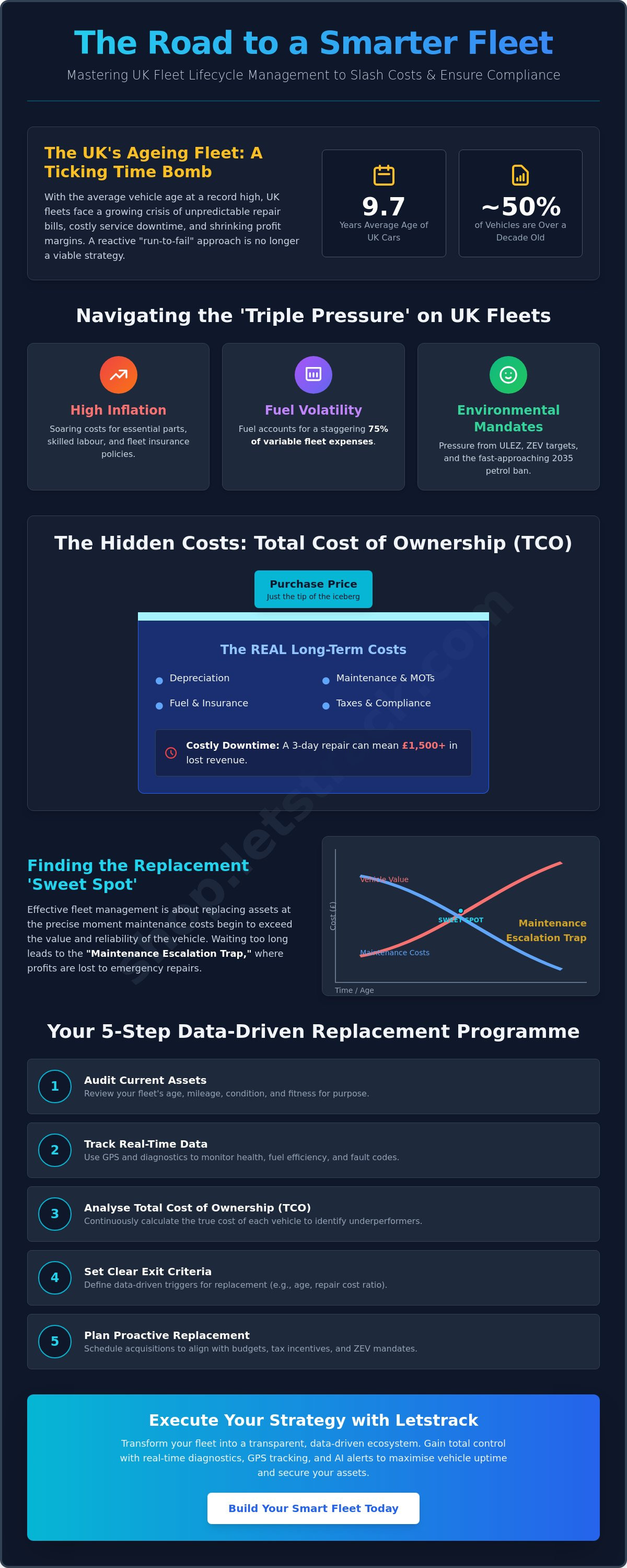
Every vehicle follows a predictable financial arc. In the UK, the depreciation curve is steepest during the first 36 months of a vehicle's life. While it's tempting to hold onto assets once the finance is cleared, this often leads to the maintenance escalation trap. This is the point where unpredictable repair bills and MOT failures begin to outpace the cost of a new lease. Finding the "sweet spot" in fleet lifecycle management uk requires balancing these hard numbers against the rising risk of catastrophic mechanical failure. You need to know when an asset stops being a tool and starts being a liability.
Don't ignore the invisible cost of downtime. When a vehicle is off the road, it's a drain on your resources, not a source of revenue. If a van generates £500 per day in income, a three-day repair doesn't just cost you the garage bill; it's a £1,500 hit to your top line. Newer vehicles act as a shield against these disruptions. They come equipped with advanced safety features that actively lower your insurance premiums and protect your drivers. By adhering to official UK government guidance, you ensure your fleet remains a safe, compliant, and efficient tool for your business.
The Quantitative Metrics That Matter
Fuel efficiency isn't static. Older engines naturally degrade, and in a market where fuel represents 75% of variable expenses, even a 10% drop in MPG is a significant blow to your ROI. You should also monitor the secondary market to optimise residual values. Selling an asset at the right time provides the capital needed for your next upgrade. Monitor your maintenance-to-value ratio closely. If a vehicle's annual repair costs approach 50% of its current market value, your data is telling you to replace it immediately to protect your profit margins.
Qualitative Factors: Brand Image and Driver Retention
Your vehicles are a rolling billboard for your UK business. A clean, modern fleet projects authority and reliability to every customer you visit. Conversely, an aging, unreliable fleet damages your reputation and frustrates your workforce. Driver retention is a critical challenge in 2026. Providing your team with safe, modern vehicles equipped with the latest tech shows you value their safety and comfort. It's a powerful tool for recruitment and long-term loyalty. This reduces the mental load on your fleet managers. They can focus on growth strategy rather than juggling emergency rentals and angry customer calls. To stay ahead of these shifts, consider how a shield 4G GPS tracker can provide the real-time awareness you need to manage these assets with total confidence.
How GPS Telematics Drives Replacement Precision
GPS telematics transforms fleet lifecycle management uk from a guessing game into a precision science. Manual logs often fail to capture the nuances of vehicle wear. By using an automated "Truth Engine," you gain an unblinking view of every asset's performance. Real-time engine diagnostics allow you to spot recurring faults before they lead to a total breakdown. Integrating the Letstrack Vehicle Health Tracker provides you with the spatial and mechanical awareness needed to protect your investments. It gives you the psychological tranquility of knowing exactly which vehicles are healthy and which are nearing their exit point.
Driver behaviour also plays a massive role in vehicle longevity. Harsh braking, rapid acceleration, and excessive idling accelerate the depreciation of your assets. By improving fleet productivity with telematics, you can identify high-risk usage patterns that lead to premature replacement needs. This vigilant approach ensures you aren't replacing vehicles simply because of poor driving habits that could be corrected. You remain in total control of your fleet's financial health. It creates a steady, rhythmic pulse of efficiency across your entire operation.
Automating the Maintenance Log
Precision starts with accurate data. S7 GPS trackers deliver the mileage accuracy required for rigorous scheduling. You can use geofencing to distinguish between "Site-Time" and "Drive-Time." This helps you understand if a vehicle is working hard on-site or just clocking up motorway miles. Connect this data to your preventative maintenance programme to ensure no service is ever missed. This digital-first approach mirrors the precision of modern UK engineering. It removes the stress of manual record-keeping and replaces it with instant visibility.
Identifying Underutilised Assets
GPS data exposes "ghost vehicles" that sit idle while costing you money in tax and insurance. If a van isn't generating revenue, it's a drain on your ROI. You might choose to reallocate a vehicle to a lower-intensity route rather than selling it immediately. This extends its useful life without risking a breakdown during a critical delivery. Vigilant monitoring ensures every asset earns its keep. Advanced telematics systems can monitor voltage drops and cranking health to predict battery failure up to two weeks in advance. This allows for a cheap, planned replacement instead of an expensive emergency call-out. Every piece of hardware acts as a watchful companion for your business.
Building Your 5-Step Fleet Replacement Programme
- Step 1: Audit the Current Fleet. Categorise every asset by age, mileage, and ULEZ compliance status. Identifying which vehicles are currently incurring daily charges in Clean Air Zones is your first priority.
- Step 2: Set Replacement Thresholds. Define the "Exit Criteria" for each vehicle class. For a standard delivery van, this might be 100,000 miles or five years; for heavy-use HGVs, the metrics will be tighter.
- Step 3: Financial Modelling. Compare the cost of keeping an aging asset against the price of a new replacement. Use your TCO data to see where the maintenance curve crosses the line of a new monthly lease payment.
- Step 4: Procurement and Disposal. Leverage the high demand in the UK used-market for well-maintained assets. Timing your sale to coincide with high residual values can significantly offset the cost of new acquisitions.
- Step 5: Review and Refine. Your strategy shouldn't be static. Use monthly fleet management reports to adjust your thresholds based on real-world performance and wear.
Setting Realistic Thresholds for UK Roads
UK driving conditions vary wildly. If your fleet operates primarily in stop-start urban environments like London, Manchester, or Birmingham, your vehicles will age faster than those on long-distance motorway routes. Urban driving puts immense strain on transmissions and braking systems. You must set shorter replacement cycles for city-based assets to avoid the "invisible" costs of downtime. Specialized vehicles also require custom metrics. Don't forget the "Lead Time" factor. With the ZEV mandate requiring 33% of new car sales to be zero-emission in 2026, supply chains can be tight. Order your replacements at least 12 months in advance to ensure you don't have gaps in your operational capacity.
Disposal: Maximising the Exit Value
When it's time to retire an asset, your goal is to extract every penny of remaining value. A Full Service History (FSH) is vital for this. It proves the vehicle has been under constant guardianship, which can significantly boost the resale price at auction or trade-in. Before the handover, you must protect your business's digital footprint. Ensure all telematics data and driver history are wiped from the vehicle's onboard systems. This protects your privacy and maintains compliance with data protection standards. To start building your data-driven replacement roadmap today, invest in a shield 4G GPS tracker for the ultimate in asset visibility.
Executing Your Strategy with Letstrack Ecosystems
Letstrack acts as the vigilant protector of your fleet's financial health. To master fleet lifecycle management uk, you need more than just a spreadsheet; you need a constant linkage between your digital strategy and your physical assets. The Shield 4G GPS tracker provides the robust, real-time data required to make high-stakes replacement decisions with total confidence. It transforms a complex technical challenge into a source of daily comfort. You gain the power to see exactly how your assets perform on UK roads every single day.
Our "Everything Protected" philosophy ensures you have a holistic view of your entire operation. By integrating vehicle tracking with smart asset tags, you bridge the gap between your hardware and your human priorities. This isn't just about avoiding expensive repairs. It's about building a tech-forward culture that values efficiency and transparency. You move away from the anxiety of the unknown and toward a steady, rhythmic pulse of operational accuracy. Every vehicle becomes a transparent component of your success.
The Letstrack Advantage: Precision and Connectivity
High-value assets require higher levels of guardianship. The Rapid 4G Tracker delivers high-frequency updates that keep you connected to your most critical vehicles. Our system uses AI alerts to identify the "Red Flags" of mechanical degradation before they become financial disasters. This instantaneous awareness reduces the emotional stress of managing a diverse fleet. You gain the psychological tranquility that comes from knowing your assets are performing at their peak. It is the ultimate security detail for your bottom line.
Next Steps: From Strategy to Action
Don't try to overhaul your entire operation overnight. Start a pilot programme with a subset of your vehicles using Letstrack hardware to see the immediate benefits of data-driven replacement. Utilise "Letstrack Circles" to give your entire team visibility into fleet health. This shared awareness ensures everyone from the garage to the boardroom is aligned with your ROI goals. It's time to take control and future-proof your UK business. Empowerment starts with visibility.
Secure your fleet and optimise your strategy with Letstrack today.
Take Command of Your Fleet’s Financial Future
Mastering fleet lifecycle management uk is no longer optional; it's a vital survival strategy for the modern operator. You've learned how to identify the precise tipping point where an aging asset becomes a financial liability. By balancing quantitative data against qualitative factors like brand image and driver retention, you ensure your business remains authoritative and reliable. Transitioning your fleet toward a zero-emission future requires this level of constant vigilance and precision. You deserve the psychological tranquility that comes from having total visibility over every mile driven on UK roads.
Stay ahead of ULEZ expansions and the 2035 petrol ban with a tech-forward approach. Our ecosystem is trusted by UK businesses for security and efficiency, providing the "Truth Engine" you need to slash operational costs. We offer real-time 4G tracking data and comprehensive vehicle health diagnostics to keep your drivers safe and your uptime high. It's time to replace the stress of unpredictable repair bills with the calm reliability of digital guardianship. Empower your team with the tools they need to succeed in 2026 and beyond.
Optimise your fleet with Letstrack’s advanced GPS tracking solutions and start building your data-driven roadmap today. Your business is ready for the next level of control and efficiency.
Frequently Asked Questions
What is the most common fleet replacement cycle for UK businesses?
Most UK businesses operate on a three to five-year replacement cycle or a 100,000-mile threshold. This timing typically aligns with manufacturer warranty periods and the steepest part of the depreciation curve. By replacing vehicles within this window, you avoid the escalating maintenance costs that occur as components wear out. It ensures your fleet stays modern, compliant, and efficient while protecting your long-term ROI.
How does the ULEZ expansion affect my fleet replacement strategy?
ULEZ expansion requires you to prioritise the retirement of non-compliant diesel vehicles to avoid heavy daily charges. Operating older assets in these zones creates a constant drain on your profit margins that often exceeds the cost of a new lease. A robust fleet lifecycle management uk plan must account for these spatial boundaries. Accelerate your transition to Euro 6 or zero-emission assets to maintain total operational control.
Is it better to replace vehicles based on age or mileage?
You should use a combination of both, but high mileage is often the more urgent trigger for mechanical failure. A three-year-old van with 120,000 miles is often a higher risk than a six-year-old vehicle with only 40,000 miles. High mileage accelerates the wear on transmissions and engines. Monitor both metrics through your digital dashboard to ensure you never miss the critical tipping point for a safe, profitable exit.
How can GPS tracking help me decide when to sell a vehicle?
GPS tracking acts as a "Truth Engine" by providing real-time engine diagnostics and identifying recurring faults. When your data shows a vehicle is spending more time in the garage than on the road, the system alerts you to the problem. This vigilant monitoring allows you to spot exactly when an asset's maintenance costs begin to outpace its utility. It transforms a difficult guess into a precise, data-driven financial decision.
What are the hidden costs of delaying fleet replacement?
The primary hidden costs include lost revenue from vehicle downtime and increased insurance premiums due to a lack of modern safety features. Older vehicles also consume more fuel, which is a major concern since fuel represents 75% of variable fleet expenses. Delaying replacement leads to emergency rentals and missed delivery windows. These disruptions damage your reputation and create unnecessary stress for your management team and drivers alike.
Can a fleet replacement strategy help my business reach Net Zero targets?
A structured replacement strategy is the most effective way to align your business with the UK's Net Zero targets. By systematically phasing out internal combustion engines for electric vehicles, you reduce your carbon footprint while benefiting from lower tax rates. The 2026 ZEV mandate requires 33% of new car sales to be zero-emission. Following a clear roadmap ensures you meet these legal requirements while maintaining a tech-forward, sustainable operation.
How do I calculate the Total Cost of Ownership (TCO) for my vehicles?
Calculate TCO by aggregating the acquisition price, fuel expenditure, insurance, maintenance, and taxes over the vehicle's life. You must then subtract the projected resale value to find the true financial footprint. Using fleet lifecycle management uk data allows you to track these variables with instantaneous awareness. This comprehensive view ensures you aren't blinded by the initial sticker price and stay focused on the long-term health of your budget.
Should I switch to electric vehicles (EVs) immediately in 2026?
You should prioritise the switch for vehicles operating in urban areas to capitalise on the 4% Benefit-in-Kind rate for EVs. While a total immediate switch might be challenging for long-haul routes, 2026 is the ideal year to begin a pilot programme. Electric vans have already surpassed 100,000 units in the UK. Starting now allows you to build your charging infrastructure and gain confidence before the 2035 petrol and diesel ban.