

Calculating ROI on Fleet Tracking: The 2026 Guide for UK Businesses
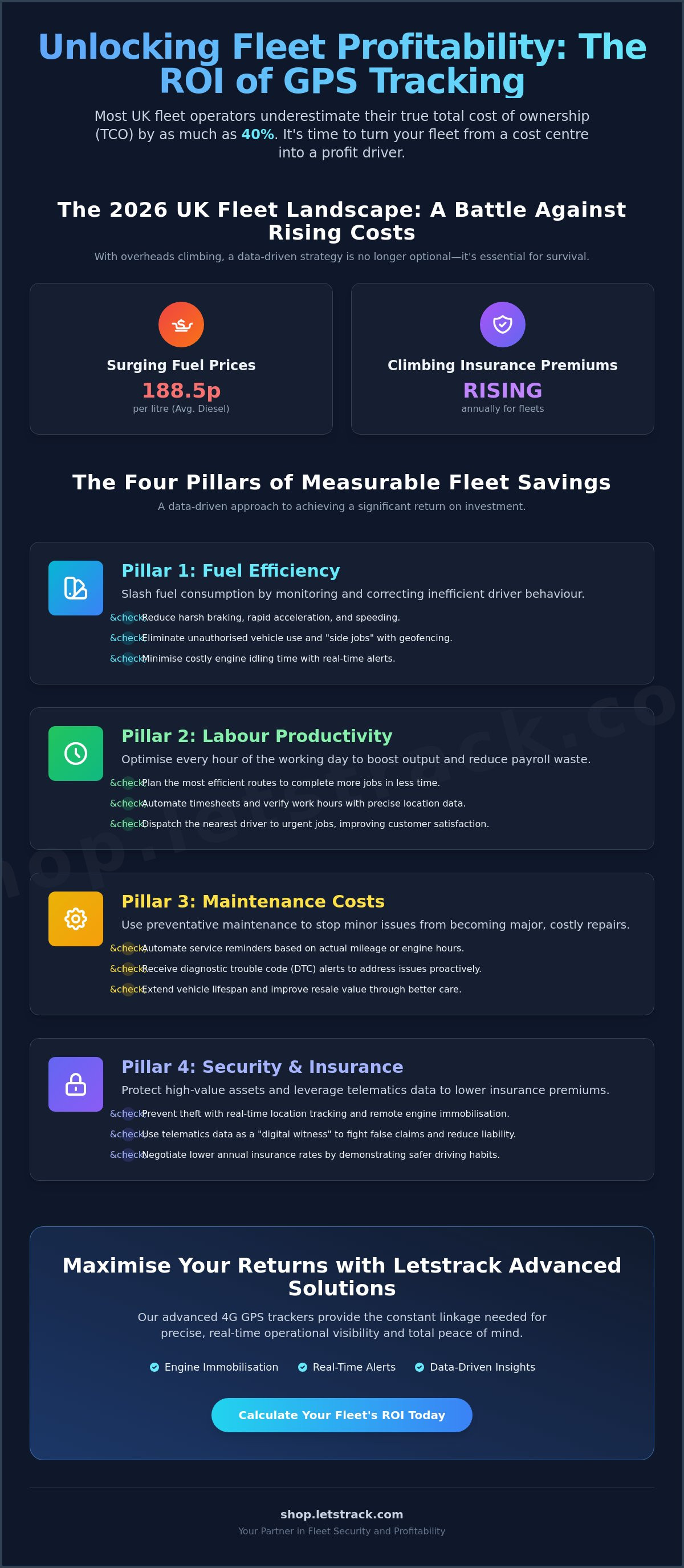
Most UK fleet operators underestimate their true total cost of ownership by as much as 40%. It’s a staggering figure that highlights why many businesses feel they’re constantly fighting a losing battle against rising overheads. With diesel prices reaching 188.5p per litre and insurance premiums climbing, you’re likely searching for a way to stop the bleed. Effectively calculating roi on fleet tracking is no longer just a financial exercise; it’s a survival strategy for the modern British business.
We'll show you how to move beyond simple location sharing to create a vigilant, data-driven operation. By quantifying the impact of telematics, you can transform your vehicles from a heavy cost centre into a streamlined profit driver. This 2026 guide breaks down the specific fuel, labour, and security savings that deliver a return on investment within months. You’ll learn how a high-tech tracker provides the constant linkage you need to ensure driver safety and total asset security. Let’s turn that uncertainty into psychological tranquillity and absolute control over your mobile assets.
Key Takeaways
- Understand how to define fleet ROI as a profit-driving strategy rather than just an overhead cost in the volatile 2026 UK market.
- Identify the four pillars of measurable savings, from slashing fuel bills to boosting labour productivity through route optimisation.
- Secure your high-value assets with engine immobilisation and real-time alerts to prevent the devastating financial impact of vehicle theft.
- Master the step-by-step process for calculating roi on fleet tracking using your baseline operational costs and investment data.
- Discover how advanced 4G GPS trackers provide the constant linkage needed for precise, real-time operational visibility and peace of mind.
What is Fleet Tracking ROI and Why Does it Matter in 2026?
Fleet ROI is the financial measure of the net profit your business gains relative to your total investment in GPS hardware and software. It's the clear line between a fleet that acts as a cost centre and one that functions as a profit driver. In 2026, market volatility has made real-time visibility an absolute necessity rather than a luxury. Calculating roi on fleet tracking allows you to see exactly where your capital is flowing. You can distinguish between "hard ROI," such as direct fuel savings and reduced payroll, and "soft ROI," which includes improved brand reputation and driver retention.
This technology acts as a watchful companion for your business. It fosters a culture of connection rather than mere surveillance. By maintaining constant linkage with your vehicles, you protect your drivers and your bottom line simultaneously. This vigilant approach ensures that every mile driven contributes to the health of your enterprise. It's about achieving psychological tranquillity through the power of data.
To better understand how these financial benefits manifest in a real-world setting, watch this helpful video:
The Shift from Expense to Asset
Viewing a GPS tracker as a one-time bill or a monthly drain is an outdated perspective that limits your growth. Modern telematics data serves as a "digital witness" during insurance claims or legal disputes. It provides the clarity you need to avoid unfair costs and protect your drivers from false accusations. Understanding what is fleet management in 2026 means recognising that every data point is a potential saving. A robust Vehicle tracking system transforms your mobile assets into transparent, manageable units of profit. It’s a tool for empowerment, giving you the control to make decisive, money-saving choices.
The 2026 UK Fleet Landscape
The UK fleet environment is more complex than ever. With fuel duty set to increase by 1p in September and 2p in December 2026, every litre of diesel counts. High-speed 4G connectivity now ensures that data transmission is instantaneous and reliable. This creates a seamless IoT ecosystem where the office and the driver are always in sync. Calculating roi on fleet tracking helps you navigate these pressures. It turns regulatory compliance, such as the ZEV mandate, into an opportunity for operational refinement. By staying connected to your priorities, you ensure your business remains resilient against rising costs.
The Four Pillars of Measurable Fleet Savings
Achieving a high return on your telematics investment requires a focus on four distinct operational areas. These pillars represent the most significant opportunities for cost recovery and profit generation. When you are calculating roi on fleet tracking, you must look beyond the initial hardware cost to the long-term impact on your daily balance sheet. By addressing fuel, labour, maintenance, and insurance, you create a robust framework for financial stability. This data-driven approach removes guesswork and replaces it with the precision of a vigilant protector.
- Fuel Efficiency: Controlling driver behaviour to slash consumption.
- Labour Productivity: Optimising every hour of the working day.
- Maintenance Costs: Using preventative maintenance to stop minor issues from becoming engine failures.
- Insurance Premiums: Leveraging technologies creating safer roads to negotiate lower annual rates.
Optimising Fuel and Reducing Idle Time
Aggressive driving is a direct drain on your profits. High-speed manoeuvres and harsh braking significantly increase fuel consumption, especially with UK diesel prices averaging 188.5p per litre in May 2026. Use geofencing to establish spatial boundaries that prevent unauthorised vehicle use or "side jobs" during business hours. This ensures your fuel is only used for company growth. A typical UK commercial fleet can reduce its total fuel expenditure by 10% to 15% simply by monitoring and correcting excessive engine idling and speeding through telematics. Consider how a 4G GPS tracker can provide the immediate visibility needed to start capturing these savings today.
Enhancing Labour and Time Accountability
Real-time location sharing eliminates the need for constant "where are you?" phone calls. This saves time for both the driver and the office staff, allowing everyone to focus on their core tasks. Automated timesheets further reduce administrative labour hours, ensuring that payroll is accurate and based on verified data. You can use Letstrack Circles to keep your entire team connected within a single, secure ecosystem. This constant linkage fosters a culture of accountability and efficiency. When calculating roi on fleet tracking, the reduction in manual admin time often provides one of the fastest routes to full cost recovery. It transforms your workforce into a more agile and responsive unit, ready to fit more jobs into every day without increasing stress or risk.
Risk Mitigation: The ROI of Security and Peace of Mind
While fuel and labour savings provide consistent monthly returns, security represents the most significant single-event ROI for any UK business. Recovering a single stolen van worth £30,000 provides an immediate financial return that can cover the cost of your entire tracking ecosystem for years. When you are calculating roi on fleet tracking, you must account for the high cost of vehicle theft, which is expected to drive motor insurance premiums up by 3% throughout 2026. A vigilant protector mindset ensures your assets aren't just monitored; they are defended. Intelligent AI alerts allow you to spot trouble before it becomes a financial burden, transforming a silent vehicle into an active participant in its own security.
- Theft Prevention: Stop a total loss before it happens with real-time spatial boundaries.
- Engine Immobilisation: Use remote kill-switches to prevent unauthorised movement of high-value cargo.
- SOS Alerts: Fulfil your "Duty of Care" by knowing a driver’s exact location during an emergency.
- AI Notifications: Receive instant warnings for battery tampering or unauthorised towing.
Recovering Assets with Real-Time Tracking
Speed is the most critical factor in asset recovery. Using a Shield 4G GPS Tracker allows you to provide the police with precise, live coordinates the moment a vehicle moves outside its designated zone. Instant alerts for an "unplugged" or "moved" status save vital hours in response time, often making the difference between recovery and a total loss. Contrast the modest cost of a tracker with the alternative: paying a heavy insurance excess, losing business uptime, and facing the replacement cost of specialised tools or cargo. This proactive linkage provides the psychological tranquillity that comes from knowing your capital is never truly out of reach.
Protecting the Most Valuable Asset: The Driver
Business continuity depends on the safety of your people. Driver safety is a core component of ROI because a single accident can lead to massive legal fees, increased premiums, and lost productivity. SOS features and real-time monitoring provide a safety net for your team, offering comfort to both the driver and their family. Our privacy-first approach ensures that all data is encrypted and remains under the control of the business. You maintain a connection that prioritises guardianship over surveillance. This balance of high-tech sophistication and emotional security ensures that your fleet remains a source of confidence, not a source of worry.
How to Calculate Your Fleet Tracking ROI: Step-by-Step
Calculating roi on fleet tracking requires a disciplined look at your operational data. You must move beyond guesswork to embrace a systematic approach that reveals the true value of your investment. This process isn't just about counting pennies; it's about establishing a baseline for psychological tranquillity and business growth. By following these five steps, you can prove the financial impact of your vigilant protector system.
- Step 1: Gather your baseline costs for the last 12 months. Include fuel, maintenance, insurance premiums, and total payroll hours.
- Step 2: Identify your total investment cost. This includes the initial purchase of your GPS tracker hardware and any ongoing subscription fees.
- Step 3: Estimate your potential savings. Use the industry average of a 10% to 15% reduction in fuel consumption and engine idle time as your target.
- Step 4: Factor in the "Recovery Value." This represents the total cost of one avoided vehicle theft, including the asset value and lost business uptime.
- Step 5: Apply the ROI formula: [(Total Savings - Total Investment) / Total Investment] x 100.
The ROI Formula in Action
Consider a hypothetical UK fleet of 10 vans equipped with the S7 GPS Tracker. If your annual fuel spend is £50,000, a conservative 10% saving puts £5,000 back into your pocket immediately. When you add reduced labour costs from automated timesheets and the prevention of even one "side job," the monthly savings quickly outpace the subscription cost. Most UK businesses with five or more vehicles achieve their break-even point within the first 3 to 6 months. This rapid return ensures your technology pays for itself while providing constant linkage to your most valuable assets.
Gathering Accurate Data for Your Audit
Don't rely on manual logs that are prone to human error. Use the Letstrack app to pull historical trip and fuel reports that offer an unvarnished view of your operations. The Letstrack map allows for global discovery of fleet inefficiencies, highlighting exactly where drivers are idling or taking suboptimal routes. If you're hesitant about a full rollout, start a pilot programme with a few vehicles to establish a clear baseline. This data-driven audit provides the evidence you need to scale your operations with confidence. Start calculating roi on fleet tracking for your own business by equipping your first vehicles today.
Maximising Returns with Letstrack Advanced Solutions
High-speed 4G connectivity is the backbone of accurate financial reporting. Without reliable data transmission, calculating roi on fleet tracking becomes an exercise in guesswork. Data gaps lead to missed savings and invisible costs that erode your bottom line. Our unified ecosystem allows you to manage vehicles, assets, and people within a single, vigilant digital interface. This constant linkage ensures that every mile driven and every litre of fuel consumed is visible in real time. It's about achieving total control through technological sophistication.
- Engine Immobilisation: A signature feature of the S5 GPS Tracker that adds a critical layer of security ROI by preventing unauthorised movement.
- Easy Installation: Lower the "cost" side of your ROI equation by using the Easy Plug Tracker, which eliminates professional fitting fees.
- Data Integrity: Ensure your reports are based on 100% accurate 4G data transmission for precise auditing.
- Asset Guarding: Protect high-value cargo with trackers that notify you the moment a spatial boundary is crossed.
Choosing the Right Hardware for Your Vertical
Selecting the correct device is essential for maximising your return. For heavy-duty commercial use, the Rapid 4G Tracker offers the durability and data density required for complex logistics. If your fleet suffers from frequent mechanical issues, the Vehicle Health Tracker identifies engine faults before they lead to catastrophic failure. This reduces maintenance-related downtime, which is a significant hidden cost for many UK businesses. The Letstrack Circles concept scales effortlessly from family safety to nationwide business management, keeping your entire team connected and secure.
The Letstrack Commitment to Connection
Our mission is to bring peace of mind and connection to business owners across the UK. We believe that calculating roi on fleet tracking should reveal a story of empowerment and psychological tranquillity. By transforming your vehicles into intelligent assets, you protect your capital and your people simultaneously. For practical utility demonstrations and to see our trackers in action, visit our official YouTube channel. Take control of your fleet's future today. Secure your assets with the power of instantaneous awareness and move forward with absolute confidence.
Secure Your Fleet’s Future and Maximise Every Mile
Mastering the art of calculating roi on fleet tracking is the first step toward transforming your business operations. You’ve seen how reducing idle time and preventing a single theft can pay for your entire tracking system within months. It’s about more than just numbers on a spreadsheet; it’s about the psychological tranquillity that comes with constant linkage to your assets. By focusing on the four pillars of savings and leveraging advanced 4G hardware, you turn a necessary expense into a powerful profit driver.
Letstrack is already trusted by thousands of UK businesses to provide real-time 4G tracking with intelligent AI alerts. Your data remains protected by encryption-secured protocols for total privacy. You don't have to accept rising fuel costs or unauthorised vehicle use as part of doing business in 2026. Take the final step toward total operational visibility and asset security now.
Optimise your fleet and secure your ROI with Letstrack today
Your journey toward a leaner, safer, and more profitable fleet starts with a single connection. Embrace the power of immediate visibility and lead your business with confidence.
Frequently Asked Questions
How long does it take to see a return on investment for fleet tracking?
Most UK businesses with five or more vehicles achieve a full return on their investment within three to six months. This rapid timeline is driven by immediate reductions in fuel consumption and the elimination of unauthorised vehicle use. By monitoring idle time and speeding, you start capturing measurable savings from the very first day of installation.
Can fleet tracking help reduce my UK insurance premiums?
Yes, insurers often provide more favourable terms to fleets that demonstrate safe driving behaviours through telematics data. With UK motor insurance premiums expected to rise by an average of 3% in 2026, having a "digital witness" is essential. Proving a commitment to safety through a reliable tracker can help you negotiate lower rates and reduce your total cost of ownership.
Is the ROI of fleet tracking worth it for small fleets of 5 vehicles or fewer?
Absolutely, because a single avoided theft or major engine failure can pay for the entire system for a small business. Calculating roi on fleet tracking for small fleets often highlights the "Recovery Value" as the primary driver. Even one vehicle recovered using a GPS tracker provides an immediate financial return that far outweighs the initial hardware and subscription costs.
How does engine immobilisation impact my fleet tracking ROI?
Engine immobilisation acts as a critical risk mitigation tool that prevents the total loss of a £30,000 asset. By using a remote kill-switch to stop unauthorised movement, you protect your cargo and your vehicle simultaneously. This feature adds a significant layer of security ROI by ensuring that your capital remains under your direct control at all times.
What are the hidden costs of fleet tracking that I should include in my ROI calculation?
You should account for initial hardware costs, monthly subscription fees, and any professional installation charges. However, choosing an Easy Plug tracker can eliminate fitting costs entirely. Including a small amount of internal admin time for reviewing weekly reports ensures your ROI calculation remains grounded in reality and accounts for total operational impact.
Will my drivers resist GPS tracking, and how does that affect ROI?
Resistance usually fades when you frame the technology as a tool for safety and guardianship rather than just surveillance. Drivers appreciate features like SOS alerts and the ability to prove their innocence in false insurance claims. High driver engagement leads to better driving habits, which directly increases your fuel and maintenance savings over the long term.
How does 4G GPS hardware improve ROI compared to older 2G or 3G models?
4G hardware ensures there are no data gaps, providing the high-resolution reporting needed for accurate financial auditing. Older 2G or 3G models often suffer from connection drops that lead to incomplete records and missed saving opportunities. In 2026, the reliability of 4G is essential for maintaining constant linkage and achieving the psychological tranquillity of total visibility.
Is driver data privacy protected when calculating productivity ROI?
Yes, all telematics data is encrypted and remains under the strict control of the business owner. Calculating roi on fleet tracking doesn't require compromising individual privacy; it focuses on operational efficiency and asset safety. Our privacy-first approach ensures that your connection to your team is built on a foundation of trust and mutual security.