
The Best GPS Luggage Tracker for 2026: Travel with Total Peace of Mind
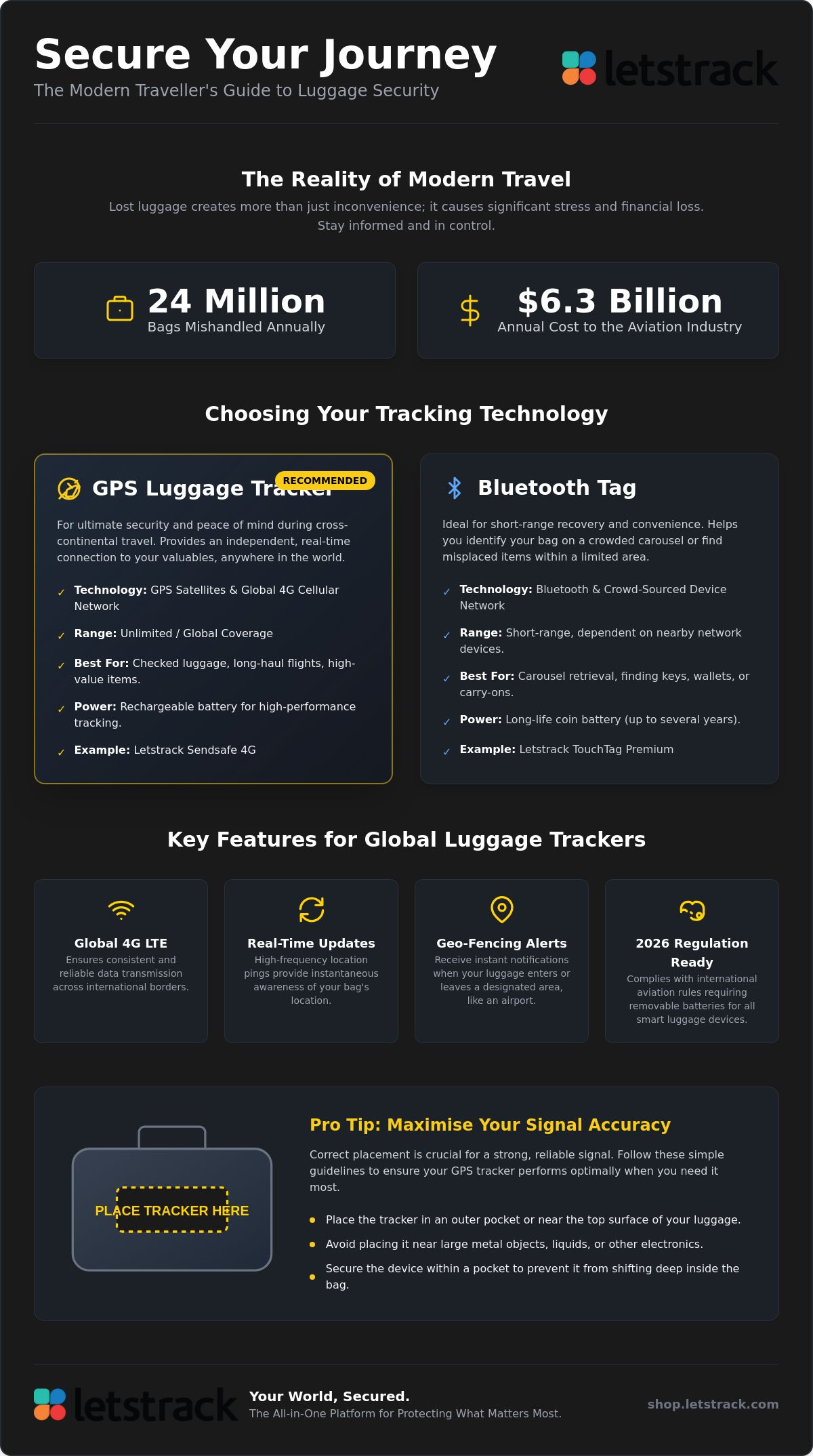
Airlines mishandled approximately 24 million bags in 2025, costing the global aviation industry a staggering $6.3 billion. For the individual traveller, these aren't just abstract figures; they represent the gut-wrenching moment of watching an empty carousel while your essentials are stuck in a different time zone. We understand the sheer frustration of being tethered to a baggage desk, waiting for answers that never seem to come.
You don't have to leave your security to chance. This guide shows you how to eliminate travel anxiety by selecting the ultimate gps luggage tracker for global security. We'll clear up the common confusion between simple Bluetooth tags and high-precision GPS monitors, ensuring you have the right tech for the job. You'll learn how Letstrack provides real-time visibility and instant alerts directly to your mobile, keeping you connected to your belongings anywhere in the world. From 2026 battery regulations to advanced geo-fencing, we'll give you the tools to stay in total control of your journey.
Key Takeaways
- Understand the vital difference between Bluetooth tags for carousel retrieval and a gps luggage tracker for cross-continental recovery.
- Learn professional placement techniques to maintain signal accuracy and protect your device from tampering during transit.
- Identify essential features like global roaming and high-frequency updates that ensure instantaneous awareness across UK and European networks.
- Explore the Letstrack ecosystem to see how integrated hardware and software provide a seamless, secure platform for asset protection.
- Gain clarity on international travel regulations for 2026, including battery compliance and cross-border tracking requirements.
Table of Contents
What is a GPS Luggage Tracker and Why is it Essential in 2026?
A GPS tracking unit for travel is a sophisticated security tool that offers a dedicated digital detail for your belongings. In 2026, a high-performance gps luggage tracker uses a combination of Global Positioning System satellites and cellular networks to transmit its exact coordinates directly to your smartphone. Unlike standard Bluetooth tags that rely on the proximity of other devices, these professional-grade units offer truly global reach. They provide a vigilant digital safety net that keeps you connected to your valuables, regardless of whether your suitcase is in a London terminal or a transit hub in Singapore.
To better understand how these devices perform in real-world conditions, watch this helpful comparison video:
The Evolution of Baggage Security
Baggage security has moved far beyond the era of simple padlocks. We've seen a shift from passive hardware to sophisticated IoT ecosystems that prioritise active visibility. Modern travel demands more than just a physical barrier; it requires instantaneous awareness. While 4G LTE connectivity was once considered a luxury, it's now the baseline for reliable travel hardware. This technology ensures consistent data transmission even in complex airport environments. Letstrack leads this evolution by offering devices like the Sendsafe 4G tracker, which transforms your suitcase into a smart, traceable asset. You're no longer relying on hope; you're utilising a watchful companion that values efficiency and transparency.
Emotional Benefits of Real-Time Visibility
The primary value of a gps luggage tracker is the psychological tranquility it delivers. Travel anxiety often peaks when you hand over your bags to an automated system. Having real-time visibility allows you to confirm your suitcase is on the same aircraft before you've even fastened your seatbelt. This empowerment is vital when communicating with airline staff. Instead of accepting vague updates, you can provide precise location data to speed up recovery. There's a fundamental difference between a bag that's truly "lost" and one that is merely "temporarily misplaced" at a transfer gate. Knowing exactly where your property sits allows you to maintain control and stay focused on your journey.
GPS vs. Bluetooth Trackers: Which Should You Choose?
Choosing between a Bluetooth tag and a gps luggage tracker depends on your specific security needs. While both offer visibility, they operate on fundamentally different levels of technology. Most travellers mistake simple Bluetooth tags for full-scale trackers, but the distinction is vital for asset recovery. Bluetooth tags like the TouchTag Premium are excellent for short-range recovery. They rely on crowd-sourced networks, meaning they need a nearby smartphone to report their location. This makes them perfect for spotting your bag on a crowded carousel or finding a misplaced laptop bag in a lounge.
Conversely, a dedicated gps luggage tracker like the Sendsafe 4G tracker functions independently. It uses internal cellular modules to transmit data across borders. It doesn't need to wait for a passerby's phone to update its position. This independence is what provides the psychological tranquility required for long-haul travel. While tags can last for years on a single coin battery, GPS units require periodic charging to power their more advanced data transmission. It's a trade-off between battery longevity and the depth of information you receive.
Compliance is key for a smooth journey. As of 2026, aviation authorities require all smart luggage to have removable batteries. Modern tracking devices are built with this in mind, adhering to FAA regulations for luggage trackers. It's a small but vital detail that ensures your security hardware stays with your bag rather than being confiscated at security. You can browse our full range of tracking hardware to find the right balance for your next trip.
When to Use Bluetooth Tags
Bluetooth tags are the perfect choice for items that usually remain within your line of sight. Think carry-on bags, laptop cases, or keys. They're particularly helpful for short-haul domestic hops where the baggage system is less complex. If your bag is hidden in a hotel storage room or buried on a carousel, you can simply ring the tag from your phone. They offer a cost-effective way to secure multiple items without needing a subscription for each one.
When a 4G GPS Tracker is Non-Negotiable
A professional tracker is essential for international itineraries involving multiple layovers. When your bag moves between different airline carriers and ground crews, the risk of a transfer error increases. High-value assets like camera gear, sports equipment, or luxury goods require the constant linkage that only 4G can provide. These units allow you to set geofences. If your suitcase moves outside the airport boundary without you, your phone will alert you instantly. It's about maintaining a personal security detail for your property.
Essential Features of a Global Luggage Tracking Device
A high-performance gps luggage tracker must provide more than basic location data; it must offer a reliable link across international borders. When your bag is moving through high-volume hubs like Heathrow or Charles de Gaulle, technical precision is your only defence against error. You need a device that operates with the same vigilance you do. Look for these non-negotiable features to ensure your property remains under your digital guardianship:
-
Global Roaming: Your tracker must transition seamlessly between UK and European networks. Much like how international travel esim data plans provide cost-effective connectivity for your smartphone, your tracker requires a robust roaming solution to avoid signal loss or high surcharges when crossing borders.
-
Real-Time Updates: Aim for "instantaneous awareness." High-frequency pings ensure you see your bag's movement as it happens, not where it was twenty minutes ago.
-
Geofencing: This allows you to create virtual spatial boundaries. If your bag leaves a designated airport zone or your hotel perimeter without you, your phone alerts you immediately.
-
Battery Longevity: Reliability is everything. The hardware must remain active throughout long-haul flights and the inevitable delays that define modern travel.
Connectivity and 4G LTE Technology
Network infrastructure is changing rapidly. By 2026, 2G and 3G networks have largely been sunsetted across the UK and Europe to make room for faster technologies. This makes 4G LTE hardware essential for consistent data transmission. A gps luggage tracker that relies on outdated bands will suffer from "dead zones" in remote or shielded airport areas. Letstrack utilises multi-network SIM cards to maintain a constant linkage. This ensures that even if one carrier has a weak signal in a specific terminal, your device automatically switches to the strongest available provider to keep you informed.
Alerts and Anti-Theft Capabilities
Security isn't just about recovery; it's about prevention. Modern trackers like the Letstrack LT Personal include motion sensors that act as a silent alarm. If someone lifts your bag while you're distracted at a cafe, you'll receive a notification instantly. These devices also maintain historical data logs. If an airline mishandles your bag, you have a digital paper trail to prove exactly where the chain of custody was broken. This level of transparency is vital for hold-room disputes or insurance claims. Some units even feature SOS buttons, allowing the device to double as a personal security tool for solo travellers navigating unfamiliar cities.
How to Secure Your Suitcase for Maximum Tracking Accuracy
To ensure your gps luggage tracker provides the instantaneous awareness you rely on, you must consider the physical environment of your suitcase. Unlike external tags that are easily removed by unauthorised hands, a professional tracker should be placed inside the lining of your bag. This covert placement prevents tampering and ensures the device remains a vigilant protector throughout the journey. Before you head to the airport, charge your hardware to 100%. Reliability depends on power, and a fully charged unit ensures your bag is visible even through unexpected 24-hour delays. Check the Letstrack app while in the departures lounge to verify the device is active and "pinging" before the ground crew loads it onto the aircraft.
Signal penetration is a vital factor in tracking accuracy. Most soft-shell suitcases allow GPS and cellular signals to pass through easily. However, if you use premium aluminium or metal-lined hard-shell cases, be aware that these can act as a shield, potentially weakening the signal. In these instances, place the tracker as close to the zip or a non-metallic pocket as possible. This ensures the gps luggage tracker maintains a constant linkage with the network. Find the perfect tracker for your next journey to ensure your valuables never leave your digital sight.
Placement Tips for Different Luggage Types
Soft-shell bags offer the best performance for internal trackers because the fabric doesn't obstruct satellite data. For hard-shell cases, positioning the device in a top pocket away from the main frame is best. If you prefer a visible deterrent or need a backup for your internal GPS, use the Call & Locate Luggage Tag on the exterior. For those carrying specialised tech gear or camera equipment, secure the tracker in a dedicated padded compartment. This protects the hardware from impact while maintaining a clear line of sight for data transmission.
App Configuration for Peace of Mind
Hardware is only half the solution; how you configure the Letstrack app determines your level of control. Set up your geofences around the airport and your destination hotel before you even leave for the terminal. This ensures you receive an immediate alert if your bag deviates from its intended path. To avoid alert fatigue, customise your notification settings so you only receive high-priority updates. You can also share location access with family members using Letstrack Circle tracking, providing an extra layer of guardianship. Finally, test the "ring" function on your tags to ensure you can quickly locate your bag if it's hidden under other luggage at the hotel storage or carousel.
Letstrack Luggage Solutions: Protecting Your World
Security is more than a single device; it is a seamless ecosystem that provides total asset protection. Letstrack delivers a sophisticated platform where hardware and software work in unison to ensure your belongings are never truly out of reach. From the TouchTag Premium for everyday carry-on items to professional-grade GPS units for checked baggage, our range is designed for the modern traveller. We prioritise your privacy by using military-grade encryption for all location data. You retain total control over your information, ensuring that your gps luggage tracker remains a private security detail for your eyes only.
Choosing our technology means joining a global community of travellers who value psychological tranquility. We understand that your luggage contains more than just clothes; it holds the essentials for your journey and the valuables you've worked hard to acquire. By maintaining a constant linkage between your smartphone and your suitcase, we transform a complex technical tool into a source of daily comfort. Our platform is built on the promise of immediate visibility, allowing you to focus on the experiences ahead rather than the risks behind.
The Letstrack Advantage: Vigilant Protection
Our UK-designed IoT software leads the industry in reliability and precision. The Letstrack app acts as a unified command centre, allowing you to manage your vehicles, pets, and luggage in one intuitive interface. This digital-first approach ensures that you don't need multiple apps to protect what matters most. For those new to the ecosystem, our YouTube tutorials provide quick, digestible bursts of information for easy setup. We've removed the complexity of hardware integration, replacing it with a rhythmic pulse of efficiency that reinforces your sense of control.
Choosing the Right Letstrack Device
Selecting the correct hardware is essential for global recovery. The Sendsafe 4G Tracker is our premier recommendation for cross-continental travel, offering the robust cellular connectivity required for international baggage systems. If you need a versatile tool that doubles as a personal safety device, the LT Personal is the ideal choice for its compact form and SOS capabilities. For the ultimate security layer, we suggest a dual-layered approach. Combine a dedicated gps luggage tracker for long-distance monitoring with a TouchTag for carousel retrieval. This ensures you have total coverage from the moment you check in until you reach your hotel room. Join the Letstrack community today to keep your world secure and travel with absolute confidence.
Take Control of Your Global Journey
Managing the complexities of international travel in 2026 requires a proactive approach to security. You've learned that the most effective strategy involves a dual-layered defence; combining a high-precision gps luggage tracker for global recovery with Bluetooth tags for close-range retrieval. By prioritising 4G LTE connectivity and covert internal placement, you ensure your belongings remain visible across every border and transfer hub. To complement your security setup, Tak-tical offers a strategic guide on how to pack your bag for maximum efficiency and comfort, helping you travel with even greater ease.
Letstrack provides the vigilant protection you need to transform travel anxiety into psychological tranquility. Our ecosystem is trusted by over 1 million active users globally, offering a watchful companion that never sleeps. We prioritise your security with fully encrypted data for total privacy and provide UK-based expert support whenever you need assistance. It's time to move from passive hope to active, instantaneous awareness.
Secure your next trip with a Letstrack GPS Tracker today and join a community dedicated to keeping their world secure. Travel with the confidence that you're always connected to what matters most.
Frequently Asked Questions
Are GPS luggage trackers legal to use on flights in 2026?
Yes, GPS luggage trackers are completely legal to use on flights in 2026, provided they comply with international aviation safety standards. All major airlines permit these devices in both checked and carry-on luggage. You must ensure the battery is removable if it's integrated into the suitcase structure, though standalone trackers are generally exempt. Letstrack devices are engineered to meet these strict requirements, ensuring your security hardware never causes an issue at check-in.
Will a GPS tracker work if my bag is inside a metal shipping container?
GPS signals generally cannot penetrate solid metal shipping containers due to a physical phenomenon called electromagnetic shielding. While your gps luggage tracker is highly sensitive, it requires a line of sight to satellites or cellular towers to transmit location data. If your bag is inside a thick metal enclosure, the signal may drop until the container is opened or the bag is moved to a more open area like a cargo hold or terminal.
Do I need a subscription for my luggage tracking device?
Professional GPS trackers require a subscription to cover the costs of global cellular data transmission. This ensures your device has a constant linkage to 4G networks across different countries without you needing to manage local SIM cards. While Bluetooth tags operate without ongoing fees, a subscription-based tracker provides the independent, long-range visibility necessary for international recovery. It's a small investment for the psychological tranquility of knowing your assets are always monitored.
How long does the battery typically last on a 4G luggage tracker?
Battery life on a 4G luggage tracker typically ranges from several days to a few weeks, depending on your chosen ping frequency. If you set the device to update every few minutes, it will consume power faster than a daily update mode. Letstrack hardware features intelligent power management to ensure the device remains active throughout long-haul flights and the inevitable delays of modern travel. Always charge your unit to 100% before departing for maximum reliability.
Can I track my luggage in real-time across different countries?
You can track your luggage in real-time across different countries using Letstrack’s global roaming capabilities. Our devices utilise multi-network SIM cards that automatically switch to the strongest available provider in the UK, Europe, and beyond. This ensures a seamless transition as your bag moves through international transit hubs. You maintain instantaneous awareness of your property’s location directly through the mobile app, regardless of the borders you cross during your journey.
What is the difference between an AirTag and a professional GPS tracker?
The primary difference lies in the transmission technology and range. An AirTag is a Bluetooth tag that relies on a nearby network of smartphones to report its position, making it ideal for close-range retrieval. A professional gps luggage tracker uses satellites and independent cellular networks to provide unlimited range. This independence is vital for locating bags lost in transit hubs where crowd-sourced Bluetooth networks might be sparse or unavailable to the user.
Will the tracker still work if there is no Wi-Fi at the airport?
Your tracker does not require airport Wi-Fi to function. It operates using dedicated GPS satellites for location and 4G cellular networks for data transmission. This independence ensures that even in remote terminals or cargo areas with no public internet access, your device remains a vigilant protector. As long as there is a cellular signal, your suitcase stays connected to the Letstrack platform, providing you with constant, reliable updates throughout your trip.
Can I share my luggage location with my travel companions?
You can easily share your luggage location with travel companions using the Letstrack app’s circle tracking features. This allows your family or group to monitor the bag's status, providing an extra layer of guardianship. You retain total control over who sees this information and can enable or disable sharing at any time. All shared data is protected by military-grade encryption, ensuring your privacy remains a top priority while you stay connected with your group.