
Personal GPS Tracker for Elderly: The 2026 Guide to Safety and Independence
Discover how modern GPS technology provides a 'Digital Guardian' for your ageing loved ones, ensuring their safety without compromising their dignity. Finding the right balance between independence and safety is a challenge every family faces, but with the right tools, you can achieve true peace of mind.
Why a Personal GPS Tracker for Elderly Loved Ones is Essential in 2026
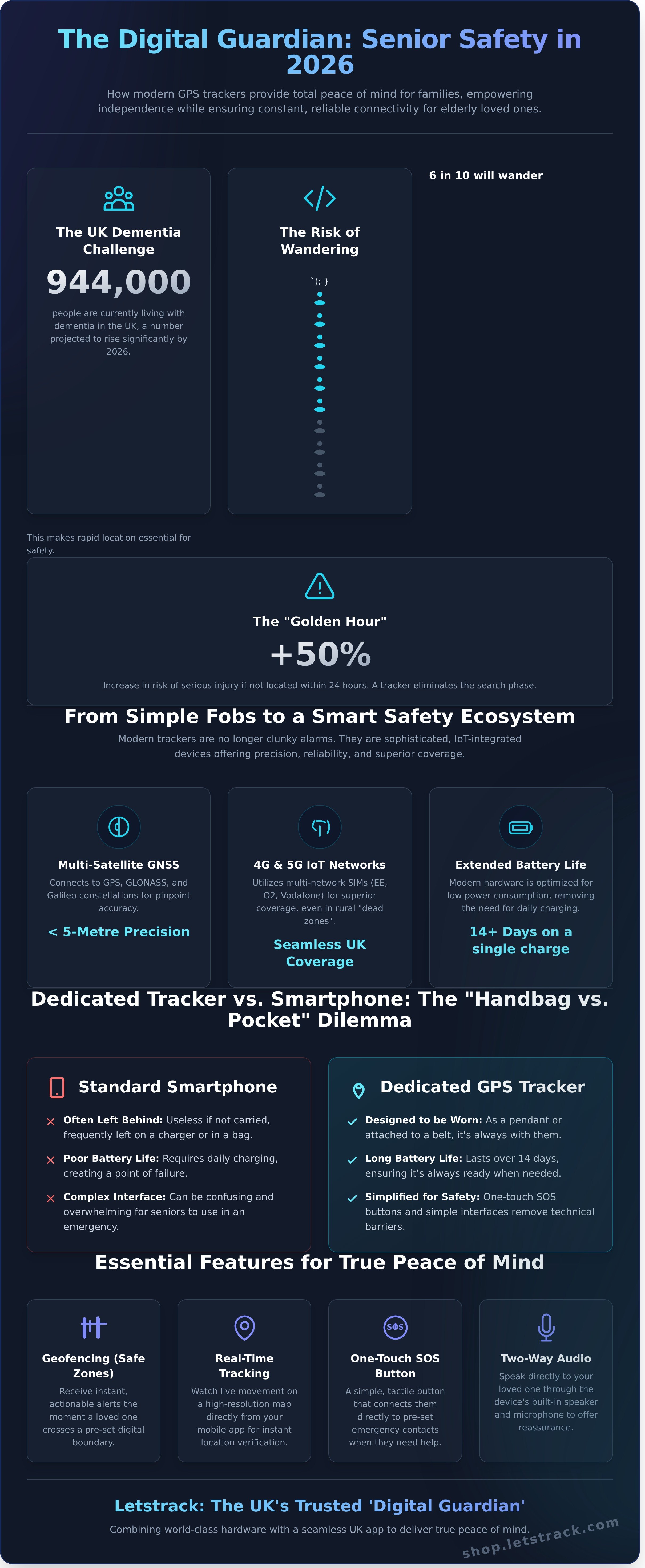
In 2026, a personal GPS tracker is no longer just a dot on a map. It's a complete safety ecosystem, a wearable or portable device that offers a direct line of communication and a digital safety net. This technology is at the heart of the growing 'Freedom to Roam' movement, which champions the right of UK seniors, including those with early-stage dementia, to maintain their active lifestyles confidently. The reality of conditions that cause wandering is stark; the first 24 hours are critical. Modern GPS has evolved from simple beepers into intelligent IoT guardians, providing real-time information when it matters most.
Maintaining Independence vs. Ensuring Safety
The greatest fear for many adult children is 'the phone call'. A GPS tracker transforms this anxiety into reassurance. It’s not about surveillance; it's about empowerment. For seniors, there's a profound psychological benefit in knowing they can be found if they become confused or have a fall. For carers, the burnout from constant worry is significantly reduced. Instead of reactively searching, you can proactively set up digital safe zones (geofences) and receive automated alerts, allowing your loved one to enjoy their walk to the local shops or park with an invisible layer of protection.
The Reality of Dementia and Wandering in the UK
Wandering is a common and dangerous behaviour associated with dementia and other cognitive impairments. In the UK, thousands of families grapple with this reality daily. While a standard mobile phone might seem like a solution, it often fails. Phones can be forgotten, switched off, or have their location services disabled. For someone experiencing confusion, navigating a complex smartphone interface to call for help is often impossible. A dedicated personal GPS tracker solves the 'handbag vs. pocket' dilemma by being a simple, single-purpose device that is easy to wear or attach, ensuring it's always with them when they need it.
How Modern GPS Tracking Technology Works for Senior Safety
Today's personal trackers for the elderly leverage a powerful combination of technologies to provide pinpoint accuracy and reliable connectivity. The industry's shift to 4G and 5G IoT (Internet of Things) networks ensures superior coverage across the UK, from bustling city centres to rural villages where signal can be patchy. These devices use GNSS (Global Navigation Satellite Systems) for precise outdoor location, while also balancing battery life through smart reporting intervals. Crucially, a feature like multi-user access, standard in the Letstrack ecosystem, allows the whole family and designated carers to monitor a loved one's safety from a single, intuitive app.
Connectivity: Beyond Just GPS
True safety requires more than just a GPS signal. When a loved one is indoors, such as in a shopping centre or a large public building, GPS signals can be weak. This is where advanced trackers excel.
- Wi-Fi and LBS: Modern devices use Wi-Fi and LBS (Location Based Services) to triangulate a position using nearby Wi-Fi networks and mobile phone towers, providing an approximate location even when indoors.
- 4G Connectivity: For rural UK areas, 4G is non-negotiable. It provides the stable, far-reaching connection needed to transmit location data reliably, closing the gaps left by older 2G or 3G networks.
- Real-Time Tracking: For dementia-related safety, 'real-time' is the gold standard. Letstrack’s technology provides location updates as frequently as every 10 seconds, ensuring you have the most current information during a potential wandering incident.
The App Ecosystem: Your Control Centre
The physical tracker is only half of the solution. The power lies in the app on your phone, which acts as your family's safety control centre.
- The Letstrack App: Designed for UK users, our app provides a clear, easy-to-use interface to see your parent's location on a map in real-time.
- Instant Alerts: Set up instant push notifications directly to your phone. You'll be the first to know if the SOS button is pressed, the battery is running low, or if a geofence has been crossed.
- Historical Route Playback: This powerful feature allows you to review your parent's movements over the past day or week. It’s not about checking up on them, but about understanding their patterns. You can identify new favourite walking routes to add to their 'Safe Zone' or notice deviations from their routine that might warrant a friendly check-in.
Choosing the Right Device: Wearables, Tags, and Pendants
The best personal GPS tracker for an elderly person is the one they will consistently wear or carry. Compliance is key, which is why form factor is so important. In 2026, you should expect a high-quality tracker to offer several days of battery life, be durable enough for daily use, and be water-resistant. Most importantly, the 'discrete' factor cannot be overstated; devices that don't look 'medical' are far more likely to be accepted and used.
| Feature | Personal Pendant/Tracker | Smart Tag | GPS Watch |
|---|---|---|---|
| Best For | All-day reliability, prominent SOS button. | Discretion, attaching to keys, bags, or belts. | Users comfortable with wearable tech. |
| Discretion | Moderate to High | Very High | Low to Moderate |
| SOS Button | Yes, typically large and easy to press. | No | Yes, usually a side button. |
| Battery Life | 2-5 days | 1-3 days | 1-2 days |
| Example | Letstrack Smart Guard Tracker | Letstrack Touchtag Premium | Third-party device |
The Versatility of the Personal Tracker
Dedicated personal trackers are often the most robust solution. They are designed for one purpose: safety.
- The LT-Personal is a compact and reliable option for all-day peace of mind.
- The Smart Guard Tracker is perfect for those who need a clear, accessible SOS button for immediate alerts.
- For more independent seniors who travel, the Sendsafe 4G Tracker offers superior connectivity and durability.
Discrete Tracking with Smart Tags
For parents who strongly resist wearing a dedicated device, a smart tag is an excellent alternative.
- The Touchtag Premium can be attached to a set of keys, slipped into a wallet, or clipped onto a handbag.
- This creates an 'invisible' safety net, tracking the items your parent never leaves home without. This can prevent the device from being consciously removed or forgotten.
- While they lack a dedicated SOS button, tags are a powerful tool for location monitoring, especially for individuals in the early stages of cognitive decline who still have a high degree of independence.
Setting Up Your Safety Net: Geofencing and Alerts
A geofence is a virtual boundary you draw on the map within your tracking app. It’s your primary tool for proactive safety. When the tracker enters or leaves this 'Safe Zone'—such as the home, garden, or local high street—you receive an instant alert. This allows you to avoid 'alarm fatigue' by only being notified of genuinely unusual movements. The most important step, however, is having the 'privacy talk' with your parent to ensure they understand the device is a tool for their safety and freedom.
Creating Effective Geofences
Setting up a geofence in the Letstrack app is simple and takes only a minute.
- Step 1: Open the app, select the device, and choose the geofence option.
- Step 2: Centre the map on your parent’s residence and draw a radius of around 200 metres to cover the house and immediate surroundings.
- Step 3: Create additional 'Safe Zones' around places they visit frequently, like a friend’s house, the GP surgery, or a local park.
- Step 4: Consider creating 'Danger Zones' or 'No-Go Zones' for areas like busy A-roads, railway lines, or nearby lakes, which will trigger an immediate alert if entered.
Introducing the Device to Your Parent
How you frame the conversation is crucial for getting their buy-in.
- Focus on Connectivity: Talk about it as a tool for connection and peace of mind, not 'tracking'. Use phrases like, "This is so you can get help if you need it," or "This just lets us know you're okay on your walks."
- Highlight the SOS Feature: Frame the device primarily as a personal alarm they control. The SOS button is their feature to call for help, which is a more empowering concept than being monitored.
- Establish a Routine: Create a dedicated 'charging station' next to their bed, by their keys, or wherever they put their essentials down. Making charging part of their daily routine is vital for ensuring the device is always ready.
Why Letstrack is the UK's Trusted 'Digital Guardian'
Letstrack offers more than just hardware; we provide a complete, seamless safety ecosystem designed for UK families. Our 'Peace of Mind' philosophy is built on the foundation of true real-time tracking, because we know that in an emergency, every second counts. With a dedicated UK-based support team and a global footprint in IoT safety, we are the trusted choice for families looking to protect their loved ones.
A Single Ecosystem for Family Safety
Our platform allows you to create a holistic safety net. You can integrate personal trackers for your parents and GPS trackers for your vehicles, all within a single, easy-to-use dashboard on your phone. This unified approach simplifies monitoring and gives you a complete overview of your family's safety. For a simple guide on setting up your devices and app, you can explore our helpful YouTube tutorials.
The Letstrack Commitment to Quality
We understand the trust you place in our technology. That’s why all our devices undergo rigorous testing to meet UK standards for connectivity, durability, and weather resistance. We provide continuous software updates to our app, ensuring your system is always secure and equipped with the latest features for 2026 and beyond.
Ready to provide your loved one with the freedom they deserve and the peace of mind you need? Protect your loved ones with the UK's #1 Personal GPS Tracker
Frequently Asked Questions (FAQs)
Is it legal to put a GPS tracker on an elderly person in the UK? Yes, it is legal, provided it is done in the person's best interests, especially if they lack the mental capacity to consent (e.g., due to advanced dementia). It is always best to have an open conversation and obtain their consent if possible.
How long does the battery last on a personal GPS tracker for elderly users? Battery life varies by device and usage, but you can typically expect 2-5 days from a modern 4G personal tracker like those from Letstrack. Our devices also feature intelligent low-power modes to conserve energy when the person is not moving.
Do these trackers work indoors or in areas with poor mobile signal? Yes. While GPS is best for outdoors, our advanced trackers use Wi-Fi and LBS (Location Based Services) to provide an approximate location indoors. By using the 4G network, they offer the most reliable connectivity available across the UK, even in areas with weaker signals.
Can more than one family member track the same person on their phone? Absolutely. The Letstrack app allows for multi-user access, so you can grant permission to siblings, partners, or trusted carers to view the location and receive alerts on their own smartphones.
Is there a monthly subscription fee for real-time elderly tracking? Yes, a subscription is required. This fee covers the cost of the built-in SIM card's data usage on the 4G network, access to the Letstrack real-time tracking platform, app features, data storage, and customer support. It’s what enables the 'live' tracking that is essential for safety.
What happens if my parent presses the SOS button on the tracker? When the SOS button is pressed, an instant alert is sent via push notification to all authorised users' phones. The alert includes the precise location of the device, allowing for an immediate and rapid response.
Are these devices waterproof enough for someone who forgets to take it off in the shower? Most high-quality personal trackers are water-resistant (often rated IP65 or higher), meaning they can withstand splashes, rain, and brief accidental submersion like in a shower. It's always best to check the specific IP rating of the device.
Which is better for a dementia patient: a watch, a pendant, or a tag? This depends entirely on the individual. A pendant or dedicated tracker (like the Letstrack Smart Guard) is often best as it has a clear SOS button and long battery life. For someone who resists wearing a new item, a discrete tag (like the Letstrack Touchtag) attached to their keys or bag is an excellent, non-intrusive option.