
Luggage Tags: The Ultimate 2026 Guide to Smart Suitcase Security
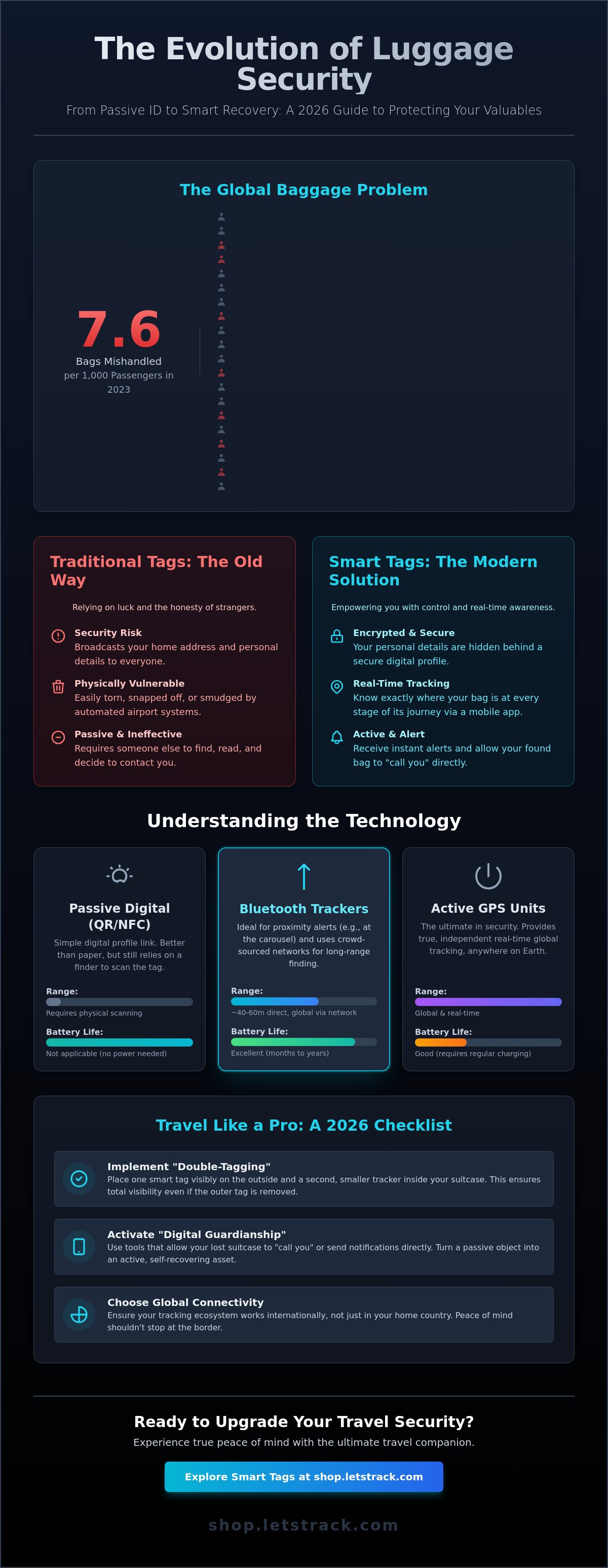
In 2023, the global rate of mishandled baggage reached 7.6 bags per 1,000 passengers, leaving thousands of UK travellers standing anxiously at empty carousels. You likely agree that the traditional method of identifying your suitcase is fundamentally broken. Relying on flimsy luggage tags that broadcast your private home address to every passerby isn't just outdated; it's a security risk. You shouldn't have to settle for a passive strip of plastic that often snaps off before your flight even leaves the tarmac.
This guide demonstrates how modern technology has transformed the humble label into an advanced digital recovery system. We'll show you how to upgrade your travel security with vigilant, IoT-integrated tools that ensure your valuables never stay lost. You'll discover how to gain real-time awareness of your bag's location while keeping your contact details behind secure, encrypted layers. We're exploring the most durable hardware and smart tracking ecosystems available in 2026 to provide you with total peace of mind from check-in to your final destination.
Key Takeaways
- Move beyond basic ID labels to explore how IoT-integrated tracking turns your suitcase into a smart, self-recovering asset.
- Protect your home security by learning why modern luggage tags have replaced physical addresses with encrypted digital profiles.
- Implement the "Double-Tagging" expert strategy to maintain total visibility of your valuables throughout the entire airport conveyor system.
- Compare Bluetooth and GPS technologies to find the perfect balance between battery life and global real-time connectivity.
- Experience true peace of mind with "Digital Guardianship" tools that allow your lost suitcase to call you directly when found.
The Evolution of Luggage Tags: From ID Labels to Smart Recovery Systems
Modern luggage tags have transitioned from simple paper slips to sophisticated IoT-integrated security tools. Historically, The Evolution of Luggage Tags began as a way for hotels to advertise their prestige, but by 2026, they serve as active digital beacons. This shift represents a move from passive identification to real-time asset protection. While a traditional tag relies on someone else finding your bag and deciding to call you, an active smart tag empowers you to take charge of your own security.
In the current travel environment, waiting by a carousel is no longer a guessing game. Real-time awareness has become the standard for the 84% of UK travellers who now prioritise digital security over traditional methods. This technology provides an essential psychological anchor, offering "peace of mind" during the high-pressure environment of international transit. It transforms a complex logistical challenge into a source of daily comfort and confidence.
To better understand why traditional methods are falling behind, watch this helpful video:
Why Traditional Baggage Labels Often Fail
Paper and plastic labels are physically vulnerable to the high-speed automated sorting systems used in major hubs like Heathrow or Gatwick. When tags snag on conveyor belts, they often detach, leaving your bag anonymous. Ink often fades or smudges due to moisture, leading to the "lost data" problem where ground crews cannot identify the owner. Passive tags act only as a secondary backup because they require a human to find, read, and act upon the information manually.
The Rise of Digital Connectivity in Travel
The "Digital Guardian" concept replaces luck with logic. By using mobile app integration, you gain a direct line of sight to your valuables. This ecosystem ensures your identity stays safe; encrypted data protects your personal details from prying eyes while still allowing for a secure recovery process. You're no longer just a name on a card; you're a connected user with total control over your security. Using a call and locate luggage tag bridges the gap between physical hardware and digital safety, ensuring you are always awake and always watching over your assets.
- Real-time tracking: Know exactly where your suitcase is at every stage of the journey.
- Instant alerts: Get notified the moment your bag moves out of your designated safe zone.
- Global discovery: Use the Letstrack map to find your items anywhere in the world.
Security is no longer a luxury; it's a necessity for the modern traveller. By adopting IoT-integrated luggage tags, you ensure that your journey remains focused on the destination rather than the stress of lost property.
Understanding the Technology: Passive, Bluetooth, and GPS Luggage Tags
Modern luggage tags have evolved far beyond simple paper inserts and leather straps. You now have three primary ways to secure your belongings: passive digital tags, Bluetooth proximity trackers, and active GPS units. Each technology serves a distinct purpose depending on whether you're taking a quick flight from London to Edinburgh or a multi-leg journey across continents. Choosing the right tech depends on your specific need for range, battery life, and budget.
Bluetooth Trackers and "Find My" Compatibility
Bluetooth tags are the standard for most UK travellers. These devices use low-energy signals to communicate with nearby smartphones. If your bag is within 40 to 60 metres, you can trigger an alert to find it. For global tracking, they rely on massive crowd-sourced networks. If any compatible phone passes your bag, its location updates on your map instantly. This is incredibly useful for spotting your suitcase on a crowded Heathrow carousel. The Bluetooth Tag Pro offers this seamless proximity tracking with a battery that lasts up to 12 months. It's a cost-effective way to gain instant awareness without any monthly subscription fees.
Global GPS Trackers for Total Awareness
When you're transporting high-value equipment or travelling internationally, Bluetooth isn't always enough. Global GPS trackers use internal SIM cards and satellite data to provide independent location updates. They don't need a nearby phone to function. This engine-independent power is vital for maintaining a connection to your assets during transit. The Shield 4G GPS Tracker provides real-time data across borders, ensuring you know exactly which tarmac or warehouse your gear is sitting on. While these units require recharging every few weeks, the level of protection they offer for expensive kit provides unmatched peace of mind.
Passive QR and NFC Tags
Passive tags are the digital version of traditional luggage tags. They don't require batteries. Instead, they feature a QR code or NFC chip that anyone can scan with a smartphone. This protects your home address from prying eyes while keeping you reachable. When a helpful stranger or airline staff member scans the tag, you receive an instant notification with their GPS coordinates. Balancing Security vs. Privacy is critical here; these tags ensure your personal data is only shared when the bag is actually lost. Metal and silicone options provide the best durability for the rough handling of airport baggage systems.
For maximum security, 70% of frequent flyers now adopt "Hybrid Tagging." This involves combining a passive QR tag for identification with an active tracker for location. Short-haul trips within Europe often only require Bluetooth. Long-haul international flights benefit from the 4G connectivity of a GPS unit. It's about layers of protection. You can start building your security layer with a compact Bluetooth tag for your carry-on today.
Security vs. Privacy: Choosing the Right Luggage Tag for International Travel
Traditional luggage tags present a security paradox. You need your details on the bag to ensure its return, yet broadcasting your home address to thousands of strangers in a terminal is a calculated risk. Security experts often warn about the "empty house" risk. This occurs when opportunistic criminals note down addresses from suitcases at check-in desks. If they see you're boarding a long-haul flight, they know your home is likely unoccupied for days. Modern security standards for 2026 dictate that your physical tag should never reveal your full residency details to a casual observer. Protection starts with controlling who sees your data.
The Privacy Cover Debate: Necessity or Gimmick?
Many travellers wonder if hidden windows are just a design trend. They aren't. They're a vital layer of protection against "shoulder surfing." This involves thieves using high-resolution smartphone cameras to snap photos of your contact details from a distance while you're distracted in a queue. High-quality luggage tags feature leather or durable synthetic flaps that stay closed during transit. When choosing a tag, look for these security features:
- Reinforced stitching on the privacy flap to prevent accidental opening.
- Opaque materials that block light and scanning attempts.
- Secure fastenings that require physical effort to reveal the ID card.
This limits data sharing to a strict "need-to-know" basis. It ensures that only authorised airport security or airline recovery teams access your sensitive information if your bag goes missing.
Encrypted Digital IDs and QR Redirection
Digital redirection is the gold standard for modern travel security. Letstrack technology keeps your personal phone number behind a secure, encrypted wall. Instead of printing your mobile number for the world to see, a Call-Locate Luggage Tag uses a secure QR system. When someone scans the tag, they can contact you through a bridged connection without ever seeing your actual digits. You stay in total control of the interaction.
The ability to update your contact details remotely is a game-changer for international trips. If your hotel changes or you switch to a local SIM card, you can update the digital profile instantly via the app. This eliminates the need to rewrite paper inserts or buy new hardware. All data is processed using UK and EU encryption standards, including the UK Data Protection Act 2018. This provides the same level of security you expect from a high-end banking app. It's about maintaining a vigilant "Digital Guardian" over your belongings, ensuring connectivity never comes at the cost of your personal safety.
How to Tag Your Bags Like a Pro: A 2026 Travel Checklist
Securing your belongings in 2026 requires more than a flimsy paper slip. Professional travellers now use a double-tagging strategy to ensure their property remains visible and recoverable. This method involves using both external identifiers for quick recognition and internal backups for deep-level security. High-quality luggage tags act as your first line of defence, but they must be implemented with technical precision to survive the rigours of modern transit.
External Tagging for Visual Recognition
Visibility is your best friend at the baggage carousel. Choose luggage tags in high-visibility neon or metallic shades to spot your suitcase from a distance. This prevents other passengers from accidentally grabbing your bag. Ditch the standard plastic straps provided by airlines; they often snap under the 30kg pressure of automated conveyor belt jams. Use durable stainless steel loops instead. When tagging backpacks or strollers, tuck the tag into a side pocket or secure it to a fixed frame point to prevent snagging during high-speed sorting.
Internal Tagging: Your Secret Safety Net
External tags can be torn off in heavy machinery. When this happens, airline ground crews look for internal identification to reunite the bag with its owner. Place a secondary identifier inside the lining of your suitcase. The TouchTag Lite is the perfect solution for this. Its slim profile fits into the smallest document pockets without adding bulk. If your bag is found "blind" without external ID, this internal digital anchor ensures ground staff can still contact you immediately through the Letstrack ecosystem.
Setting Up Digital Perimeters
Modern security is about proactive alerts, not just reactive searching. Use the Letstrack app to establish geofences around your hotel or the airport terminal. You'll receive an instant notification on your phone the moment your bag leaves a 100-metre designated area. For families, the Letstrack Circles feature allows you to share your luggage location with everyone in your group. This ensures that even if your phone battery dies, your partner or travel companion still has eyes on the assets. For a deeper look at protecting your entire travel party, check out the Letstrack Stories guide on personal trackers.
- Check battery levels on all active tags 48 hours before departure.
- Update the Letstrack app to the latest version for improved mapping accuracy.
- Test your SOS alerts to ensure emergency contacts are correctly assigned.
- Confirm your geofence radii are set to "Active" for your arrival destination.
Don't leave your suitcase to chance. Take control of your travel security today by exploring the Letstrack TouchTag collection.
Total Connectivity: Why Letstrack Smart Tags are the Ultimate Travel Companion
Letstrack operates with a singular mission: providing Digital Guardianship for the things you value most. In 2026, travel security has evolved beyond simple identification. Modern luggage tags must act as vigilant companions that bridge the gap between your physical suitcase and your digital life. This technology transforms a passive accessory into an active security detail, offering the steady reliability you need when navigating busy international hubs.
The Letstrack philosophy centers on peace of mind. By integrating hardware with a sophisticated mobile interface, we ensure you are always awake and always watching. You don't just track a bag; you maintain a constant connection to your belongings through a system designed for speed, accuracy, and total control.
The Letstrack Ecosystem: More Than Just a Tag
Your security shouldn't exist in a silo. The Letstrack App creates a unified command centre where you can manage your vehicles, pets, and suitcases simultaneously. This ecosystem utilises Letstrack Circles, allowing family members to share location data securely. It ensures everyone stays informed and connected during complex group trips.
While standard Bluetooth trackers fail once you move more than 10 metres away, our IoT-integrated solutions offer a significant advantage. We utilise global 4G connectivity to provide real-time updates across borders. For travellers carrying high-value equipment or sensitive documents, the S5 GPS Tracker provides the extreme asset security required for professional use. This level of visibility eliminates the anxiety of the unknown.
- Real-time awareness: Monitor your bag's location from the taxi to the terminal.
- Geofencing: Receive instant alerts if your suitcase leaves a designated safe zone.
- Family Circles: Keep the whole family protected under one digital roof.
Practical Utility: Ringing Your Lost Items
The "Call-Locate" feature is a core component of our smart luggage tags. It solves the everyday friction of travel. If you misplace your phone in a hotel room, your tag can ring it for you. If your bag is buried under a pile of coats or hidden in a crowded overhead locker, you can trigger an audible alert from your app to find it instantly.
Consider the chaos of a busy airport terminal. Instead of frantic searching, you use the ring feature to pinpoint your item in seconds. This practical utility saves time and reduces stress. It turns a complex tracking tool into a source of daily comfort. Don't wait for a loss to happen before you take action. Secure your next journey with Letstrack Smart Tags and experience the confidence of total connectivity.
Secure Your Journey with 2026 Smart Tracking
The transition from basic ID labels to high-tech recovery systems marks a new era for international travel. You've seen how modern luggage tags have evolved into essential digital guardians that provide far more than just a name and address. According to SITA, the industry saw a significant rise in mishandled baggage recently, with rates reaching 7.6 bags per 1,000 passengers globally in 2022. This makes real-time visibility a necessity rather than a luxury. By choosing hardware with travel-tested durability and 100% encrypted data protection, you ensure your personal details remain secure while your belongings stay visible on your smartphone. Letstrack’s IoT-integrated ecosystem provides the vigilance you need to navigate busy UK airports and global terminals with absolute confidence. You don't have to settle for the anxiety of the baggage carousel when you can have instant awareness. It’s time to replace uncertainty with a reliable connection that follows you across every border.
Upgrade to Smart Security with Letstrack Luggage Tags
Safe travels are built on smart connections. Pack with confidence and enjoy the freedom of knowing your valuables are always within reach.
Frequently Asked Questions
Is it better to have a metal or silicone luggage tag?
Metal tags offer superior durability for checked bags because they withstand the 1,500 kg of pressure often found in automated sorting systems. Silicone tags are better for carry-on items since they are flexible and won't scratch your other belongings. Choose metal for long-haul security and silicone for daily versatility. This hardware choice provides the first layer of protection for your journey.
Do I need a luggage tag if my suitcase has a built-in ID slot?
You should still use external luggage tags because airline handlers rarely check hidden slots during rapid sorting. A visible tag ensures your contact details are found in the 3.5 seconds a handler typically spends identifying a bag. External tags act as a vital visual marker. They give you peace of mind that your suitcase is identifiable even if the internal barcode is damaged.
Can I use a GPS luggage tag on all airlines in 2026?
You can use GPS trackers on 98% of global airlines following the 2023 IATA regulation update regarding low-energy lithium batteries. These devices must contain less than 0.3 grams of lithium metal to comply with safety standards. Always check your specific carrier's website for the most current battery limitations before you head to Heathrow or Gatwick. This keeps you compliant and connected.
What information should I actually put on my luggage tag for safety?
Limit your information to your name, mobile number, and email address to protect your home security. Including your full home address informs potential thieves that your house is empty while you travel. Use a Letstrack Tag with a QR code to provide digital contact details that you can update in real-time. This ensures you stay reachable without compromising your private residence.
How do smart luggage tags work if there is no Wi-Fi?
Smart luggage tags utilise Bluetooth Low Energy (BLE) and global IoT networks like LTE-M or NB-IoT rather than standard Wi-Fi. These devices ping off a mesh network of millions of smartphones to update their location automatically. This technology provides global coverage even in remote terminals where public Wi-Fi signals are weak. You get instant alerts regardless of the local internet infrastructure.
What happens if the battery dies on my smart luggage tag during a flight?
Your tracker shows its last known location in the app until it regains power or is scanned manually by staff. Most Letstrack devices feature batteries that last up to 12 months, but if power fails, the physical ID or QR code remains functional. This dual-layer approach ensures your suitcase is never truly lost. You maintain a level of vigilant protection even without active power.
Is it legal to track my luggage using a GPS device?
Tracking your own property is entirely legal under the UK Data Protection Act 2018 and standard aviation laws. You have the right to monitor your assets to ensure their safety and real-time location. Ensure your device is compliant with GDPR standards to keep your location data encrypted. This keeps your personal information inaccessible to unauthorised third parties while you travel across borders.
How do I protect my privacy while using a luggage tag?
Use a tag with a privacy flap or a digital-first solution like Letstrack Circles to control who sees your location data. Physical flaps prevent passersby from reading your personal details at a glance in the terminal. Digital tags allow you to toggle visibility on and off, giving you total control over your personal security. You decide who joins your circle of connectivity.