

How to Track Company Vehicles: The 2026 Guide to Fleet Connectivity
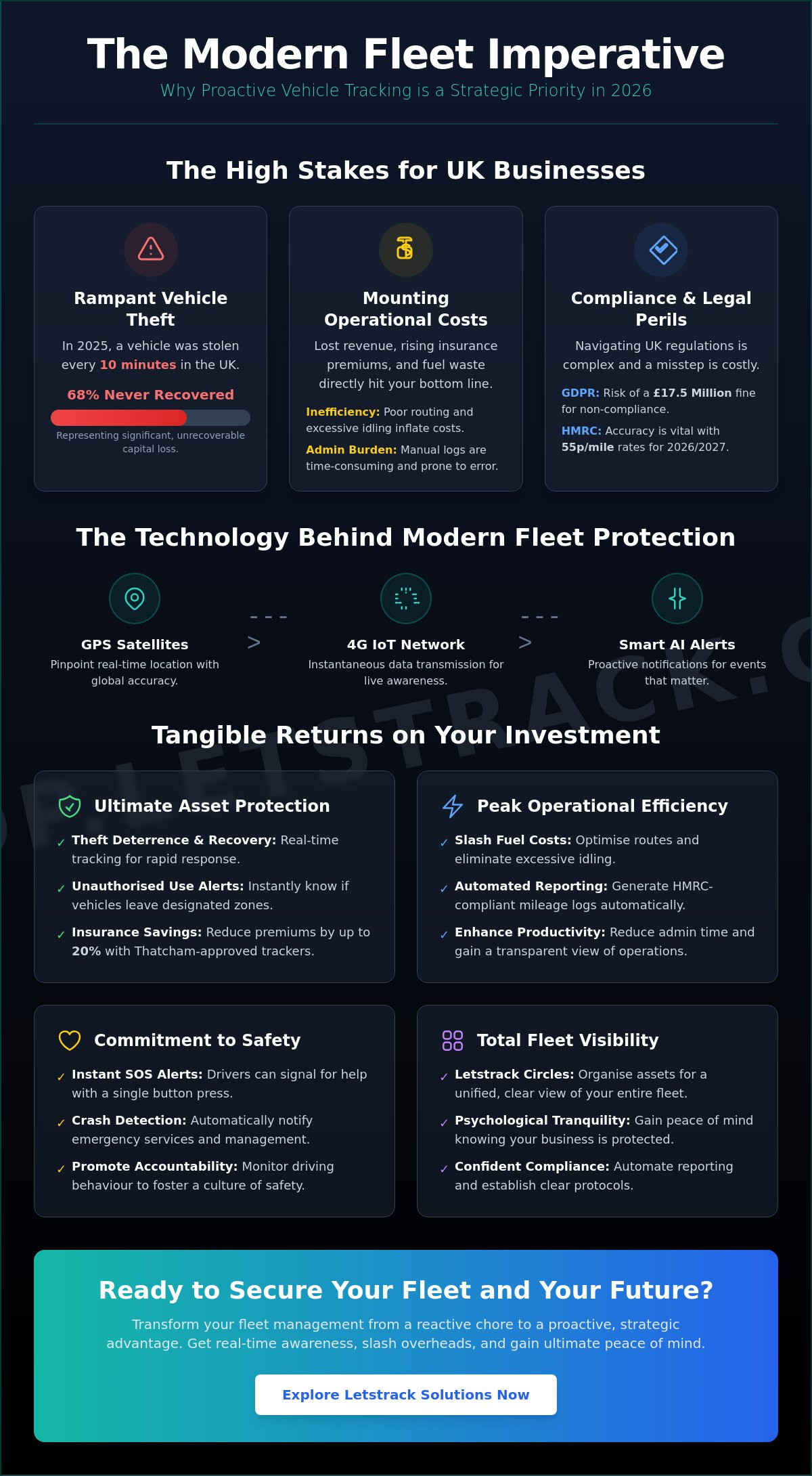
In 2025, a vehicle was stolen every ten minutes across the UK, and 68% of those assets were never recovered. For any business owner, these aren't just numbers; they represent lost revenue, rising insurance premiums, and a direct hit to your operational stability. You need more than just a map. You need a vigilant digital protector that keeps you connected to your fleet at all times. Learning how to track company vehicles effectively is no longer about simple surveillance. It's about building a sophisticated, secure ecosystem that empowers your team while protecting your bottom line.
We understand that the balance between total visibility and employee trust feels delicate. You're likely worried about unauthorised vehicle use or the sting of a £17.5 million GDPR fine for non-compliance. This guide promises to clear the fog. You'll master the latest GPS tracker technology, navigate the 2026 HMRC mileage rates of 55p per mile, and implement steps that turn your fleet into a source of psychological tranquility. We'll explore how to automate your compliance, prevent theft, and slash overheads using real-time location sharing and smart AI alerts.
Key Takeaways
- Transform your fleet management from reactive logging to proactive, real-time awareness to reduce overheads and fuel waste.
- Master how to track company vehicles using advanced 4G IoT technology for instantaneous data transmission and total asset security.
- Navigate UK GDPR and HMRC requirements confidently by establishing clear transparency and legitimate interest protocols for your drivers.
- Identify the ideal hardware solution for your business, comparing rapid OBD-II deployment with the security of professional hardwired trackers.
- Organise your assets into Letstrack Circles to achieve total fleet visibility and the psychological tranquility of knowing your business is protected.
Why Tracking Company Vehicles is a Strategic Priority in 2026
In 2026, fleet management has evolved far beyond simple dots on a map. Static logs and end of day reports are relics of the past. Modern business owners now prioritise a Vehicle Tracking System that provides instantaneous, real-time awareness. This shift from reactive management to proactive connectivity is a strategic necessity. It allows you to respond to delays, unauthorised use, or emergencies the moment they happen. Understanding how to track company vehicles effectively ensures your business remains agile and your assets stay secure in an increasingly fast paced market.
The transition to 4G IoT networks has transformed the GPS tracker into a vigilant digital protector. This technology doesn't just record where a van has been; it monitors how it is being driven. By integrating high tech hardware with intuitive software, you gain a transparent view of your entire operation. This level of visibility fosters a culture of accountability and safety, ensuring that every mile driven contributes to your company's growth rather than draining its resources.
To better understand the balance between fleet visibility and driver privacy, watch this helpful video:
Protecting Your Assets from Modern Theft
With a vehicle stolen every ten minutes in the UK during 2025, traditional alarms are no longer a sufficient deterrent. High value company vans are primary targets for sophisticated thieves who can bypass basic security in seconds. Implementing a robust solution like the Shield 4G GPS tracker provides a critical layer of guardianship. Real time location data allows for rapid recovery, often before a vehicle can be stripped or moved across borders. The presence of both visible and hidden tracking units creates a powerful deterrent, giving you the peace of mind that your physical capital is always under a watchful eye.
Driving Operational Efficiency and ROI
Operational costs are often inflated by invisible inefficiencies like excessive engine idling and poor route planning. By analysing historical traffic and location data, you can optimise every journey to slash fuel expenditure. This is particularly vital as you manage the transition to electric vehicles under the 2026 ZEV mandate. Using a S7 GPS tracker also automates your administrative burden. Instead of chasing drivers for manual logs, the system generates HMRC compliant reports automatically. With the 2026/2027 mileage rate set at 55p per mile, accuracy in reporting is essential for maximising your tax efficiency and reducing overheads.
Safety remains the ultimate priority for any responsible employer. Instantaneous SOS alerts and crash detection features ensure that if a driver is in trouble, help is dispatched immediately. This commitment to safety does more than protect your team; it also reflects well on your business profile. Installing Thatcham approved trackers can reduce your annual commercial insurance premiums by up to 20%, directly boosting your return on investment while securing your fleet's future.
The Technology Behind Modern GPS Vehicle Tracking
Modern GPS vehicle tracking is a sophisticated fusion of global satellite signals and high-speed 4G IoT networks. Unlike the passive logging systems of the past, today's technology offers active, instantaneous awareness. It's the difference between finding out a vehicle was misused yesterday and receiving an alert the second it leaves a designated zone. When you're deciding how to track company vehicles, the priority should be this constant linkage. It transforms a simple hardware device into a watchful companion that never sleeps.
A key advantage of this digital ecosystem is the ability to leverage the strategic benefits of fleet management through AI-driven insights. Artificial intelligence now filters vast amounts of data to highlight only what matters. It identifies aggressive driving patterns or out-of-hours use, sending critical notifications directly to your smartphone. This ensures you aren't overwhelmed by data but empowered by it. You can access this visibility 24/7 through dedicated mobile apps, keeping you connected to your assets whether you're in the office or on the move.
GPS vs. IoT: A New Era of Connectivity
The shift to 4G-enabled trackers ensures your fleet remains connected even in the most remote corners of the UK. Whether your vans are in the Scottish Highlands or the narrow streets of London, the data transmission remains crisp and reliable. Cloud-based software processes this information in milliseconds, providing a seamless experience across all your devices. Security is paramount; all data is protected by end-to-end encryption. This keeps your business information private and ensures compliance with strict UK data laws. For rapid deployment, an easy-plug tracker can get your connectivity live in minutes.
Understanding Geofencing and AI Alerts
Geofencing allows you to draw virtual boundaries around depots, warehouses, or client sites. In 2026, geofencing and tracking applications account for 42% of the fleet management market, according to projections from January 2026. When a vehicle crosses these spatial boundaries, you receive an immediate alert. AI takes this further by monitoring vehicle health and driver behaviour. It detects harsh braking or rapid acceleration, allowing you to coach drivers for better safety and fuel efficiency. This proactive approach reduces wear and tear while keeping your team safe.
The Letstrack Circles concept takes this connectivity to a collaborative level. You can organise your fleet into manageable groups based on region, team, or vehicle type. This unique approach allows for shared visibility among managers, ensuring everyone stays informed without compromising security. It's about creating a connected community within your business, where peace of mind is the standard, not a luxury. If you're ready to secure your assets, consider exploring the Shield 4G GPS tracker for maximum protection.
Navigating UK Laws: Consent, GDPR, and HMRC Compliance
Compliance isn't just a administrative checkbox; it's a shield for your business. Under UK GDPR, you must establish a 'Legitimate Interest' before you begin monitoring your fleet. This means balancing your operational needs with the driver's fundamental right to privacy. A failure to get this right can lead to severe consequences. As of May 2026, the maximum fine for a UK GDPR breach stands at £17.5 million or 4% of your total annual worldwide turnover. Understanding how to track company vehicles legally is the foundation of a resilient, secure business.
Transparency is your strongest tool for maintaining a positive workplace culture. Covert tracking is illegal in almost all commercial circumstances. You must inform your team about what data is being collected and why. When employees understand that a GPS tracker is there to ensure their safety and simplify their admin, resistance turns into trust. This open approach transforms a technical tool into a shared asset for the whole team.
Securing Employee Consent and Trust
Drafting a clear vehicle tracking policy is an essential first step. Add this to your employee handbook to ensure everyone is on the same page. Focus on the safety benefits, such as instantaneous SOS alerts and breakdown support, which provide drivers with a direct link to help in an emergency. For vehicles used outside of business hours, privacy is non-negotiable. Implement 'Privacy Switches' within the app to allow drivers to mask their location during personal time. This ensures you remain a vigilant protector of your assets without intruding on your team's private lives.
Meeting HMRC Mileage Standards
Accuracy in mileage reporting is vital for both tax efficiency and legal protection. For the 2026/2027 tax year, the HMRC approved mileage rate for cars and vans is 55p per mile for the first 10,000 business miles. This is a significant increase from previous years, making precise records more valuable than ever. Using a dedicated vehicle health tracker automates the P11D process by generating digital trip reports that distinguish between business and private use.
Digital logs remove the risk of human error and ensure your data can withstand a rigorous HMRC audit. By automating this workflow, you save hours of administrative work and eliminate the fear of 'Benefit in Kind' (BIK) tax errors. It's about creating a steady, rhythmic pulse of efficiency that keeps your business compliant and your overheads low. When your data is encrypted and user-controlled, you gain total visibility without compromising on security or ethics.
Choosing the Right Tracking Hardware for Your Fleet
Selecting hardware is the tactical phase of your connectivity strategy. Whether you manage three local delivery vans or a national fleet of HGVs, the hardware must reflect your specific security requirements. When considering how to track company vehicles, you'll find that one size rarely fits all. You need a device that integrates seamlessly with your vehicle's architecture while providing a constant, unblinking eye on your investment. This choice determines the quality of your data and the speed of your response during a crisis.
Plug-in vs. Hardwired Trackers
OBD-II trackers are the gold standard for rapid deployment. These 'Plug and Play' devices, such as the Easy Plug Tracker, are ideal for leased vehicles or fleets that require frequent hardware rotation. You simply plug them into the diagnostic port. There's no need for professional installation, and you can move them between assets in seconds. This flexibility is perfect for businesses that scale quickly or use temporary subcontractors.
For permanent fleet assets and high-risk security, hardwired units are the superior choice. Devices like the S7 GPS Tracker are installed deep within the vehicle's wiring, hidden from view. This makes them nearly impossible for unauthorised individuals to find or tamper with, ensuring your guardianship remains intact. Hardwired trackers also allow for more advanced features, such as remote engine immobilisation, which gives you the power to stop a stolen vehicle in its tracks via your mobile app.
Advanced Features for Commercial Use
In 2026, 4G connectivity is the absolute baseline for reliable fleet operations. Older 2G or 3G units suffer from signal dropouts and data lag, which can be disastrous during a recovery attempt. A modern 4G tracker ensures a steady, rhythmic pulse of information, providing the instantaneous awareness you need to manage a fast-moving business. You don't just want to know where your vehicles are; you want to know they are healthy and ready for the road.
Modern units also offer sophisticated 'Vehicle Health' monitoring. Using a vehicle health tracker allows you to see fault codes and battery levels in real-time. This proactive data helps you schedule maintenance before a minor issue becomes a costly breakdown, protecting your ROI. For non-powered equipment like trailers, generators, and site tools, asset tags provide the same level of visibility. This creates a single, inseparable ecosystem where every part of your inventory is accounted for and protected.
A critical feature for any commercial tracker is a robust battery backup. If a thief attempts to cut the power supply, a high-quality tracker will remain active, continuing to broadcast its location. It's about taking immediate, empowered action to protect your property. Secure your business today by choosing a GPS tracker that offers total visibility and uncompromised security.
Implementing Letstrack Solutions for Total Fleet Visibility
Implementing a connectivity strategy isn't just about hardware. It's about transforming raw data into actionable intelligence that brings peace of mind to your daily operations. When you master how to track company vehicles with Letstrack, you aren't just observing a map. You're creating a vigilant, secure environment where every asset is accounted for. This digital transformation ensures that your business remains agile, efficient, and protected against the unexpected challenges of 2026.
The Letstrack ecosystem offers a unified approach to asset guardianship. You can monitor everything from heavy goods vehicles to small delivery vans within a single interface. By using the Shield 4G, you gain maximum security through advanced features like engine immobilisation and AI-driven alerts. This constant linkage doesn't just protect your property; it empowers your team. Real-time location sharing allows your customer service department to provide precise ETAs, boosting client trust and operational transparency.
The Letstrack Circles Advantage
One of the most powerful features of our platform is the 'Letstrack Circles' concept. This allows you to organise your fleet into manageable groups based on specific criteria like region, vehicle type, or delivery route. It's a collaborative way to manage visibility. You can grant specific access levels to different team members, ensuring that everyone has the information they need without compromising data security. This structure mirrors the precision of your business, providing a steady, rhythmic pulse of efficiency across your entire UK operation.
Getting Started with Your Fleet Transformation
Taking the first step toward total visibility is straightforward. Follow these three steps to secure your assets and optimise your overheads:
- Step 1: Audit your fleet. Identify your high-risk vehicles or those with the highest operational costs. Focus on assets that are essential for daily revenue.
- Step 2: Select your hardware. Choose between the rapid deployment of an easy-plug tracker or the permanent security of a hardwired unit based on your fleet's specific needs.
- Step 3: Empower your team. Train your managers and drivers on the Letstrack Tracking App. Ensure they understand how to use the privacy switches and SOS features to enhance their own safety.
Your journey toward total fleet visibility starts with a single connection. Don't leave your assets to chance in an unpredictable market. Learning how to track company vehicles effectively is the best investment you can make for your business's future. Secure your company vehicles today with Letstrack and experience the psychological tranquility that comes with being truly connected. Every vehicle, every mile, and every driver is protected by a vigilant digital protector that never sleeps.
Secure Your Fleet's Future with Instant Connectivity
The challenge of how to track company vehicles is no longer about simple location checks; it's about building a vigilant, 4G-connected ecosystem. You now understand that real-time 4G connectivity and AI-driven security alerts provide a level of guardianship that traditional systems simply cannot match. By automating your HMRC-ready mileage reporting, you've turned a complex administrative burden into a streamlined pulse of efficiency that protects your business from costly errors.
Choosing the right hardware is the final piece of your security puzzle. Whether you opt for a rapid-deploy tracker or a covert hardwired unit, you're investing in the psychological tranquility that comes from constant awareness. This technology empowers you to protect your team, secure your assets, and optimise your overheads with a single, unified interface. It's time to transform your fleet from a source of worry into a transparent, high-performing asset.
Don't leave your fleet's safety to chance in an unpredictable market. Empower your fleet with Letstrack's 4G GPS Solutions and take full control of your business assets today. Your journey toward total visibility and connection starts here. Stay connected, stay secure, and lead your business with confidence.
Frequently Asked Questions
Is it legal to track company vehicles in the UK without employee consent?
No, covert tracking is illegal in almost all UK business scenarios. You must inform your drivers about the presence of a tracker and establish a 'Legitimate Interest' under UK GDPR. Establishing how to track company vehicles legally requires a foundation of transparency to prevent disputes. Providing a clear written policy ensures your team understands the system is a tool for safety and efficiency, not just surveillance.
How much does it cost to track a company vehicle per month?
Monthly costs vary based on the level of connectivity and data transmission required for your specific business needs. While entry-level plans provide basic location sharing, advanced systems with AI alerts and engine immobilisation sit at a different tier. You should check current subscription options to find a plan that balances your need for total visibility with your operational budget and fleet size.
Can GPS tracking reduce my business insurance premiums?
Yes, installing a Thatcham-approved tracker can reduce your annual commercial insurance premiums by up to 20%. Insurers view GPS tracking as a significant risk mitigator because it dramatically increases the chances of rapid vehicle recovery after a theft. This reduction in risk allows you to recoup the initial hardware investment through lower overheads, providing a tangible return on your security investment.
What happens if a driver unplugged an OBD-II tracking device?
If a driver unplugs an OBD-II device, the system sends an instantaneous alert to your digital dashboard. Modern units feature tamper alerts designed to notify managers of any unauthorised removal or power loss. This ensures your guardianship remains active and allows you to address the issue immediately. Constant linkage is required for secure fleet operations, and AI-driven notifications keep you informed of these critical events.
How do I explain vehicle tracking to my employees to avoid backlash?
Focus the conversation on driver safety and administrative ease rather than monitoring. Explain how features like SOS alerts and breakdown support provide a direct lifeline in emergencies. Highlighting the automated mileage logs also shows drivers how the system removes the burden of manual paperwork. Using privacy switches for after-hours use demonstrates that you respect their personal time and value their right to privacy.
Does vehicle tracking work if the car battery is disconnected?
High-quality trackers continue to function even if the vehicle's main battery is disconnected. These units include an internal backup battery designed to broadcast location data for a limited period after power loss. This is a critical security feature for asset protection. It allows you to track a vehicle if a thief attempts to disable the power supply, ensuring your vigilant protector remains active during a crisis.
Can I use vehicle tracking data for HMRC mileage claims?
Yes, you can use automated tracking data to produce accurate, HMRC-compliant mileage reports. For the 2026/2027 tax year, the business mileage rate is 55p per mile for the first 10,000 miles. Digital logs provide the precise records needed to withstand a rigorous audit. This automation ensures you claim the correct amounts while reducing the risk of 'Benefit in Kind' tax errors and saving hours of admin.
What is the difference between a car tracker and a fleet management system?
A car tracker is the physical hardware that provides location data, while a fleet management system is the comprehensive software ecosystem. A tracker gives you the 'where', but the management system provides the 'how' and 'why' through AI alerts and analytics. When you're researching how to track company vehicles, look for a solution that integrates both components for total operational awareness and peace of mind.