

Cloth Iron On Name Labels: The Ultimate 2026 Guide to Labelling & Organisation
Imagine it's Monday morning and your child's expensive school blazer has vanished from the cloakroom without a trace. It's a frustrating, costly experience that thousands of UK parents face every term, often because traditional markers fade or labels peel off after a single wash. You need a solution that remains vigilant when you aren't there to watch over your family's belongings.
We agree that you deserve a labelling system that's permanent, scratch-free, and simple to apply. This guide will teach you exactly how to choose and maintain cloth iron on name labels to ensure every item, from sports kits to winter coats, always finds its way home. We'll also examine how the EU's Ecodesign for Sustainable Products Regulation, in full effect since 12 January 2026, is making Digital Product Passports a reality for modern wardrobes.
You'll discover the best application techniques for long-term durability and see how products like Letstrack Smart Iron-On Tags with QR codes provide real-time connectivity for your assets. This is your roadmap to achieving total peace of mind through smarter organising and reliable asset protection.
Key Takeaways
- Understand how heat-activated thermoplastic adhesive creates a permanent bond that survives 60-degree washes and high-heat tumble drying.
- Master the professional application of cloth iron on name labels by using the correct heat settings on clean, softener-free fabrics.
- Protect the dignity of loved ones in care homes or hospitals by reducing laundry anxiety with discreet, long-lasting identification.
- Discover how to transition from simple identification to a multi-layered safety strategy using the Letstrack ecosystem for real-time asset recovery.
- Gain total control over your family's belongings with a flexible labelling solution designed for long-term durability and peace of mind.
What are Cloth Iron On Name Labels and Why Do You Need Them?
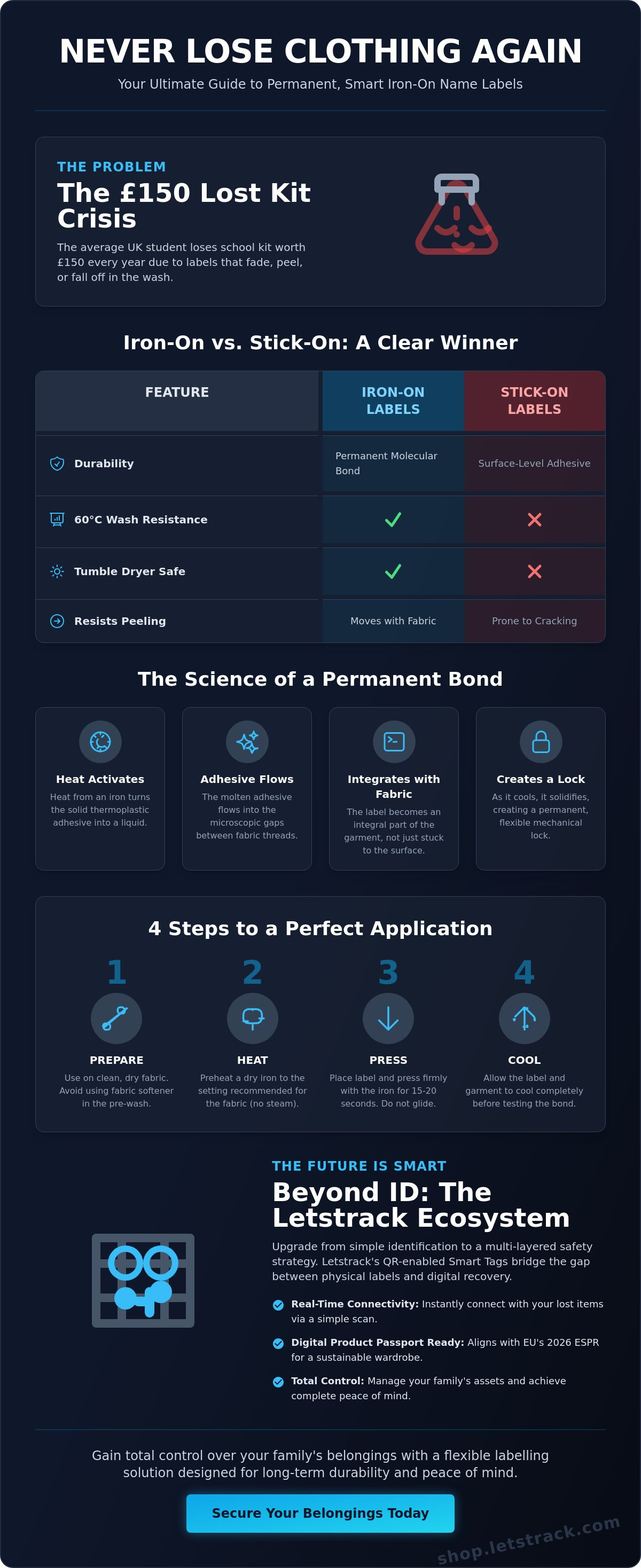
Precision-engineered identification is the first line of defence against lost property. At their core, cloth iron on name labels are high-performance tags that use a heat-activated adhesive to bond permanently with fabric fibres. This creates a resilient link that stays attached through the rigours of daily life. Unlike traditional stickers that rely on surface-level glue, these labels become an integral part of the garment itself. They are designed to withstand the high temperatures and mechanical stress of modern laundry cycles.
The secret to this durability is the thermoplastic backing. When you apply heat from a domestic iron or a professional heat-press, this solid adhesive transitions into a liquid state. It flows into the microscopic gaps between fabric threads to create a mechanical lock. You can find detailed information on how iron-on labels work to understand this molecular bond. This process results in a flexible, permanent attachment that moves with the fabric instead of cracking or peeling away.
To better understand this concept, watch this helpful video:
Many parents still remember the tedious hours spent sewing name tapes into collars. Modern families don't have that luxury. These cloth iron on name labels offer a faster, more secure alternative. We use specific terminology like "permanent ink" and "nylon-polyamide blends" to describe the high-grade materials that ensure longevity. These labels are designed for heat-press compatibility, allowing you to secure an entire school uniform in minutes rather than hours. This efficiency provides immediate empowerment for busy households.
The Evolution of Clothing Identification
Clothing identification has moved far beyond hand-stitched monograms. High-speed thermal transfer technology now allows for crisp, clear text that won't fade over time. As of January 2026, the EU's Ecodesign for Sustainable Products Regulation (ESPR) has accelerated the need for durable labelling that supports Digital Product Passports. Modern synthetic fabrics require specific adhesive types to prevent peeling. We now prioritise soft-touch materials that avoid the skin irritation often caused by older, scratchy nylon tags, ensuring comfort for children with sensory sensitivities.
Key Use Cases: School, Sport, and Beyond
Managing the lost property mountain in UK schools is a constant battle. A 2025 survey suggested that the average UK student loses £150 worth of kit every year. Clear labelling on high-performance PE kits is essential. These labels bond with moisture-wicking fabrics without damaging the technical fibres. In communal environments like boarding schools or sports academies, they provide the first layer of security for personal belongings. For high-value assets, integrating these with a label sticker tag or QR system adds a layer of real-time recovery potential, bridging the gap between physical ID and digital connectivity.
The Benefits of Choosing Iron On Over Stick On Labels
Choosing the right identification method is a decision between temporary convenience and long-term security. While stick-on labels offer speed, they often fail under the thermal stress of a standard laundry cycle. High-quality cloth iron on name labels provide a superior alternative because they create a molecular bond with the fabric. This permanent solution ensures that even after months of heavy use, the identification remains legible and attached. It's about building a reliable system that guards your family's assets without constant maintenance.
Durability is the primary differentiator. These labels are engineered to withstand 60-degree washes and heavy-duty tumble drying. Cheaper stick-on versions rely on pressure-sensitive adhesives that degrade when exposed to heat and water. In contrast, the heat-activated resin in iron-on tags penetrates the garment fibres. This flexibility allows the label to move with the fabric, preventing the unsightly cracking or peeling seen in inferior products. For high-value items that require digital tracking, you might consider pairing physical labels with a TouchTag Premium to create a multi-layered security approach.
Washing Machine and Tumble Dryer Resistance
The reliability of an iron-on label depends on the "melt point" of its adhesive. Standard domestic laundry temperatures rarely exceed 60 degrees, which is safely below the threshold required to break the label's bond. This makes them the preferred choice for industrial laundry settings in schools or hospitals. To achieve the best results, understanding fabric care symbols is critical. Checking the care tag ensures the garment can handle the iron's heat without damage, allowing the ink to remain crisp after 50 or more wash cycles.
Comfort and Skin Sensitivity
Comfort is just as important as durability, especially for children. Traditional woven labels often have sharp edges that cause skin irritation. Modern cloth iron on name labels feature a "soft-touch" finish and rounded corners. This design choice serves two purposes: it prevents the label from lifting at the edges and ensures it doesn't chafe against sensitive skin. We always recommend using non-toxic, eco-friendly inks. These are essential for toddler clothing and items that come into direct contact with the skin, providing safety that goes beyond simple identification.
Investing in a bulk pack for the school year is a cost-effective strategy. It reduces the cost per garment and ensures you always have a professional labelling solution ready for new purchases. If you want to extend this level of organisation to your digital life, check out how a Bluetooth Tag Mini can help you locate smaller essentials in real-time.
Step-by-Step: How to Apply Iron On Labels Like a Pro
Applying cloth iron on name labels is a task that demands vigilance and precision. While the process is quick, cutting corners leads to peeling and loss of property. Achieving a permanent bond requires a specific synergy of heat, time, and pressure. Before you begin, ensure the garment is freshly laundered and completely dry. It must be free from fabric softener. Research into textile adhesives indicates that residual chemicals from softeners are responsible for a significant percentage of adhesion failures. These chemicals create a microscopic barrier that prevents the label's resin from anchoring into the fabric fibres.
Set your iron to the "Silk" or "Wool" setting. This is the "Goldilocks" zone for most thermoplastic adhesives. It's hot enough to liquefy the resin but not so intense that it damages synthetic fabrics. Place the label on the garment and cover it with a silicone release sheet or a piece of thin parchment paper. This protects both the label surface and your iron's baseplate from adhesive transfer. Apply firm, downward pressure for exactly 15 seconds. Do not use a back-and-forth "ironing" motion. Stationary pressure ensures the adhesive flows vertically into the weave of the cloth. If you are organising a school kit, consider placing a SendSafe 4G Tracker in the backpack once you've finished labelling the uniform. This provides a dual layer of security: physical ID on the clothes and real-time location awareness for the bag.
Common Application Mistakes to Avoid
The most frequent error is the "Steam Trap." You must turn off the steam function and empty any water from the iron's reservoir. Steam introduces moisture into the bond, which creates tiny air pockets that cause the label to lift after the first wash. Overheating is another risk. If the iron is too hot, you may "burn off" the adhesive layer rather than melting it into the fabric. Finally, check your work surface. Never apply labels on a bumpy or padded ironing board cover. A hard, flat surface like a wooden board covered with a single thin pillowcase provides the resistance needed for a permanent set.
Troubleshooting Peeling Labels
If you notice an edge lifting, use the "Second Press" technique. Re-apply heat and pressure for 10 seconds, focusing specifically on the stubborn corner. This often happens if your iron has uneven heat distribution, a common issue in older domestic models. Allow the label to cool completely for at least 24 hours before the first laundry cycle. This "curing" time is essential for the bond to reach maximum strength. Be aware that certain fabric treatments, such as Teflon coatings or heavy waterproofing, may resist standard adhesives. In these cases, a slightly longer press time may be required to penetrate the protective layer.
Specialist Uses: Care Homes, Hospitals, and Travel
Asset protection isn't just for the school run. While we've discussed school uniforms, the utility of cloth iron on name labels extends into more sensitive environments like residential care and medical wards. For families with loved ones in care homes, "laundry anxiety" is a genuine concern. It's the stress of knowing personal, often expensive, clothing might vanish in a communal wash system. Clear, permanent identification is a vigilant solution. It ensures that a resident's wardrobe remains theirs, preserving their dignity and providing immediate peace of mind for their relatives.
Hospital stays present similar challenges. In high-turnover environments, personal items like dressing gowns, travel blankets, and even slippers are easily misplaced. Using a permanent label ensures these belongings return home with the patient. This isn't just about organisation; it's about maintaining a sense of self and security during a vulnerable time. By applying these labels to internal pockets or garment linings, you create a discreet but authoritative mark of ownership that care staff can easily identify.
Labelling for the Elderly and Vulnerable
When labelling for the elderly, clarity is paramount. Use high-contrast fonts, such as black text on a white background, to ensure care staff can read the name even in low-light conditions. Place labels in consistent, high-visibility areas like the back of the neck or the waistband. For those caring for individuals with dementia, physical identification is only the first step. We recommend combining these labels with personal GPS trackers to provide a multi-layered safety net for vulnerable wanderers. This hardware-software ecosystem ensures you're always connected to what matters most.
Travel and Adventure: Beyond the Wardrobe
Your cloth iron on name labels are also a "Digital Guardian" for your travel gear. Apply them to the internal linings of suitcases, the underside of sleeping bags, or even camping equipment for festivals and school trips. In a crowded airport or a busy campsite, these labels provide a reliable way to recover lost property. Multi-child households can benefit from colour-coding labels. Assigning a specific colour to each family member allows for rapid sorting after a holiday or a trip to the laundrette. This system turns a complex organisational task into a simple, efficient routine.
Empower your family with a complete security strategy that bridges the gap between physical and digital protection. Protect your family's assets and safety with our personal tracking solutions today.
The Letstrack Ecosystem: From Labels to Smart Connectivity
Physical identification is a vital first layer of defence. However, a name tag is essentially a passive tool. It relies entirely on the honesty and initiative of a stranger to return your property. To achieve true security in 2026, you must transition from simple identification to real-time recovery. While cloth iron on name labels ensure a garment is identifiable once found, a digital ecosystem allows you to be proactive. It moves the responsibility of recovery from the finder back to the owner.
Letstrack Circles transform asset management into a shared family responsibility. By using our integrated app, you create a private network where location data is encrypted and user-controlled. You aren't just labelling clothes; you're building a connectivity map for your entire household. For items with hard surfaces, such as water bottles, lunch boxes, or tablets, integrating label sticker tags alongside your fabric labels creates a unified tracking strategy. This ensures every item in your child's bag is accounted for, whether it is made of polyester or plastic.
Protecting What Matters Most: High-Value Assets
Expensive school blazers, tech-heavy backpacks, and laptops represent a significant financial investment. A name tag might help if the item reaches a lost property office, but high-value assets require more vigilance. Using the Touchtag Lite provides discreet, smart tracking for bags and heavy coats. These devices allow you to ring a misplaced item or view its precise location on the Letstrack map. Our mission is centered on this "Peace of Mind" concept, transforming complex hardware into a source of daily confidence for busy UK families.
Smart Tracking for Total Visibility
Smart tracking provides total visibility that traditional cloth iron on name labels cannot provide alone. If a suitcase is misplaced during travel or a kit bag is left on a bus, global discovery features help you locate it in real-time. Geofencing adds a sophisticated layer of protection. It allows you to set virtual boundaries around the school or home, sending instant alerts to your phone if an item leaves a designated area. For those managing a high volume of equipment, our range of inventory tags offers professional-grade asset management. This multi-layered approach ensures your family’s belongings don't just have a name; they have a guaranteed way home.
Take Control of Your Family's Assets
By April 2026, the shift toward Digital Product Passports makes durable labelling more critical than ever. Mastering the application of cloth iron on name labels is your first step toward a more organised, compliant home. You've learned how to create a permanent bond that survives 60-degree washes and how to protect the dignity of loved ones in care settings. These physical markers provide a reliable baseline for identification that stands the test of time.
True security comes from combining physical tags with smart technology. Letstrack offers a multi-layered defence system featuring UK-based expert support and real-time tracking technology. Your data privacy is always protected through encrypted, user-controlled systems. This ensures your valuables are never truly lost, even when they leave your sight. You now have the tools to transition from passive identification to proactive recovery.
Secure your valuables with Letstrack Smart Tags and join our circle of protection today. Stay connected and stay confident.
Frequently Asked Questions
How long do iron-on name labels typically last?
High-quality labels last for the life of the garment when applied according to the manufacturer's instructions. These tags are engineered to withstand over 50 wash cycles at 60 degrees Celsius without peeling or fading. Because the thermoplastic adhesive creates a permanent bond with the fabric fibres, the identification remains vigilant from the first day of term until the item is outgrown.
Can I use a hair straightener to apply iron-on labels?
Yes, a hair straightener is an effective tool for applying labels to small or awkward items. Set the device to a medium heat, typically between 150 and 170 degrees Celsius, and clamp the label firmly for 15 seconds. This method provides the direct, stationary pressure needed to liquefy the adhesive. It's a tech-forward solution for labelling narrow collars or the inside of plimsolls where a traditional iron won't fit.
Are iron-on labels safe for delicate fabrics like silk or polyester?
They are safe for most synthetics if you use a protective barrier and the correct heat setting. Always place a silicone release sheet or parchment paper between the iron and the garment to prevent scorching. For polyester or nylon blends, use the "Silk" setting to ensure the adhesive melts without damaging the delicate base material. Check the garment's care symbols to confirm it can handle moderate heat before you begin.
What happens if I need to remove an iron-on label later?
Re-heating the tag is the most reliable way to remove it for garment resale or donation. Apply a hot iron over parchment paper for 10 seconds to soften the adhesive, then use tweezers to peel the label away while it's still warm. While cloth iron on name labels are designed for permanent security, this process allows you to update the identification if the item changes hands within your family circle.
Can these labels withstand the high temperatures of a commercial laundry?
Professional-grade iron-on labels are specifically designed for the rigours of industrial laundry environments. They remain securely bonded in commercial washers and dryers that reach temperatures of 90 degrees Celsius. This durability is essential for care homes and hospitals, where high-heat sanitisation is a daily requirement. It ensures that personal belongings are always protected and identifiable, even in large-scale communal laundry systems.
Do iron-on labels stay on Teflon-coated school uniforms?
Yes, they stay attached, but they require a slightly longer application time to penetrate the protective coating. Increase your press time to 20 seconds and apply maximum downward pressure to force the adhesive through the Teflon layer. If the fabric is heavily treated, applying the label to the manufacturer's care tag is a reliable alternative. This ensures the bond is made with the untreated fabric underneath for total peace of mind.
What is the best way to label dark-coloured clothing?
Use white labels with high-contrast black ink to ensure maximum visibility on navy, black, or dark grey garments. This high-contrast approach allows teachers or care staff to identify the owner at a glance, even in low-light cloakrooms. Clear, bold lettering is a vital component of a vigilant organisation strategy. It reduces the time items spend in lost property and ensures they find their way home quickly.
How do I stop my iron-on labels from feeling scratchy?
Choose labels with rounded corners and a soft-touch finish to eliminate skin irritation. Scratchiness is usually the result of sharp, square edges or stiff, low-quality materials. Modern cloth iron on name labels utilise flexible nylon-polyamide blends that move with the fabric. This ensures that the label provides permanent protection without causing discomfort for children with sensory sensitivities or delicate skin.