

Best GPS Tracker for Dementia Patients UK: A 2026 Buying Guide
Imagine it’s 3:15 PM on a rainy Tuesday and your father hasn’t returned from his usual walk to the local chemist. The sharp panic that sets in during those first 10 minutes of silence is a feeling 850,000 UK families understand all too well. You want to respect their independence, yet the fear of a wrong turn or an injury is overwhelming. Selecting the right gps tracker for dementia patients uk isn’t just a tech purchase; it’s a vital step in reclaiming your sleep and your loved one's freedom.
You already know that constant worry shouldn’t be the price of caregiving. We promise to show you how to choose a reliable, IoT-integrated solution that delivers instant location updates and geofencing alerts directly to your smartphone. This guide explores the latest discreet wearables and "safe zone" systems for 2026, ensuring you have the tools to act as a digital guardian while your family stays connected and secure.
Key Takeaways
- Discover how a digital safety net protects vulnerable adults from wandering while preserving their vital independence and dignity.
- Learn why 10-second real-time updates and SOS emergency buttons are the critical features required for an immediate response.
- Compare discreet tags and wearables to identify the best gps tracker for dementia patients uk based on your loved one's specific daily routine.
- Master the setup of virtual geofences to receive instant mobile alerts the moment a family member moves beyond a designated safe zone.
- Explore the "Letstrack Circles" concept to share caregiving across the family, providing collective peace of mind through a secure, encrypted ecosystem.
Why a GPS Tracker for Dementia Patients is Essential in the UK
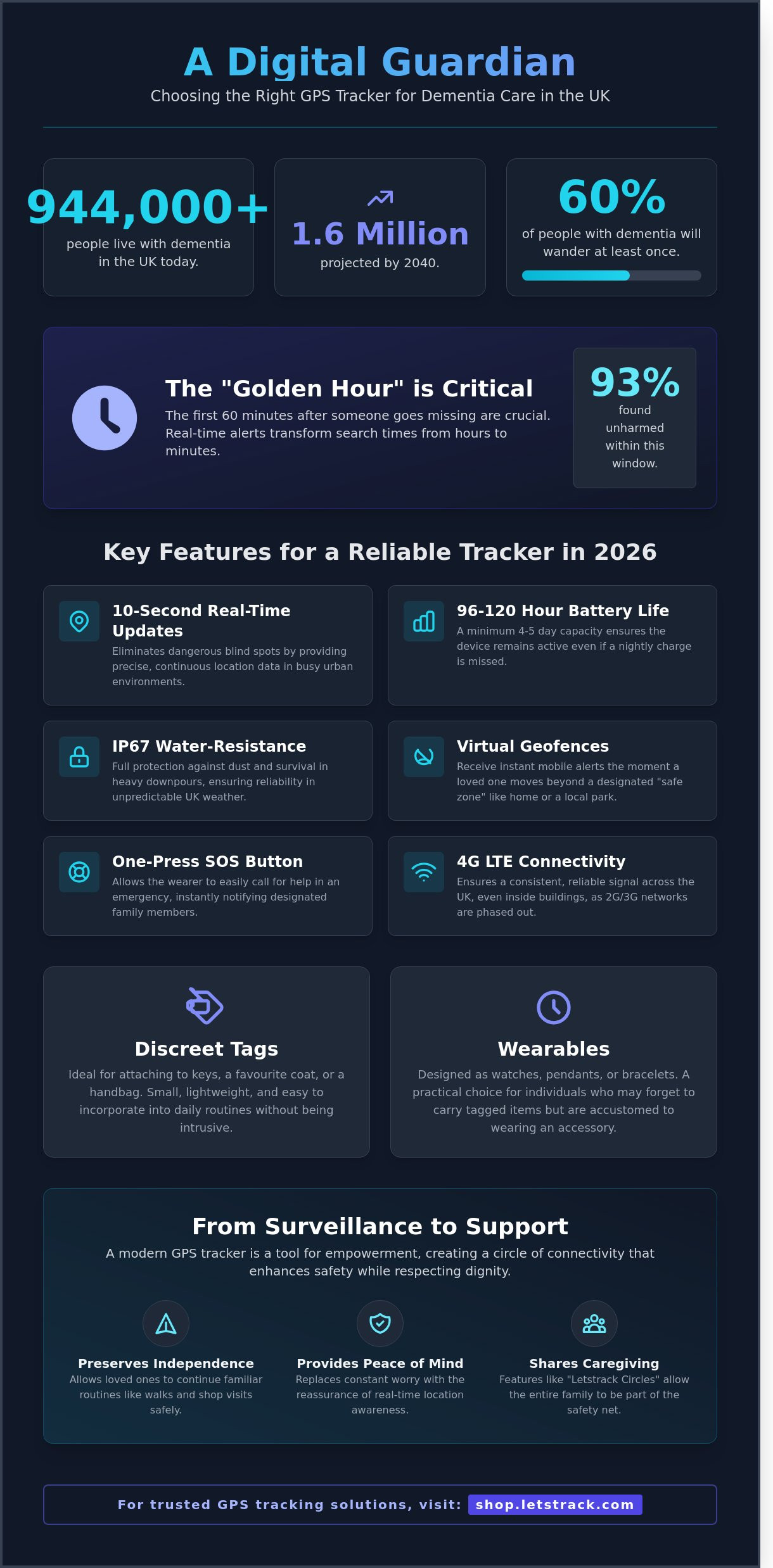
Over 944,000 people live with dementia in the UK today. This figure is projected to rise to 1.6 million by 2040. For many families, the most distressing symptom is "wandering," where a loved one becomes disoriented and leaves home without a clear destination. A gps tracker for dementia patients uk serves as a 24/7 digital guardian, ensuring they are never truly lost. It transforms a frightening situation into a manageable event by providing instant location updates directly to a smartphone app. This technology acts as a silent companion, watching over vulnerable adults when you cannot be physically present.
To better understand how these devices provide a safety net for the elderly, watch this helpful video:
Understanding Wandering and Safety Risks
Research from the Alzheimer’s Society indicates that 60% of people with dementia will wander at least once. Common triggers include boredom, a desire to "go home" to a childhood residence, or simple confusion during a routine walk. In these moments, the "Golden Hour" is critical. This term refers to the first 60 minutes after someone goes missing, where the chances of finding them safe are highest. Statistics show that 93% of individuals found within this window are unharmed. By using a modern GPS tracking unit, families receive instant geofencing alerts the moment a loved one exits a safe zone. This real-time data reduces search times from hours to minutes, providing vital protection against the UK’s unpredictable weather and busy traffic.
The Shift from Surveillance to Support
We don't view tracking as a tool for surveillance. It's a tool for dignity and freedom. Using a device like the Letstrack Personal allows patients to continue their daily habits, such as visiting a local park or shop, without constant physical supervision. This safety net keeps people in their favourite environments for longer periods, often delaying the transition to residential care. Ethical safety plans should involve the patient as early as possible, framing the gps tracker for dementia patients uk as a way to ensure they can stay independent. It creates a circle of connectivity that brings peace of mind to the entire family while respecting the individual's desire for movement.
- Real-time awareness: See exactly where your loved one is at any second.
- Instant alerts: Get notified on your phone if they leave a pre-set safe area.
- SOS features: Many devices allow the wearer to call for help with one button press.
- Historical data: Review past routes to understand common wandering patterns.
Key Features of a Reliable Dementia Tracker in 2026
Choosing a gps tracker for dementia patients uk requires looking beyond basic location pings. In 2026, real-time tracking is the non-negotiable standard for family safety. Passive logging, which only updates every few minutes, creates dangerous blind spots during a wandering episode. A high-spec device provides updates every 10 seconds. This precision allows you to see exactly which turn a loved one took in a busy UK high street, providing the visual clarity needed for a rapid response.
Reliability also hinges on physical resilience. UK weather is notoriously unpredictable; a device must have at least an IP67 water-resistance rating to survive a heavy downpour or an accidental splash. Battery life is equally vital for peace of mind. Look for hardware that maintains active tracking for at least 96 to 120 hours on a single charge. This buffer protects the user if a carer forgets the nightly plug-in, ensuring the digital guardian remains vigilant. The Shield 4G GPS tracker offers this level of rugged endurance and power management for long-term safety.
- Real-time updates: 10-second intervals eliminate guesswork in urban environments.
- Long-life battery: Minimum 4-day capacity to bridge charging gaps.
- IP67 Rating: Total protection against dust and immersion in water.
- Geofencing: Instant alerts when a user leaves a pre-defined safe zone.
The Importance of 4G LTE Connectivity
By 2026, 2G and 3G networks have been phased out across most of the UK. Modern trackers must utilise 4G LTE or 5G connectivity to ensure consistent signal penetration inside thick-walled homes and dense urban centres. IoT-integrated devices use these advanced networks to provide a more accurate "last-seen" location if a user enters an area with poor satellite visibility. This connectivity ensures that your gps tracker for dementia patients uk stays online when it matters most.
SOS Alerts and Two-Way Audio
The SOS button is the most direct link between a confused user and their family. Pressing it triggers an instant, high-priority notification on the carer's smartphone app. Two-way audio then allows you to speak directly through the device, offering immediate comfort. This voice connection can instantly de-escalate a panic attack or provide simple directions to a lost individual. An SOS alert acts as a critical lifeline for dementia safety by bridging the gap between a moment of distress and immediate human connection.
Choosing the Right Form Factor: Tags vs. Wearables
Selecting the correct gps tracker for dementia patients uk requires a balance between high-tech capability and the user's daily habits. You must assess whether the patient is likely to remove a device or if they still maintain a routine with specific items. By 2026, tracking hardware has become smaller and more resilient, offering options that fit into a pocket or sit comfortably on a wrist without causing distress.
Discreet Tags and Personal Locators
Discreet tags are ideal for the early stages of dementia. Using a TouchTag Premium for keys or wallets ensures that location data is available whenever they leave the house. These tags use the "Find My" network, providing a massive search grid across the UK. For more precise, active monitoring, the LT Personal device offers a dedicated GPS signal. You can effectively hide this small unit in the lining of a favourite coat or inside a handbag. This prevents the user from feeling "tracked," which often reduces the urge to leave the device behind. It's a simple way to maintain safety without disrupting their sense of independence.
Wearable Safety and Smart Watches
The Smart Guard Tracker serves as an all-in-one safety watch. It's often the most natural choice for elderly users who have worn a timepiece their entire lives. Beyond location, it provides two-way voice calls and SOS alerts. While "Find My" tags offer long battery life, dedicated wearables provide real-time updates every 10 to 60 seconds. This speed is vital during a wandering incident. Ensure you choose a model with a comfortable, hypoallergenic strap to encourage 24-hour use. For patients in advanced stages, lockable "un-removable" straps are now a standard safety feature to prevent the wearer from accidentally taking the device off.
- Tags: Best for battery longevity and discretion; usually lasts 12 months.
- Wearables: Best for instant communication and real-time accuracy; requires daily charging.
- Placement: Always place trackers in items the patient naturally picks up, like a wallet or house keys.
Your choice should reflect the patient's level of cognitive decline. A wearable offers the highest level of security for those prone to frequent wandering, while a discreet tag provides peace of mind for those still maintaining a high degree of independence. Every second counts when a loved one is missing. Picking the right form factor ensures the gps tracker for dementia patients uk stays with them when they need it most. This connectivity is the bridge between technical functionality and human safety.
How to Organise Geofences and Safe Zones
A geofence is a virtual boundary you draw on a digital map. When your loved one crosses this invisible line, your smartphone receives an instant alert. Selecting the right gps tracker for dementia patients uk means choosing a system that balances high-tech alerts with ease of use. This feature acts as a 24/7 digital sentry, transforming a passive device into an active protection tool.
Effective safety management requires multiple zones. You shouldn't rely on a single circle around the house. Instead, create a "Home" zone for the building, a "Garden" zone for the outdoors, and "Safe Hubs" for the local pharmacy or community centre. This tiered approach tells you exactly where they are, not just that they've left home. You can customise these alerts for different times. A walk in the garden is safe at 14:00, but an alert at 02:00 suggests immediate wandering that requires intervention.
Managing false alarms is vital for maintaining carer vigilance. GPS signals can occasionally drift by 5 to 10 metres due to tall buildings or heavy cloud cover. To prevent alert fatigue, set your home boundary slightly wider than the physical walls. This ensures every notification you receive is genuine and deserves your full attention. By refining these boundaries, you maintain the high level of responsiveness needed for real-time safety.
Step-by-Step Geofence Setup
Setting up your first safe zone takes less than two minutes. Open the Letstrack app and tap the "Safe Zone" icon. You can choose a circular radius or draw a custom polygon to match the exact shape of a park or street. Enter the UK postcode, name the zone "The Local Shop" or "Day Centre," and save. Your digital guardian is now active. You'll receive a push notification the moment the gps tracker for dementia patients uk enters or exits these areas.
Privacy, Security, and Data Encryption
Security is our priority because location data is deeply personal. Letstrack uses military-grade AES 256-bit encryption to protect every signal sent from the device to the cloud. Your data remains entirely user-controlled; only you and those you invite into your "Letstrack Circle" can see the real-time movement. Our secure UK-compliant cloud infrastructure ensures that your family's privacy is never compromised while providing the constant connectivity you need.
Secure your peace of mind today with the Letstrack LT Personal tracker for real-time safety updates.
Why Letstrack is the Trusted Choice for UK Families
Letstrack acts as a digital guardian for your family. We don't just sell hardware; we provide a 24/7 security detail for your most vulnerable loved ones. Choosing the right gps tracker for dementia patients uk families can rely on means finding a balance between high-tech precision and emotional security. Our mission focuses on bringing peace of mind to every household through constant connectivity. We combine global IoT infrastructure with dedicated UK-specific support to ensure your loved ones remain safe. Our ecosystem integrates high-performance hardware with a seamless mobile app, turning complex data into instant, actionable insights.
The Power of Letstrack Circles
Caregiving is a team effort. The "Letstrack Circles" feature allows you to invite siblings, neighbours, or professional carers into a private tracking group. Every member sees the same real-time data. When an alert triggers, the app sends synchronised notifications to everyone in the circle simultaneously. This ensures no SOS call or geofence breach goes unnoticed. If a family member wanders, the app-to-app features allow the entire circle to coordinate a search. You can see each other's live positions on the map, making the recovery process fast and organised.
Recommended Devices for Dementia Care
We offer specialised hardware designed for different stages of dementia. For robust, long-term personal tracking, the S7 GPS Tracker is the industry standard. It provides pinpoint accuracy and long battery life, ensuring you stay connected even during extended outings. For those who prefer a more traditional look, the Smart Guard offers professional tracking in a familiar watch format. It's discreet and comfortable for daily wear.
- Pinpoint Accuracy: Our devices use advanced GPS modules for real-time location sharing.
- Instant Alerts: Receive notifications the moment a loved one leaves a pre-set safe zone.
- Encrypted Data: Your family's privacy is protected by bank-grade encryption.
Getting started is straightforward. Select your preferred hardware and activate a Letstrack subscription to access real-time updates and historical route data. This setup provides the constant vigilance needed for effective dementia care. It transforms a complex gps tracker for dementia patients uk into a source of daily confidence for the whole family.
Secure Their Independence and Your Peace of Mind
Selecting the right gps tracker for dementia patients uk is about more than location dots on a map; it's about maintaining dignity through 2026 and beyond. You've seen how 4G IoT integrated hardware ensures reliable connectivity across the country, while custom geofencing provides the instant alerts needed for a rapid response. By choosing a device with Red Dot Design Award winning heritage, you're investing in hardware that's as discreet as it is durable.
Letstrack prioritises your family's privacy with fully encrypted real-time data, ensuring you're always the one in control of sensitive information. Whether you choose a wearable or a compact tag, the goal remains the same: keeping your loved ones safely connected to the people who care most. Don't wait for a wandering incident to upgrade your home safety strategy.
Secure your peace of mind, shop the Letstrack Personal Safety collection today
You've now got the knowledge to provide a safer, more confident lifestyle for your family starting today.
Frequently Asked Questions
Is it legal to use a GPS tracker for a dementia patient in the UK?
Yes, using a gps tracker for dementia patients uk is legal under the Mental Capacity Act 2005. You must ensure the device is used in the person's best interest if they're unable to provide informed consent. This technology balances their right to privacy with your need to ensure their physical safety and security.
How long does the battery typically last on a personal GPS tracker?
Battery life ranges from 2 to 7 days depending on your specific tracking intervals. Our wearables feature IoT-integrated power management to maximise efficiency. You'll receive a push notification when the charge hits 20 per cent, so you're never left wondering if the device is active.
Can I track my loved one if they go inside a shopping centre or a building?
Yes, you can track them inside buildings using our hybrid positioning technology. When GPS signals are blocked by roofs, the device switches to Wi-Fi and LBS data. This allows you to locate a loved one inside a shopping centre or flat with confidence.
Do these trackers require a monthly subscription for the app to work?
Yes, a subscription is necessary to maintain the real-time data connection. These plans typically start around £5 per month and cover the cost of the built-in SIM card. It's a small investment that ensures your Letstrack app provides instant updates without any distance limits.
What happens if the person with dementia forgets to wear or carry the device?
If they forget the device, our geofencing alerts will notify you the moment they leave a designated safe zone. We suggest using a wearable watch or a device attached to a bunch of keys they always carry. Establishing a consistent routine is the best way to ensure they stay connected.
Are Letstrack devices waterproof enough for the British weather?
Yes, Letstrack hardware is built to withstand the harshest British weather. With an IP67 water-resistance rating, our trackers survive heavy rain and puddles. You don't have to worry about the tech failing during a typical UK winter.
Can multiple family members track the same person at the same time?
Yes, the Letstrack Circles feature lets you share access with as many family members as you like. Every person in your circle sees the same real-time map and receives the same SOS alerts. This creates a collaborative safety network that keeps everyone informed and in control.
How accurate is the GPS location on these devices?
You can expect accuracy within 5 to 10 metres when the person is outdoors. Our gps tracker for dementia patients uk uses advanced satellite technology to provide a precise location. This level of detail is vital for a quick response if a family member wanders into an unfamiliar area.